


Did you know that for a small business with fewer than 25 employees, every single minute of IT failure in 2026 costs approximately $1,670? If you are focused on preventing downtime for my business Pearland, you realize that even a short outage during peak hours can devastate your weekly revenue. It’s frustrating to feel like you’re at the mercy of unpredictable outages or Houston’s volatile weather. You shouldn’t have to wait for a technician to show up hours after your systems have already crashed.
We understand that you need absolute reliability to serve our local community effectively. This guide will show you how to identify hidden technical risks and implement a disaster recovery plan that keeps your doors open 24/7. We will explore how local network monitoring and proactive system health dashboards provide the stability your operations require. You’ll gain a clear path toward total operational peace of mind with a partner who has supported the Greater Houston area since 1995. By the end of this guide, you will know exactly how to secure your infrastructure against the most common causes of technical failure.
Key Takeaways
- Learn to distinguish between planned maintenance and emergency outages to better manage your operational expectations and budget.
- Discover the step-by-step process for calculating the true financial impact of an outage when preventing downtime for my business Pearland.
- Identify the five strategic pillars of business continuity, including real-time network monitoring and multi-layered cybersecurity.
- Understand how structured cabling and cloud distribution protect your physical site from hardware vulnerabilities and intermittent connectivity issues.
- Explore the local advantage of partnering with a Pearland-based IT expert to ensure rapid on-site response times that national helpdesks cannot match.
Understanding IT Downtime in the Pearland Business Landscape
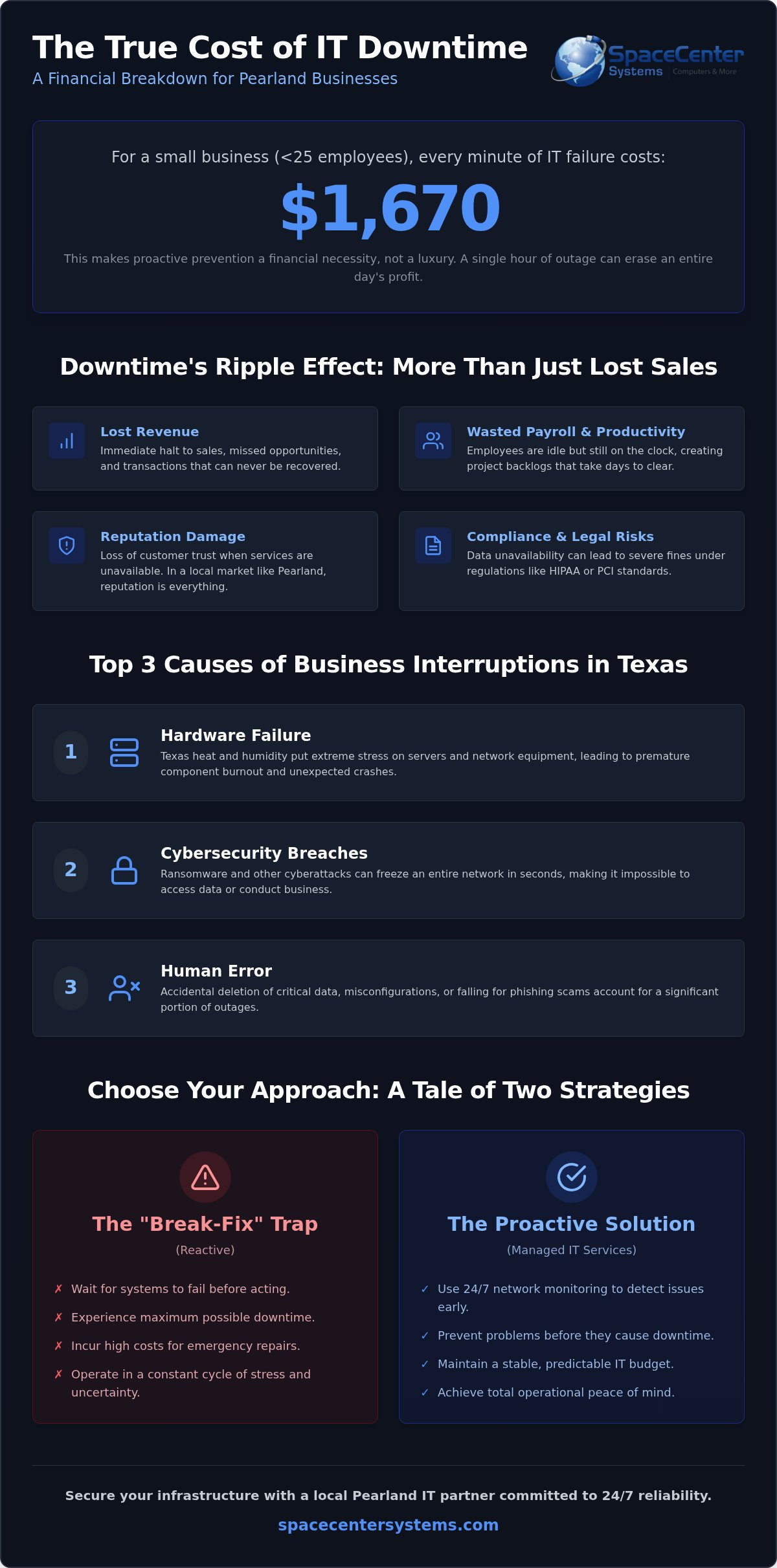
Downtime occurs whenever mission-critical systems are unavailable for use. It’s more than just a computer that won’t turn on. It’s the moment your point-of-sale system freezes, your patient records become inaccessible, or your team can’t reach the cloud. When you’re focused on preventing downtime for my business Pearland, you have to distinguish between planned maintenance and unplanned emergency outages. Planned maintenance involves controlled updates that happen after hours. Unplanned outages are chaotic, expensive, and often preventable. According to 2026 industry data, small businesses with fewer than 25 employees lose approximately $1,670 for every minute of IT failure. This makes prevention a financial necessity.
In the Greater Houston area, our local risks are unique. We deal with extreme humidity that stresses hardware and a power grid that can be unpredictable during hurricane season. Relying on “good enough” IT is often the primary cause of small business failure in our region. If your technology only works when conditions are perfect, your business is at risk. Effective Business continuity planning ensures that your operations remain stable even when the local environment is not. We’ve seen how local grid instability can turn a minor glitch into a day-long closure for firms that lack a resilient infrastructure.
Common Causes of Technical Interruptions in Texas
Hardware failure remains a top threat. Many server rooms in Pearland lack the precise climate control needed to combat Texas heat. This leads to premature component burnout and unexpected crashes. Beyond physical hardware, cybersecurity breaches are a leading cause of system lockouts. Ransomware can freeze an entire network in seconds, making it impossible to conduct business. Finally, human error, such as the accidental deletion of critical operational data, accounts for a significant portion of outages. Without a robust Business Continuity & Disaster Recovery strategy, these common issues can lead to permanent loss of customer trust.
The ‘Break-Fix’ Trap vs. Proactive Prevention
The traditional “break-fix” model is a trap that keeps business owners in a cycle of stress. Waiting for a system to fail before calling a technician ensures that you experience maximum downtime and the highest possible repair costs. Proactive network monitoring allows us to detect anomalies in real-time. We often fix a bottleneck or a failing drive before your employees even notice a problem. Local expertise is vital here. When a physical component fails, you don’t want a technician driving in from another city or waiting on a national helpdesk. You need a partner who has been a pillar of the Pearland community since 1995. Starting with a 90-Day IT Needs Assessment is the first step in moving from a reactive mindset to a position of absolute reliability.
Calculating the Real Cost of Downtime for Your Organization
Many business owners view technology as a utility, only noticing it when the bill arrives or the connection drops. However, the financial reality of an outage goes far beyond a missed afternoon of work. When you’re focused on preventing downtime for my business Pearland, you must account for the immediate drain on your cash flow. This includes lost sales that never return, wages paid to employees who cannot perform their duties, and the high cost of emergency technicians who charge a premium for last-minute repairs. If you aren’t prepared, a single afternoon of silence from your servers can erase a week’s worth of profit.
The damage often extends deep into the community. In a growing city like Pearland, your reputation is your most valuable asset. If a medical clinic cannot access patient records or a law firm misses a filing deadline, the loss of customer trust can be permanent. There’s also a significant productivity drain known as the ripple effect. When one core system fails, it doesn’t just stop one person. It halts entire departments, creating a backlog that takes days or weeks to clear. For those in specialized sectors, the stakes are even higher. Data unavailability can lead to severe compliance fines under regulations like HIPAA or PCI standards, making Business Continuity & Disaster Recovery a legal necessity rather than an optional expense.
A Simple Formula for Downtime Impact
To understand your specific risk, use this Downtime Cost Formula: (Number of affected employees x Average hourly rate) + (Lost revenue per hour) + (Recovery costs) = Total Hourly Impact. By applying this to your last outage, you can see exactly how much a single hour of failure costs your bottom line. If these numbers feel overwhelming, our 90-Day IT Needs Assessment can help you identify exactly where your vulnerabilities lie before they cost you another dollar.
The Hidden Toll on Employee Morale
Technology should empower your team, not frustrate them. Constant technical glitches lead to staff burnout and high turnover rates. Employees want to work in an environment where the tools “just work.” Providing a stable network and reliable Managed IT Services creates a psychological benefit that keeps your team focused on growth rather than troubleshooting. In Pearland’s competitive job market, having a reputation for modern, seamless technology is a major advantage for hiring and retaining top talent. Reliability isn’t just about servers; it’s about supporting the people who drive your success every day.
Five Strategic Pillars for Preventing Business Interruptions
Reliability isn’t a happy accident; it’s the outcome of a disciplined technical strategy. While some providers focus only on fixing what’s broken, our approach centers on five essential pillars that keep your operations running smoothly. When you’re prioritizing preventing downtime for my business Pearland, these pillars form the foundation of a resilient organization that can withstand both technical glitches and external threats.
- Proactive Network Monitoring: Detecting anomalies in real-time allows us to address bottlenecks or failing hardware before they lead to a total system crash.
- Robust Cybersecurity: Implementing high-grade firewalls and email security blocks attackers before they can penetrate your network and disrupt your workflow.
- Automated Patch Management: Ensuring all software is current closes the security gaps that hackers often exploit to gain unauthorized access.
- Data Backup and Redundancy: Maintaining secure, off-site copies of vital data ensures you can recover your files even if your local hardware is physically compromised.
- Employee Training: Reducing the risk of human error by teaching your team to recognize phishing and social engineering attempts that could lead to a breach.
By integrating these elements, you create a stable environment where technology supports your goals rather than hindering them. This comprehensive approach is what separates a thriving Pearland business from one that is constantly struggling with technical setbacks.
The Role of Business Continuity & Disaster Recovery (BCDR)
Many owners confuse a basic backup with a complete business continuity & disaster recovery plan. A backup is just a copy of your files. A continuity plan is a roadmap for how your business operates while those files are being restored. We work with you to establish your Recovery Time Objective (RTO), which is how long you can afford to be down, and your Recovery Point Objective (RPO), which determines how much data you can afford to lose. These metrics guide your technical investments and ensure your recovery is measured in minutes, not days.
Cybersecurity as a Downtime Deterrent
Ransomware has become the ultimate forced downtime event. It doesn’t just steal data; it locks your entire operation until a ransom is paid. Conducting regular cybersecurity assessments is essential for Pearland firms to identify weak points before criminals do. We utilize a layered defense strategy that includes Multi-Factor Authentication (MFA) and Advanced Threat Protection. This approach creates multiple hurdles for an attacker, significantly reducing the likelihood of a successful breach that would halt your business. It’s a proactive way of preventing downtime for my business Pearland by securing your digital perimeter.
Building a Resilient Infrastructure: From Cabling to the Cloud
A solid digital strategy is only as strong as the physical and virtual foundations it sits upon. While many providers focus exclusively on software, preventing downtime for my business Pearland requires a deep look at your physical environment. If your server room looks like a tangled web of wires or your hardware is approaching its fifth year of service, you are operating on borrowed time. Resilience starts at the layer where data actually moves, from the copper in your walls to the servers in the cloud.
Hardware lifecycle management is a critical part of this foundation. We recommend a structured replacement schedule for workstations and servers before they reach their failure point. Aging equipment doesn’t just slow down; it becomes more susceptible to overheating and component failure, especially in our humid Texas climate. This need for preventive care is universal; much like how transport businesses rely on Complete Truck Services LLC for semi-truck repair to avoid mechanical failure, IT infrastructure requires consistent maintenance. Additionally, internet redundancy is no longer a luxury. Implementing a secondary failover connection ensures that if a local fiber line is cut or a provider goes dark, your network automatically switches to a backup source. This keeps your team connected without a second of lost productivity.
The Importance of Structured Cabling in Pearland
Many technical interruptions are actually physical ones. “Spaghetti” wiring in server rooms is more than an eyesore; it’s a significant risk factor. Poorly organized cables restrict airflow, leading to overheating, and make it far too easy for a technician or employee to accidentally disconnect a critical system. Investing in professional structured cabling Houston services ensures that your infrastructure is organized, labeled, and heat-efficient. It also prepares your physical network to handle the massive data loads expected as we move through 2026, providing the bandwidth your growing business requires.
Leveraging Cloud Computing for Reliability
Transitioning mission-critical applications to cloud infrastructure management is one of the most effective ways to distribute risk. By moving your data away from on-site hardware vulnerabilities, you ensure that your team can stay productive even if your physical office is inaccessible due to a weather event or power outage. This flexibility is supported by modern VoIP phone systems, which allow your communication lines to remain open regardless of your physical location. When your infrastructure is distributed, a single point of failure at your Pearland office won’t result in a total business standstill. If you are ready to modernize your setup, you can schedule a consultation to see which cloud model fits your operational needs.
Building this level of resilience is a long-term investment in your company’s stability. Preventing downtime for my business Pearland isn’t just about reacting to problems; it’s about engineering them out of existence through better design and modern technology. Since 1995, we’ve helped local firms transition from fragile setups to high-availability environments that can withstand the unique challenges of the Greater Houston area.
Partnering with a Local Pearland IT Expert for 24/7 Reliability
Choosing the right technology partner is the final and most critical step in securing your company’s future. While national helpdesks claim they can manage everything remotely, they often fall short when a physical crisis occurs. When a server motherboard fails or a local fiber line is physically damaged, you don’t need a voice on a phone in another time zone. You need “boots on the ground” professionals who can arrive at your office in minutes. This local advantage is the cornerstone of preventing downtime for my business Pearland, ensuring that your recovery is measured in minutes rather than days of lost revenue.
We believe that a true IT partner should function as an extension of your team, not just a vendor you call during an emergency. This collaborative approach allows us to understand your specific operational workflow and anticipate needs before they become problems. By shifting from a “break-fix” model to a proactive partnership, you also gain the benefit of predictable budgeting. Instead of facing thousand-dollar emergency repair bills, you move to a flat monthly fee that covers comprehensive care. This transparency allows you to invest in growth rather than constantly paying to fix old mistakes.
Our process begins with a 90-Day IT Needs Assessment. This deep dive identifies your organization’s unique “downtime DNA,” highlighting exactly where your current systems are most vulnerable. We look at everything from your backup frequency to the age of your hardware, creating a roadmap that eliminates risks systematically. It’s a pragmatic, business-first strategy designed for owners who prioritize stability above all else.
Why Pearland Businesses Trust SpaceCenter Systems
SpaceCenter Systems has served as a pillar of the Greater Houston business community since 1995. With over 30 years of local experience, we have supported our peers through every major weather event and economic shift in the region. We offer specialized expertise in sectors that demand absolute reliability, such as healthcare IT and multi-family housing management—where property managers often rely on local experts like Verdant Tree Farm to maintain their physical landscape alongside our digital solutions. Our team doesn’t just provide technical support; we provide the quiet confidence that comes from knowing a local authority is watching your network 24/7. We focus on practical solutions that drive efficiency without the clutter of unnecessary “hologram” tech trends.
Getting Started with a Resilience Strategy
You can take the first step toward total operational peace of mind today by auditing your current vulnerability. Ask yourself how long your doors could stay open if your primary server failed right now. If the answer is “not long,” it’s time for a professional review. We invite you to schedule a consultation for a comprehensive network evaluation. Establishing a long-term managed IT services partnership is the most effective way of preventing downtime for my business Pearland. Let us handle the technical complexities so you can focus on what you do best: growing your business in our local community.
Securing Your Operational Future in Pearland
Protecting your organization from technical failure requires more than just a quick fix or a remote helpdesk. It demands a comprehensive strategy that addresses both your physical infrastructure and your digital security. By moving from a reactive “break-fix” mindset to proactive network monitoring and cloud redundancy, you ensure that your team stays productive regardless of the challenges 2026 brings. Stability isn’t a luxury; it’s a fundamental requirement for any firm looking to thrive in the Greater Houston area.
Reliability is built on local expertise and a neighborly commitment to service. Since 1995, we’ve provided comprehensive IT, security, and AV solutions that help owners feel confident in their technology. Our local technicians are always available for on-site support, ensuring that when you’re focused on preventing downtime for my business Pearland, you have a partner who is physically present and personally invested in your success. You don’t have to navigate these technical complexities alone.
Secure your business future with a 90-Day IT Needs Assessment from SpaceCenter Systems. We’re ready to help you build a stable foundation that supports your long-term growth and provides total peace of mind. Your business deserves technology that works as hard as you do.
Frequently Asked Questions
What is the most common cause of IT downtime for small businesses in Pearland?
Network and IT environment issues account for approximately 43% of downtime events, followed by cybersecurity attacks at 32%. In our local area, hardware failure due to the extreme Texas heat and humidity is a frequent trigger for these environment-related outages. Proactive monitoring helps identify these physical risks before they lead to a total system crash.
How much does IT downtime actually cost a small business per hour?
For a small business with fewer than 25 employees, the average cost of downtime in 2026 is approximately $1,670 per minute. This means a single hour of failure can cost your organization over $100,000 in lost productivity, missed sales, and emergency repair fees. Mid-size enterprises often face even higher costs, averaging over $300,000 per hour of inactivity.
Can managed IT services completely eliminate downtime?
No provider can guarantee 100% uptime, but managed IT services are designed to reduce unplanned outages to near-zero. We use real-time network monitoring and system health dashboards to identify and resolve 90% of technical issues before they disrupt your workflow. This proactive approach is the most reliable method for preventing downtime for my business Pearland.
What is the difference between data backup and business continuity?
Data backup is the process of making a copy of your files, while business continuity is the plan and infrastructure that keeps your operations running during a disaster. If your server fails, a backup gives you the data, but a continuity plan provides the virtual environment to keep working while the hardware is repaired. Both are necessary for true resilience.
How does local Houston weather affect my business’s IT reliability?
Houston’s extreme humidity can cause server components to corrode or overheat, while our volatile storm seasons lead to frequent power grid instability. These environmental factors make physical infrastructure protection, such as structured cabling and climate-controlled server rooms, essential for local firms. We design systems specifically to withstand the unique geographic challenges of the Greater Houston area.
Is it cheaper to use a break-fix technician or a managed IT service?
Managed IT services are generally more cost-effective because they offer predictable, flat-rate monthly fees that cover all maintenance. Break-fix technicians often charge high hourly rates for emergency calls, and those costs don’t include the massive revenue lost during the hours you wait for them to arrive. A proactive partnership eliminates the high price of technical chaos.
What should be included in a basic business continuity plan?
A basic plan must include your Recovery Time Objectives (RTO), a clear staff communication strategy, and a list of redundant systems like failover internet connections. It should also document the location of your off-site backups and provide step-by-step instructions for accessing mission-critical apps during an outage. These documents ensure your team stays focused and productive during a technical crisis.
How often should my business conduct a cybersecurity assessment?
You should conduct a professional cybersecurity assessment at least once a year or after any major change to your network infrastructure. Since cyberattacks cause 32% of all business interruptions, regular audits are vital for identifying vulnerabilities before hackers exploit them. Staying current with your security posture is a critical part of preventing downtime for my business Pearland.