


The most expensive technology investment you’ll ever make is the one that fails when your business needs it most. If you’ve ever dealt with the frustration of sudden network downtime or felt overwhelmed by the technical jargon of an office move, you know that a reliable foundation is everything. Planning for structured cabling Houston businesses can depend on requires more than just pulling wires through a ceiling. It’s about building a stable digital backbone that supports your team’s growth for years.
We understand that choosing between Cat6a and fiber optics feels like a gamble when you’re managing multiple contractors and deadlines. You deserve a clean, organized server room and a network that supports 10-Gigabit speeds for high-definition video conferencing. This guide simplifies the essentials of network infrastructure so you can plan a scalable, high-performance system. We’ll show you how to avoid common pitfalls and ensure your office environment is fully future-proofed for 2026 and beyond, drawing on our 25 years of local experience in the Greater Houston area.
Key Takeaways
- Learn how to transition from disorganized “spaghetti” wiring to a standardized architecture that prevents costly network downtime.
- Discover the specific use cases for Cat6a and fiber optics to ensure your office supports 10-Gigabit speeds and 4K video conferencing.
- Understand how to design a scalable layout using MDF and IDF frames to accommodate future headcount growth and workstation density.
- Master a proven project management workflow for structured cabling Houston, beginning with a professional 90-Day IT Needs Assessment.
- Identify the benefits of working with a local, single-source partner to integrate your IT, surveillance, and audio-visual systems seamlessly.
Understanding Structured Cabling as Your Houston Business Backbone
Think of your office network as a building’s foundation. If that foundation is cracked, every system built on top will eventually shift or fail. In the technical world, Understanding Structured Cabling means viewing your network as a standardized architecture rather than a collection of individual wires. Instead of the tangled mess of “spaghetti” wiring hidden behind desks or in server closets, professional structured cabling Houston services provide an organized, labeled, and highly efficient infrastructure. This systematic approach ensures that every jack, cable, and patch panel follows a strict hierarchy, making your network easier to manage and expand.
Reliable cabling is the primary defense in preventing downtime for my business Pearland. When cables are run haphazardly, they’re prone to signal interference and physical wear. In the Greater Houston area, local building codes and low-voltage regulations are strict. Professional structured cabling Houston contractors understand these nuances, ensuring that your installation meets all safety and performance standards. This compliance is essential for avoiding fines and ensuring the safety of your facility. We’ve spent over 25 years helping local businesses move away from chaotic setups toward systems that actually work.
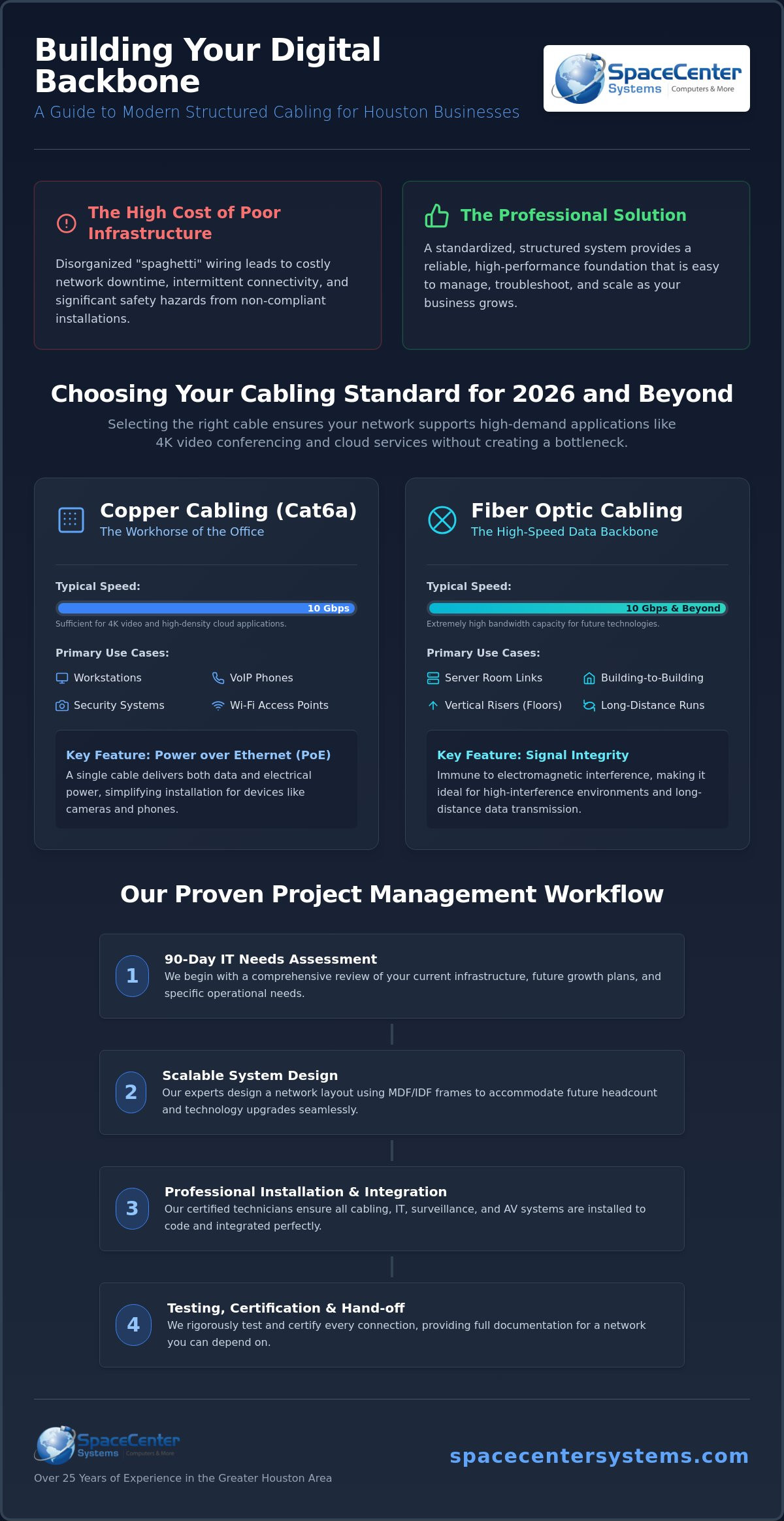
The High Cost of Poor Network Infrastructure
Intermittent Wi-Fi and sluggish data speeds aren’t always software glitches. Often, they’re the direct result of degraded or poorly installed copper. When your team waits for large files to sync or deals with dropped video calls, your operational efficiency takes a hit. These micro-delays add up to hours of lost productivity across a month. Beyond performance issues, non-compliant wiring can be a safety hazard. Cables that aren’t properly rated for plenum spaces can facilitate the spread of fire or release toxic smoke. Investing in quality infrastructure protects both your data and your people.
Structured vs. Conventional Point-to-Point Cabling
Conventional point-to-point cabling connects one piece of hardware directly to another. While this might work for a small home setup, it’s a liability for a growing company. If a connection fails, finding that one specific cable in a massive, unorganized bundle is nearly impossible. A structured environment uses a central patch panel system. This makes troubleshooting nearly instantaneous because every port is mapped and tested. This level of organization simplifies server management and reduces the labor hours required for future upgrades. You’ll see long-term cost savings every time you add a new workstation or reorganize your floor plan.
How to Choose the Right Cabling Standards: Cat6 vs. Fiber Optic
Selecting the right cable isn’t just about current speed; it’s about how much data your business will move in three to five years. In 2026, the industry standard for new commercial structured cabling Houston installations has shifted decidedly toward Cat6a. While older standards might save a few dollars upfront, they often fail to support the 10-Gigabit speeds required for uncompressed 4K video conferencing and high-density cloud applications. Choosing the right material ensures your network won’t become a bottleneck as your team grows.
Copper Cabling: The Workhorse of the Office
Copper remains the primary choice for connecting individual workstations and VoIP phone systems. Standard Cat6 cabling provides reliable performance up to 1Gbps at distances of 100 meters, which is sufficient for basic administrative tasks. However, for data-heavy Houston firms, Cat6A is the superior choice. It handles 10Gbps speeds and offers better protection against crosstalk in high-interference environments. Copper is also essential for “Power over Ethernet” (PoE). This technology allows a single cable to provide both data and electricity to devices like business security systems Houston owners use to protect their property.
Fiber Optic Cabling: High-Speed Backbones
Fiber optics serve a different purpose, typically acting as the high-speed backbone that connects your Main Distribution Frame (MDF) to various Intermediate Distribution Frames (IDF) across a large office or warehouse. Multi-mode fiber is common for internal building runs, while single-mode fiber is used for longer distances. This infrastructure is critical for IT support for healthcare offices that constantly transfer large medical imaging files. Fiber is immune to electromagnetic interference, making it the most stable option for mission-critical data paths.
Beyond the cable type, you must consider the jacket rating to stay compliant with Houston fire codes. Plenum-rated cable is mandatory for any air-handling spaces, such as the area above a drop ceiling, because it’s designed to resist fire and emit less smoke. Riser-rated cable is used for vertical runs between floors but doesn’t meet the same safety standards as plenum. If you’re unsure which standard fits your building’s footprint, our team can provide a detailed networking assessment to map out the most efficient and compliant path for your project.
We see many business owners struggle with these technical decisions during a move or expansion. Our goal is to provide a clear, functional plan that balances performance with your specific operational needs. By matching the right cable standard to each specific use case, you create a network that is both dependable and ready for future technology shifts.
Designing a Scalable Network Layout for Your Office
A successful layout starts with understanding the hierarchy of your hardware. The Main Distribution Frame (MDF) serves as the primary hub where your external internet service enters the building. For larger Houston offices, Intermediate Distribution Frames (IDF) act as satellite hubs to ensure no copper run exceeds the 100-meter performance limit. When we design structured cabling Houston layouts, we prioritize workstation density and future headcount. It’s much cheaper to run extra drops during the initial phase than to bring a crew back six months later because you hired three new account managers.
Integrating conference room AV cabling Houston into your initial blueprints is equally vital. Modern meeting spaces require dedicated lines for 4K displays, microphones, and control panels. If these aren’t accounted for in the primary design, you’ll likely end up with unsightly external conduits or tripping hazards. Beyond the wires, your design must include proper ventilation. Sensitive IT equipment generates significant heat; without dedicated cooling, your hardware’s lifespan will drop significantly.
The Server Room: Your Network Command Center
Your server room shouldn’t be an afterthought in a cramped closet. Professional server rack installation Houston services ensure your hardware is mounted securely and organized for easy maintenance. We use horizontal and vertical cable organizers to prevent the “nesting” effect that makes troubleshooting impossible. Security is another pillar of design. We often recommend integrating access control systems so only authorized personnel can enter these sensitive areas, protecting your physical data assets.
Wireless Access Point (WAP) Placement
Great office Wi-Fi support Houston depends entirely on the physical cables hidden behind your walls. We conduct a detailed heat map survey before any installation to identify dead zones and high-traffic areas like lobbies or breakrooms. This data allows us to place Wireless Access Points strategically, ensuring every employee has a strong, redundant connection. By hardwiring every WAP back to the MDF, you eliminate the latency issues that often plague purely wireless mesh systems in commercial environments.
Step-by-Step: Managing a Structured Cabling Project in Houston
Managing a project for structured cabling Houston businesses can rely on requires a disciplined, phase-based approach. We’ve spent over 25 years refining this process to ensure that your network is stable from the moment you plug in your first device. A successful installation isn’t just about pulling wire; it’s about following a sequence that eliminates guesswork and prevents future downtime.
- Phase 1: IT Needs Assessment. Everything begins with a IT Needs Assessment. We evaluate your current bandwidth usage, device density, and five-year growth projections to determine the right cable standards.
- Phase 2: Blueprints and Path Design. We create a detailed map of low-voltage paths. This design ensures cables avoid electrical lines and other sources of interference that can degrade signal quality.
- Phase 3: The Rough-In. Our technicians pull the cable through walls, ceilings, and conduits. This phase is best executed during construction or renovation before the drywall is finished.
- Phase 4: Termination and Labeling. We punch down every cable into high-quality patch panels and workstation jacks. Every single drop is clearly labeled, matching your network map for instant identification.
- Phase 5: Certified Testing and Handover. We use specialized equipment to certify every run. You receive full documentation, including test results and a physical map of your network infrastructure.
Preparing for an Office Move
Coordination is the most critical factor during an office move. You must sync your cabling project with general contractors and furniture installers to ensure floor boxes and wall jacks line up with your desk layout. We recommend starting your office move IT support Houston planning at least 90 days before your move date. This lead time is essential for managing “Cutover” day, where we ensure your internet and VoIP phone system installation Houston businesses depend on are fully functional the moment your team walks through the door.
For companies considering international expansion alongside their local growth, BizCity Group offers an alternative through flexible workspace solutions that include robust, ready-to-use technical infrastructure.
Testing and Certification: The Proof of Performance
Don’t settle for simple “continuity testing,” which only checks if a signal can pass through the wire. You should insist on Fluke certification reports for every drop. This process proves that your Cat6 or Cat6a runs actually hit the speeds they’re rated for. Proper labeling and certified testing might seem like small details, but they save thousands of dollars in future troubleshooting costs. If a port fails three years from now, a labeled and certified system allows a technician to fix it in minutes rather than hours. If you’re ready to build a reliable foundation for your office, schedule a consultation with our local team today.
Selecting a Local Houston Cabling Contractor: The SpaceCenter Advantage
Choosing a contractor for structured cabling Houston projects is a decision that impacts your business for a decade or more. You need a partner who understands that cabling isn’t just about utility; it’s about the long-term stability of your operations. SpaceCenter Systems has spent more than 25 years serving businesses in Pearland, Sugar Land, and the Greater Houston area. This deep regional history means we aren’t just another service provider. We are your neighbors, and we’re invested in the success of our local economy.
One of the most significant advantages we offer is our role as a single-source technology partner. You won’t have to manage separate contractors for your IT infrastructure, surveillance systems, and low-voltage wiring. This unified approach ensures that every component of your office technology works in harmony. We maintain a strict commitment to professional aesthetics. Our “clean space” philosophy means your server rooms and workstations will be organized, labeled, and free of the clutter that often plagues poorly managed installations. Once the project is complete, you’ll have access to our 24/7 helpdesk services to ensure your team stays productive.
Why Local Expertise Matters in Houston
Local knowledge is indispensable for high-performance infrastructure. We understand the specific building codes and low-voltage permitting requirements in Houston, Pearland, and League City. This expertise prevents the costly delays and inspection failures that often occur with national firms unfamiliar with our regional standards. Because we’re located right here in the community, our response times for on-site support are significantly faster than a company dispatched from another state. We’ve also spent decades building strong relationships with local internet service providers, allowing us to coordinate your circuit installations more effectively.
Beyond the Cable: Managed Technology Partners
A cable run is only as good as the data it protects. We integrate your physical infrastructure with advanced cybersecurity protocols from day one. Our team provides ongoing network monitoring to track the health of your backbone and identify potential issues before they cause downtime. This proactive care reflects our philosophy of stability and support. You shouldn’t have to worry about the complexities of your network; you should be able to rely on it. If you’re ready to build a future-proofed office environment, we invite you to schedule a consultation with our specialists today.
Build a Network Foundation That Lasts
Your office network is only as strong as the physical infrastructure supporting it. By moving away from disorganized wiring and investing in a standardized architecture, you protect your team from the high costs of network downtime. Whether you’re upgrading to Cat6a for 10-Gigabit speeds or installing a fiber optic backbone, the goal is to create a scalable environment that grows with your business. Each decision made during the design phase impacts your operational efficiency for years to come.
Since 1995, we’ve helped companies across Houston and Pearland integrate their managed IT and physical security into one cohesive system. We don’t just pull wire; we provide a certified foundation. Every drop we install undergoes rigorous Fluke testing to guarantee it meets the performance standards your operations require. Choosing the right partner for structured cabling Houston means gaining a local ally invested in your long-term stability and success.
Ready to eliminate technical clutter and future-proof your office? Schedule Your Houston Structured Cabling Assessment Today. We look forward to supporting your growth with a more reliable network.
Frequently Asked Questions
How much does structured cabling cost per drop in Houston?
The cost of a network drop depends on several variables, including the type of cable used, the distance of the run, and the physical complexity of the building. Labor is often the most significant factor, especially in retrofit projects where technicians must “fish” wires through existing walls. While industry rates vary, bundling multiple drops into a single project generally reduces the overall price per connection compared to individual service calls.
Do I need Cat6 or Cat6A for my new office in 2026?
For most new commercial projects in 2026, Cat6a is the preferred standard for future-proofing. It supports 10-Gigabit speeds and provides the necessary bandwidth for uncompressed 4K video conferencing and high-density cloud applications. While standard Cat6 is sufficient for basic workstations, choosing Cat6a ensures your structured cabling Houston investment remains viable as technology demands increase over the next decade.
Can I use my existing cabling when I move into a new Houston office space?
You can use existing cabling, but it’s vital to have it professionally tested and certified before your move-in date. Many older Houston offices contain legacy Cat5e wiring or cables that have been damaged by previous tenants. An audit ensures the infrastructure can handle your specific data loads, preventing the frustration of intermittent connectivity or slow speeds after you’ve already set up your furniture. For a complete step-by-step approach to relocating without technical disruption, review our ultimate office move IT checklist for Houston businesses before your transition date.
What is the difference between a low-voltage contractor and a standard electrician?
Low-voltage contractors specialize in data integrity and high-speed signal performance, while standard electricians focus on high-voltage power delivery. Structured cabling requires strict adherence to TIA/EIA standards to prevent signal interference and crosstalk. A specialized contractor understands how to manage data paths and termination points to ensure your network backbone operates at its maximum rated speed without errors.
How long does a typical structured cabling installation take?
A typical installation for a medium-sized office usually takes between three to five business days. The exact timeline depends on the total number of drops and whether the project is a new construction or a retrofit. New construction projects often move faster because technicians have clear access to wall studs and ceilings before the drywall is installed, whereas retrofits require more careful navigation around existing structures.
Is fiber optic cabling necessary for a small business with only 20 employees?
Fiber optic cabling isn’t usually required for every workstation in a small office, but it’s highly recommended for the network backbone. If you need to connect a server room to a secondary wiring closet or handle massive data files, fiber provides superior reliability. It’s immune to electromagnetic interference and offers much higher bandwidth capacity over longer distances compared to traditional copper wiring.
Do you provide structured cabling services in Sugar Land and Pearland?
Yes, we provide full structured cabling Houston services throughout the Greater Houston area, including Sugar Land, Pearland, and League City. Our local presence allows us to stay current with specific municipal building codes and low-voltage permitting requirements. This regional expertise ensures your installation is compliant and allows our team to provide rapid on-site support whenever your business needs it. For companies with offices in other regions like Southern California, Quick-Tel Communications offers comparable expertise in business-focused telecommunications and network infrastructure.
What kind of warranty comes with a professional cabling installation?
Professional installations generally include a labor warranty and a manufacturer warranty on the cabling materials. When a system is fully certified using specialized testing equipment, many cable manufacturers offer extended performance warranties that can last for several years. This documentation serves as your proof of performance and ensures that your infrastructure is built to last through multiple hardware refresh cycles.