


Imagine it’s Monday morning and your office network suddenly drops during a critical client presentation. You open the server closet only to find a “spaghetti” mess of unlabeled wires, making it impossible to troubleshoot the issue quickly. It’s a frustrating scenario for many local business owners who haven’t yet invested in a professional structured cabling installation in Pearland. You likely feel that your technology should be a silent partner that supports your growth, not a source of constant stress or a bottleneck for your team’s productivity.
We’re here to help you regain control. Discover how a clean, organized, and labeled cabling system provides the scalable foundation your business needs for reliable high-speed data, voice, and security. This guide covers everything from the latest ANSI/TIA-568-E standards to the specific requirements for HIPAA compliance in medical office wiring. We’ll also explain why Cat6A has become the 2026 baseline for supporting 10 Gbps speeds and how our 25 years of local experience helps you avoid the high cost of technical downtime. By the end of this article, you’ll understand how to future-proof your infrastructure to support the next decade of growth.
Key Takeaways
- Learn how a professional structured cabling installation Pearland provides a clean, labeled foundation that eliminates network drops and supports high-speed data.
- Understand the performance gap between Cat6 and Cat6A to ensure your infrastructure supports 10Gbps speeds and modern Power over Ethernet applications.
- Discover why specialized data cabling expertise is necessary to prevent signal interference and costly downtime caused by improper cable bends or power line proximity.
- Explore the specific cabling requirements for HIPAA compliance in medical offices and the robust connectivity needs of modern apartment communities.
- Get a practical timeline for office moves that ensures your network is fully operational before the furniture arrives and your team starts work.
What is Structured Cabling and Why Does Your Pearland Business Need It?
A proper structured cabling installation Pearland isn’t just about pulling wires through a ceiling. It’s a strategic, standardized architecture designed to handle the massive data loads of 2026. Unlike “point-to-point” wiring, where devices are connected directly to each other in a confusing web of “spaghetti,” structured cabling uses an organized hierarchy. This system follows strict Structured cabling standards to ensure that every port, jack, and cable performs at its peak capacity. By creating a uniform infrastructure, you eliminate the guesswork that often plagues older, unorganized office environments.
The architecture typically centers around a Main Distribution Area (MDA), which acts as the central hub of your local network. From here, horizontal cabling runs out to individual workstations, VoIP phones, and wireless access points. This organized approach is the bedrock of effective managed IT services. When your physical infrastructure is predictable, your network monitoring tools can provide much more accurate data on system health. It also simplifies future moves, adds, or changes, as technicians don’t have to trace a single wire through a tangled mess to upgrade a single desk.
The Nervous System of Your Business
Structured cabling is the physical layer of the OSI model that determines your network ceiling. If this foundation is weak, even the most expensive high-speed routers can’t deliver their full potential. It supports your entire technology stack, including VoIP phone systems, high-definition security cameras, and cloud-based applications. Think of it as the nervous system that carries every bit of data your company generates. High-speed data requires precise termination and high-quality materials to prevent signal loss, ensuring that your team stays productive without the lag that often comes from substandard wiring.
Avoiding the High Cost of Downtime
Poorly planned wiring is a leading cause of intermittent connectivity issues that frustrate employees and drive away customers. When a cable fails in an unorganized “spaghetti” room, troubleshooting becomes a nightmare that can last hours or days. This leads to lost revenue and operational paralysis. Investing in a professional structured cabling installation Pearland is a critical step in preventing downtime for my business Pearland. A clean, labeled system allows for near-instant identification of issues. Technicians can simply look at a patch panel, identify the labeled port, and resolve the physical connection problem in minutes rather than hours. This level of organization is what separates a professional operation from a hobbyist setup.
Choosing the Right Standards: Cat6, Cat6A, and Fiber Optic
Selecting the right materials for your structured cabling installation Pearland determines your network’s lifespan and its ability to handle future upgrades. While older Cat5e cables are largely obsolete for new commercial builds in 2026, many businesses still weigh the benefits of Cat6 versus Cat6A. Cat6 is capable of 1 Gbps speeds, but it’s quickly becoming a bottleneck for data-intensive operations. Cat6A is now the recommended baseline for new installations because it supports 10 Gbps over the full 100-meter channel length. This extra headroom is vital for modern Power over Ethernet (PoE++) devices, such as high-end Wi-Fi 7 access points and sophisticated security sensors that require both power and high-speed data through a single line.
Copper vs. Fiber: When to Use Which?
Copper cabling like Cat6A remains the standard for most Pearland office workstations because of its cost-effectiveness and ease of termination. However, fiber optic cabling is essential for network backbones and connecting server rooms across large facilities. The advantages of fiber optic cabling include immunity to electromagnetic interference and the ability to carry data over significantly longer distances without signal degradation. In industrial environments or medical facilities with high interference, we often recommend Shielded Twisted Pair (STP) copper or fiber solutions to maintain absolute data integrity for your mission-critical systems.
Future-Proofing for 2026 Data Demands
The shift toward Wi-Fi 7 means your wireless network is only as fast as the wire feeding the access point. Wi-Fi 7 can reach speeds that easily exceed the 1 Gbps limit of standard Cat6. If your infrastructure isn’t ready, your brand-new hardware will be severely throttled. We also see a growing need for high-bandwidth cabling to support advanced AV installations and 4K surveillance systems that run 24/7. Modern data centers are even pushing toward 25G and 40G Ethernet standards, making the choice of cable quality more important than ever before.
Planning for these demands during the pre-wiring phase of construction is the most cost-effective way to build. Retrofitting a finished office is always more expensive than installing the right standards from the start. If you aren’t sure which standard fits your specific growth plan, you can request a custom infrastructure assessment to see which cabling standard will serve your business best over the next decade. Our goal is to ensure your network supports your team’s productivity without requiring a total overhaul in just a few years.
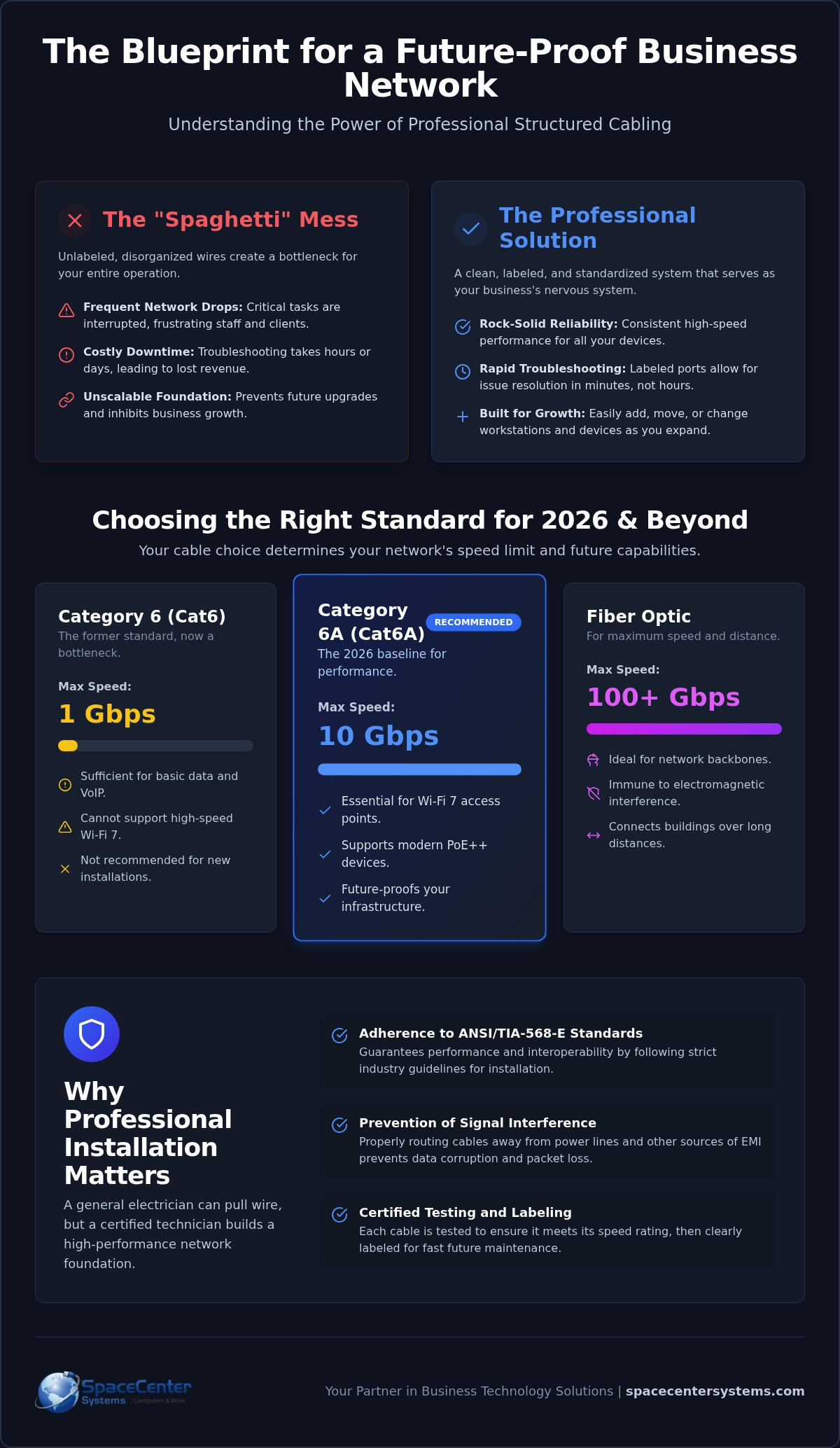
Professional Installation vs. The General Electrician
When business owners need new wiring, they often think of calling an electrician first. While electricians are experts at high-voltage power delivery, a professional structured cabling installation Pearland requires a specialized focus on low-voltage signal integrity. Unlike electrical current, data signals are incredibly sensitive to their physical environment. If a data cable is pulled with too much tension or run too close to a large power transformer, you won’t see a blown fuse. Instead, you’ll experience “ghost” network issues, packet loss, and intermittent drops that are notoriously difficult to diagnose.
Professional data technicians understand the physics of high-speed transmission. We avoid “tight bends” that can kink the internal copper pairs and cause signal reflection. We also ensure proper separation from electrical lines to prevent electromagnetic interference. This attention to detail is what ensures your network performs at its rated speed 100% of the time, rather than just “most of the time.”
Standards-Compliant vs. “Good Enough”
Adhering to TIA/EIA standards is about more than just neatness; it’s about protecting your long-term investment and hardware warranties. We use professional cable management systems, including racks, trays, and J-hooks, to support the weight of the cable and maintain its structural integrity. Electricians focus on power delivery while structured cabling pros focus on signal integrity. By following these rigorous standards, we provide an infrastructure that is easy to manage and ready for the next decade of technology shifts.
Testing and Certification
A common pitfall is assuming a connection is perfect just because a “link light” turns green on a switch. A link light only confirms a basic electrical connection; it doesn’t verify that the cable can actually sustain 10 Gbps speeds without errors. We use high-end certification tools to stress-test every drop and provide you with a comprehensive report. These certification reports are often essential for business insurance and compliance audits.
This documentation also serves as a vital roadmap for future IT consulting projects. When your ports are clearly labeled and mapped, troubleshooting takes minutes instead of hours. Reliable network monitoring starts with this physical cable integrity. At SpaceCenter Systems, we don’t just “run wires”; we build a certified, documented foundation that supports your business’s health from the ground up. This level of precision is the hallmark of a quality structured cabling installation Pearland.
Industry-Specific Cabling Needs in Pearland
Pearland’s business landscape includes everything from bustling medical centers to sprawling residential developments. Each of these environments has unique technical demands that a generic wiring job simply cannot meet. A professional structured cabling installation Pearland must be tailored to the specific operational goals of your facility. For instance, a medical clinic requires a different level of security and redundancy than a standard retail storefront. Our 25 years of local experience allows us to design systems that meet these rigorous industry standards while remaining easy to manage. We don’t just pull wire; we build a foundation that aligns with your specific compliance and growth needs.
Healthcare and Senior Living Facilities
In the medical field, reliability is a matter of patient safety. We specialize in healthcare IT support that prioritizes zero-latency access to electronic health records (EHR). This requires a robust copper or fiber backbone to handle large medical imaging files without delay. We also integrate specialized nurse call systems and medical alarms into the central network. Every drop must be installed to support HIPAA-compliant Wi-Fi networks, ensuring that patient data stays secure even when transmitted wirelessly. Our team understands the specific pathways and plenum-rated cable requirements needed for healthcare environments.
Multi-Family and Commercial Property Management
Modern apartment communities in Pearland now function like small tech hubs. Property managers need reliable infrastructure to support high-density Wi-Fi in leasing offices and resident business centers. We integrate access control systems and gate technology directly into the property’s central network for easier management. This also includes connecting intercoms and security camera installation points back to a secure monitoring station. When these systems share a standardized cabling foundation, troubleshooting becomes much faster and resident satisfaction stays high.
Beyond the internal office network, we also provide the low-voltage foundation for comprehensive surveillance. Modern 4K cameras require stable PoE power and high bandwidth to ensure clear, lag-free footage. Whether you’re managing a senior living facility or a commercial office building, these low-voltage systems are the backbone of your daily operations. We ensure your infrastructure is ready for 2026 demands and beyond, providing the stability your team and residents expect.
Schedule a specialized infrastructure assessment for your Pearland facility
Planning Your Pearland Office Move or Upgrade
Relocating your business involves dozens of moving parts, but your network infrastructure should be at the top of the list. A successful structured cabling installation Pearland must happen before the furniture arrives and ideally before the drywall is finished. If you wait until your team is ready to plug in their computers, you’ll face significantly higher costs and avoidable delays. It’s also the ideal time to coordinate with Internet Service Providers (ISPs) to ensure your demark point and entry points are positioned correctly for your server room layout. Proper planning prevents the need for messy surface-mounted raceways or exposed wires later.
To ensure nothing is overlooked during this transition, we recommend starting with our office move IT checklist. This helps you visualize the entire project from the first cable drop to the final testing phase. For those looking for a comprehensive long-term strategy, our 90-day IT needs assessment provides a clear roadmap for your technology requirements. This ensures your new space supports your growth for years to come rather than just meeting your immediate needs on move-in day.
The Office Relocation Timeline
A structured move follows three critical phases to ensure zero-day readiness. Phase 1 involves a detailed site audit and infrastructure design where we map out every port, wireless access point, and workstation. Phase 2 is the “rough-in” stage, where cables are pulled through the ceiling and walls before they are closed. Finally, Phase 3 focuses on termination, testing, and rack dressing. This last step ensures that your server room is clean, labeled, and ready for your hardware. Skipping these phases often leads to the unorganized “spaghetti” wiring that makes future troubleshooting nearly impossible.
SpaceCenter Systems: Your Local Pearland Partner
We have over 25 years of local experience in the Greater Houston area, growing alongside the Pearland community since our founding era. We understand the regional building codes and the specific needs of local businesses. When you partner with us, you get a single point of contact for your managed IT, VoIP phone systems, and cabling. This eliminates the frustration of managing multiple vendors who might blame each other for technical issues. Our quiet confidence comes from decades of resolving complex technical challenges for our peers. We are invested in your success because we are part of the same community.
Schedule a cabling project consultation today
Building a Foundation for Pearland’s Future Growth
Your network’s physical foundation determines how fast your business can move. By choosing the right standards like Cat6A and fiber optics, you ensure your infrastructure supports the high-speed data and security needs of 2026. A professional structured cabling installation Pearland provides the stability required for everything from HIPAA-compliant medical networks to high-density apartment community Wi-Fi. It’s about more than just wires; it’s about creating a scalable environment where your technology works without interruption.
SpaceCenter Systems brings over 25 years of local experience to every project. Our certified low-voltage technicians specialize in comprehensive IT and security integration, ensuring your cabling, cameras, and phone systems work in perfect harmony. We’ve spent decades helping our neighbors in the Greater Houston area navigate technical complexities with quiet confidence. We focus on preventing the high cost of downtime so you don’t have to worry about intermittent network drops or messy server rooms.
Schedule Your Structured Cabling Consultation
We look forward to helping you build a more reliable and scalable future for your team. Our experts are ready to design a system that grows alongside your business while providing the peace of mind you deserve.
Frequently Asked Questions
What is the difference between Cat6 and Cat6A cabling?
Cat6A is the modern standard for 2026 business environments because it supports 10 Gbps speeds over a full 100-meter distance. Standard Cat6 is typically limited to 1 Gbps at that same length. Cat6A also features improved shielding to reduce crosstalk and handles the higher heat levels generated by PoE++ devices, such as Wi-Fi 7 access points. This makes it the superior choice for future-proofing your office infrastructure.
How long does a typical structured cabling installation take in Pearland?
A typical structured cabling installation Pearland for a mid-sized office usually takes between three to five business days. This timeline includes the initial site preparation, pulling the low-voltage wire, termination at the patch panels, and final certification testing. Larger facilities or complex retrofits in older Houston-area buildings may require more time. We always coordinate with your project manager to ensure completion before your furniture arrives.
Do I need to upgrade my cabling if I am moving to a new office?
Yes, moving is the most strategic time to upgrade your network foundation. Many existing office spaces in Pearland still rely on Cat5e, which is insufficient for the high-bandwidth demands of modern cloud computing and VoIP phone systems. Installing Cat6A or fiber optics during your move prevents the significant disruption and higher costs associated with retrofitting a finished office once your team is already working in the space.
Can a general electrician install data cabling?
While electricians are experts in high-voltage power delivery, data cabling requires a different skill set focused on signal integrity. Professional data technicians follow strict TIA/EIA standards regarding bend radii and cable tension to prevent signal loss. We also ensure proper separation from electrical lines to avoid electromagnetic interference. Most general electricians don’t have the specialized certification tools needed to verify that your drops support 10 Gbps speeds.
What is cable certification and why do I need it?
Certification involves using specialized hardware to stress-test every cable drop in your network. It verifies that the installation meets precise industry performance standards for speed and reliability. This process goes beyond a simple “link light” test, which only confirms a basic electrical connection. Certification reports are often required for manufacturer warranties and provide essential documentation for business insurance and HIPAA compliance audits in healthcare settings.
How much does structured cabling installation cost for a small office?
The total investment for a structured cabling installation Pearland varies based on the number of data drops, the type of cable selected, and the physical complexity of your building. Factors such as ceiling height and the need for specialized fire-rated plenum cable also impact the project scope. We recommend a professional site audit to provide an accurate quote that aligns with your specific technical requirements and growth plans.
Does structured cabling support my business phone system and security cameras?
Yes, a standardized cabling foundation supports your entire technology stack, including VoIP phone systems and security camera systems. Modern structured cabling utilizes Power over Ethernet (PoE) to deliver both data and electricity through a single cable. This simplifies your office layout by eliminating the need for separate power outlets at every camera or desk location. It also ensures your security and communication tools are integrated into one manageable system.
What are the benefits of using fiber optic cabling for my local business?
Fiber optic cabling provides nearly unlimited bandwidth and is immune to electromagnetic interference from heavy machinery or fluorescent lighting. It’s the ideal solution for network backbones and connecting multiple server rooms across large Pearland facilities. Fiber also supports much longer distances than copper without signal degradation. This makes it a vital component for businesses that need to move massive amounts of data quickly and securely over the next decade.