


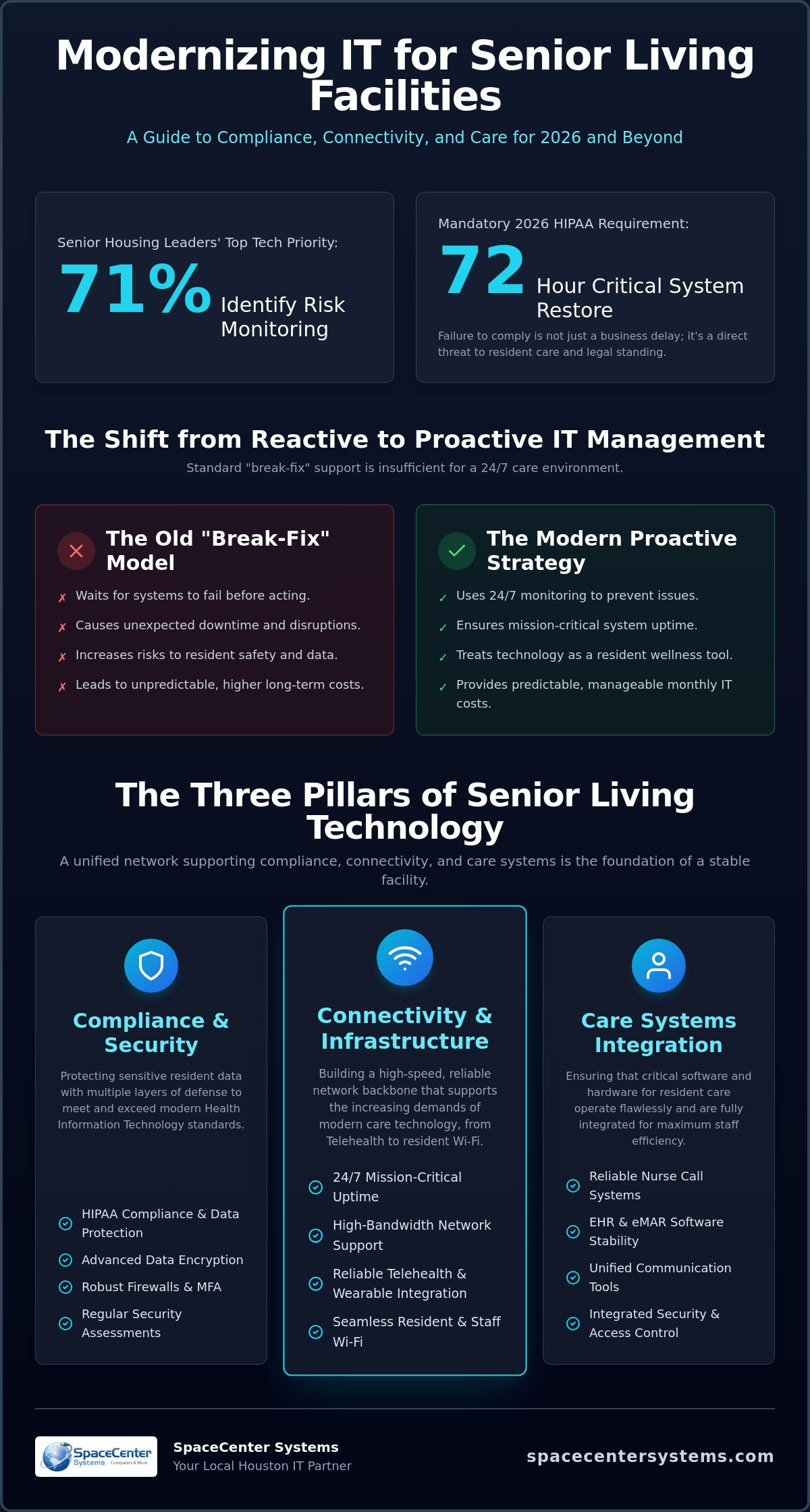
71% of senior housing leaders now identify risk monitoring as their top technology priority, yet many still struggle to meet the mandatory 2026 HIPAA requirement to restore critical systems within 72 hours of an incident. In a high-stakes environment like yours, generic IT support for senior living facilities is no longer sufficient to ensure resident safety and legal compliance. You need a technical partner who understands that a network failure in the Greater Houston area isn’t just a business delay; it’s a direct threat to resident care.
We know how frustrating it is to deal with slow response times or resident complaints about unreliable Wi-Fi while you’re trying to manage a staffing crisis. You deserve technology that works as hard as your caregivers do. This 2026 guide is designed to give you peace of mind by outlining exactly how to modernize your infrastructure. We’ll explore how to achieve seamless HIPAA compliance, maintain reliable nurse call systems, and lock in predictable monthly IT costs so you can focus on your community’s well-being.
Key Takeaways
- Learn why specialized IT support for senior living facilities is essential for 24/7 care environments where standard “break-fix” technical support falls short.
- Discover how integrating security camera systems and access control into your unified IT network improves resident safety and wander management.
- Understand the three pillars of senior living technology—Compliance, Connectivity, and Care Systems—and how they drive daily staff efficiency.
- Get a step-by-step approach to conducting a technology assessment to identify hidden vulnerabilities in your nurse call and EHR systems.
- Find out why partnering with a local Houston provider with over 25 years of experience ensures faster response times and more reliable technical support.
What is Specialized IT Support for Senior Living Facilities?
Senior living IT is a specialized subset of healthcare technology management. It sits at the intersection of hospitality and clinical care. In a community that never sleeps, technology serves as the mission-critical backbone for resident safety and daily operations. Unlike a standard corporate office where a network outage is an inconvenience, a technical failure in a care facility can disrupt the flow of life-saving information. When your infrastructure is dependable, your staff can focus on their residents instead of troubleshooting hardware.
Many providers still rely on a reactive “break-fix” model. They only call for help after a system stops working. This approach often fails in a care setting because it doesn’t include the preventative monitoring needed to stop issues before they affect a resident. Professional IT support for senior living facilities treats technology as a wellness tool. By maintaining high-speed connectivity and secure systems, you ensure that caregivers can respond to emergencies without technical delays. For facilities in the Greater Houston area, having a local partner with 25 years of experience means that on-site hardware support is always available when you need it most.
The Difference Between General IT and Senior Care IT
Standard business IT focuses on general productivity, but senior care IT focuses on mission-critical uptime. While a typical office closes at 5 PM, your facility requires 24/7 stability to support eMAR, electronic health records (EHR), and resident billing software. Specialized healthcare IT support is necessary because these systems must comply with strict federal regulations. With the 2026 HIPAA updates making previously addressable safeguards mandatory, your technical team must have deep expertise in encryption and multi-factor authentication to protect sensitive resident data at all times.
Why 2026 Demands a Proactive Tech Strategy
This year marks a turning point where technology has become central to the resident experience. The rapid expansion of Telehealth and wearable health monitors means your network must handle more bandwidth than ever before. When your infrastructure is outdated, it leads to staff burnout as caregivers struggle with slow software and frequent crashes. Proactive management helps reduce this friction. By implementing unified communication tools, property managers can oversee everything from maintenance requests to medical alerts from a single dashboard. This streamlined approach improves resident satisfaction and allows your team to focus on high-quality care.
The Three Pillars of Senior Living Technology
A stable facility environment rests on three foundational pillars: Compliance, Connectivity, and Care Systems. When these elements work in harmony, they create a seamless experience for both staff and residents. Specialized IT support for senior living facilities ensures that these components don’t operate in silos. Instead, they form a unified network that supports mission-critical tasks. Without consistent network monitoring, a single failure in your infrastructure could disrupt all three pillars simultaneously, leading to operational chaos and safety risks.
Staff efficiency depends on the reliability of these systems. If a caregiver cannot access a resident’s records or receive an alert, their ability to provide care is compromised. By focusing on these pillars, administrators can move away from reactive troubleshooting and toward a proactive model. This stability is especially vital in the Greater Houston area, where regional providers must be ready for anything from routine updates to emergency disaster recovery. Strengthening these pillars protects your community’s reputation and its bottom line.
HIPAA Compliance and Data Security
Data security is a top priority for community administrators who handle sensitive health information. Modern Health Information Technology standards require more than just a simple password. You must implement multiple layers of defense, including advanced encryption, robust firewalls, and multi-factor authentication (MFA). Because threats evolve quickly, cybersecurity is no longer a “set it and forget it” task. Regular network security assessments help identify hidden vulnerabilities in your system before they can be exploited by bad actors.
Reliable Nurse Call and EHR Integration
The technical requirements for nurse call and medical alarm systems are incredibly demanding. These are life-safety tools that require 100% uptime. One of the greatest risks in a senior living environment is the “silent alarm,” where a resident triggers an alert that never reaches the caregiver due to poor network infrastructure. To prevent this, your wireless network must be designed to handle high traffic without dropping connections. This ensures that Electronic Health Records (EHR) remain accessible at the bedside, allowing for accurate, real-time documentation of resident care. If you aren’t sure if your current setup can handle these demands, it might be time to schedule a technology consultation to review your infrastructure.
Integrated Security: Cameras, Access Control, and Intercoms
Physical security and digital infrastructure are no longer separate departments. In modern facilities, your cameras and door locks live on the same network as your medical records. This convergence is why comprehensive IT support for senior living facilities must include physical security management. When these systems are unified, property managers gain a single point of control. This reduces the technical friction that occurs when managing multiple disconnected vendors and ensures that security alerts aren’t delayed by network bottlenecks.
Integrating advanced security systems is essential for effective wander management. For residents with cognitive impairments, these tools provide a layer of protection that doesn’t feel intrusive or clinical. High-definition surveillance also serves as a vital tool for liability protection. It provides clear, timestamped documentation of incidents, which protects your staff and your facility’s reputation in the event of a dispute. Additionally, modern intercoms and gate technology streamline visitor management. These tools allow your front-desk team to verify guests remotely before they ever step foot in a resident wing. According to the Argentum Technology Report, senior living providers are increasingly prioritizing these integrated innovations to improve both safety and interoperability across their campuses.
Smart Access Control for Memory Care
Memory care units require specific technical safeguards to prevent elopement. Smart access control uses keyless entry and restricted access points to keep residents safe while allowing staff to move freely using encrypted fobs or mobile credentials. These systems generate detailed access logs. These logs are helpful for administrative reporting and required safety audits. For these hardware components to function without interruption, they must be supported by high-quality structured cabling. Reliable wiring ensures that a door lock or camera never loses power or connectivity during a critical moment. This is a foundational step that many generic IT providers overlook when setting up a new wing.
Resident Wi-Fi: Quality of Life Meets Security
Providing wall-to-wall Wi-Fi coverage in a large facility is a significant technical challenge. However, reliable connectivity is a major factor in resident satisfaction. It allows seniors to stay in touch with their families through video calls and social media, which reduces isolation. The key to a successful deployment is strict network segregation. You must separate resident Wi-Fi from the clinical network entirely. This ensures that a resident’s personal tablet or a visitor’s smartphone cannot accidentally access sensitive health data or internal servers. Professional IT support for senior living facilities creates these secure boundaries. We balance the need for open, friendly connectivity with the rigorous requirements of HIPAA compliance, ensuring your facility remains both welcoming and secure for everyone on-site.
How to Conduct a Senior Living IT Assessment
Identifying the technical debt in your current setup is the only way to move from reactive troubleshooting to proactive care. Start by documenting daily operational frustrations. Are your staff members frequently complaining about slow internet or software crashes during shift changes? These aren’t just minor annoyances; they’re clear indicators of a system that’s failing to provide adequate IT support for senior living facilities. When your technology is unreliable, it creates a ripple effect that impacts everything from resident safety to staff retention.
The next step is to create a comprehensive inventory of every connected device on your property. This list should include medical monitors, office workstations, and security cameras. Many administrators are surprised to find dozens of “ghost devices” still connected to their network, draining bandwidth and creating unnecessary security risks. Evaluating the responsiveness of your current provider is also vital. If you’re waiting hours for a callback while a nurse call system is down, your current support model isn’t meeting the 24/7 demands of a care facility.
Evaluating Your Backup and Disaster Recovery
Houston facilities face unique environmental challenges, making business continuity a non-negotiable priority during hurricane season. You must evaluate whether your current backup solutions are strictly on-site or if they utilize cloud storage and backup solutions for geographic redundancy. For care facilities, the Recovery Time Objective (RTO) is the maximum amount of time your critical systems can be down before the disruption becomes a threat to resident safety. If your current plan can’t restore EHR access within the 2026 HIPAA mandate of 72 hours, your facility is at significant risk. Facilities in the region can benefit from exploring managed backup services in Sugar Land designed specifically to meet these 2026 compliance requirements and protect against ransomware threats.
Infrastructure Check: Cabling and Wi-Fi
Check the physical foundation of your technology. Aging cables often cause intermittent connectivity that remote support can’t fix from a dashboard. If you’re planning an expansion or renovation, pre-wiring ensures that new wings are ready for modern technology standards from day one. You should also walk your hallways to identify Wi-Fi “dead zones” where a caregiver might lose access to a medical alarm while doing rounds. These gaps in coverage represent a serious safety vulnerability that must be addressed immediately. To get a clear roadmap for your facility’s future, we recommend scheduling a professional 90-Day IT Needs Assessment to identify and resolve these hidden infrastructure issues.
Choosing a Local IT Partner in Houston and Pearland
Selecting the right technical partner is a strategic decision that affects the safety of your residents and the productivity of your staff. While national providers may offer broad resources, they often lack the geographic proximity required for immediate on-site intervention. In a specialized environment like a care facility, you need a partner who understands the specific challenges of the Houston business climate, from local regulatory expectations to the environmental demands of the Gulf Coast. Choosing specialized IT support for senior living facilities from a local authority provides the stability your community needs to thrive. The same commitment to compliance-driven, proactive technology management that protects your residents is equally critical for other regulated industries in the region, such as the IT support for accounting firms Houston CPAs rely on to safeguard sensitive client data during tax season.
With over 25 years of experience in the Greater Houston area, we’ve seen how technology has evolved from a back-office tool to a life-safety system. We provide a single point of contact for your managed IT, VoIP phone systems, and physical security. This unified approach eliminates the frustration that happens when multiple vendors are involved. We invite you to experience a more personalized level of managed IT services where your technician isn’t a voice in a remote call center, but a local professional invested in your success.
The Value of On-Site Support in Pearland
Hardware-heavy facilities cannot rely on remote-only support models. When a server goes down or a critical camera fails, you need a technician who can arrive on-site in Sugar Land or League City quickly. Our team brings a neighborly warmth to every service call. We get to know your staff by name and understand the unique layout of your campus. This proximity ensures that your infrastructure remains operational, especially during critical times when remote access might be limited by regional outages.
Predictable Budgeting for Senior Care
Financial predictability is essential for community administrators who must manage tight operational budgets. Transitioning from unpredictable “break-fix” bills to a managed model allows for better long-term planning. Our flat-fee structure includes comprehensive helpdesk services, ensuring your staff always has someone to call without worrying about unexpected hourly charges. For full transparency on how we can support your facility’s growth and stability, we invite you to review our pricing page to see how our services align with your operational goals.
Securing the Future of Your Care Community
The environment of senior care is evolving rapidly, and your technology must keep pace to protect those in your care. We’ve explored how unifying your digital infrastructure with physical security systems like access control and surveillance creates a safer, more efficient community. By prioritizing HIPAA compliance and reliable connectivity, you eliminate the technical friction that leads to staff burnout and resident safety risks. These foundational pillars ensure your facility remains resilient against both digital threats and operational failures.
Beyond technical infrastructure, providing true peace of mind for residents often involves connecting families with resources for their long-term legal needs; for those looking to secure their legacy in Texas, check out Massingill Attorneys & Counselors at Law.
Choosing specialized IT support for senior living facilities means partnering with a team that understands the mission-critical nature of your work. With 25 years of local Houston experience, we provide the stability of a dedicated 24/7 helpdesk and the precision of comprehensive IT and physical security integration. Don’t let outdated systems compromise your facility’s reputation or resident wellness. You deserve a partner who is as committed to your residents as you are.
Schedule Your 90-Day IT Needs Assessment Today to start building a more dependable foundation for your community. We’re ready to help you resolve technical complexities with neighborly support and professional authority.
Frequently Asked Questions
Why do senior living facilities need specialized IT support instead of a general provider?
Senior living facilities operate 24/7 and manage life-safety systems that general providers aren’t equipped to handle. Specialized IT support for senior living facilities provides the clinical understanding necessary for nurse call integration and HIPAA compliance. We ensure that technical failures don’t disrupt medication administration or resident monitoring, which are mission-critical tasks that a standard office provider might not prioritize.
How does IT support help with HIPAA compliance in assisted living?
Specialized support implements the mandatory security controls required by the 2026 HIPAA updates, including multi-factor authentication and encryption for data at rest. We manage the required annual vulnerability scans and penetration testing to protect your facility from legal penalties. This proactive management ensures your residents’ sensitive health information remains secure against evolving digital threats.
Can you integrate our existing nurse call system with a new IT network?
We can integrate most existing nurse call and medical alarm systems into a modernized, secure network. Our team audits your current infrastructure to ensure that wireless signals and structured cabling are robust enough to support these life-safety tools. This integration prevents “silent alarms” and ensures your caregivers receive alerts instantly without any technical delays or signal drops.
What happens to our resident data during a power outage or Houston hurricane?
Your data remains secure and accessible through geographically redundant cloud storage and backup solutions. We implement business continuity plans designed to restore your critical systems within the mandatory 72-hour window required by 2026 regulations. Our local Houston expertise ensures your backup systems are hardened against regional environmental threats, providing stability when you need it most.
Do you provide 24/7 helpdesk support for night shift staff?
We provide a dedicated 24/7 helpdesk that supports your caregivers through every shift, including nights and weekends. Your night-shift staff receives the same level of technical priority as your daytime administrators to ensure continuous resident care. This means a software crash or login issue at 3 AM won’t compromise your facility’s ability to maintain accurate health records.
How do you handle Wi-Fi dead zones in large senior living communities?
We eliminate dead zones by conducting site-specific heat map surveys and installing high-density wireless access points. By utilizing professional structured cabling, we ensure that every hallway and resident room has reliable, wall-to-wall coverage. This protects your caregivers during rounds and ensures that mobile medical devices stay connected as staff move throughout the entire campus.
Is it possible to manage both clinical IT and resident internet on the same system?
You can manage both on the same physical infrastructure, but they must be strictly segregated using virtual local area networks (VLANs). This architecture separates sensitive resident health data from the public Wi-Fi used by visitors and families. It provides the high-speed connectivity your residents expect while maintaining the rigorous cybersecurity standards required for your clinical operations.
What is included in a 90-day IT needs assessment for a care facility?
The assessment includes a full hardware inventory, a cybersecurity vulnerability scan, and a comprehensive review of your HIPAA compliance status. We identify hidden infrastructure weaknesses, such as aging cables or network bottlenecks, and provide a clear roadmap for necessary improvements. This program is the first step toward securing predictable costs for your IT support for senior living facilities.