


In 2026, healthcare IT is no longer just a utility; it’s a clinical requirement for patient safety and regulatory survival. You likely feel the weight of the latest HIPAA Security Rule updates, which now mandate multi-factor authentication and the ability to restore critical systems within 72 hours. Finding reliable IT support for healthcare offices is now about more than just fixing computers; it’s about protecting your practice from massive fines and data breaches. We understand that a slow response from a national helpdesk isn’t just an inconvenience. It’s a direct threat to your clinic’s reputation and your ability to provide timely care.
We agree that your focus should remain on patients, not on technical complexities or shifting compliance audits. This guide explains how specialized support protects sensitive data, ensures bulletproof HIPAA compliance, and eliminates the downtime that delays care. You’ll learn about the mandatory technical safeguards required this year and see why having a local partner in Pearland or Houston is the most effective way to maintain a secure, zero-downtime operation. Our goal is to provide the technical authority and neighborly support you need to run a modern medical practice with total confidence.
Key Takeaways
- Learn why specialized IT support for healthcare offices is now a clinical requirement to meet mandatory 2026 HIPAA security updates and protect patient data.
- Explore the essential “Health Stack” infrastructure, including cybersecurity and network monitoring, required to maintain secure patient portals and electronic records.
- Calculate the real cost of clinical downtime and see how a proactive managed services model prevents the revenue loss associated with technical failures.
- Discover how to vet a local technology partner in the Houston area to ensure they have the specific EHR knowledge and rapid on-site response your clinic needs.
- Understand the benefits of a comprehensive approach that integrates business phones, security systems, and IT under one reliable roof to simplify your operations.
The Critical Role of IT Support for Healthcare Offices in 2026
Specialized IT support for healthcare offices is no longer a luxury reserved for large hospital systems. It’s a foundational requirement for any local clinic or private practice aiming to survive in a highly regulated environment. While standard managed services focus on general uptime, healthcare IT prioritizes the delicate intersection of technical performance, patient safety, and legal protection. This field is a critical component of Health Information Technology (HIT), where the goal is to improve the quality and efficiency of care through secure data management. The landscape has evolved rapidly. We’ve moved past simple digitizing of records into a new era of AI-integrated diagnostics and real-time patient monitoring. This shift makes your technology infrastructure a direct extension of your clinical care. Without stable, specialized support, your practice risks operational paralysis and severe regulatory penalties. Reliability here means that your systems work perfectly every time a provider reaches for a patient file or diagnostic report.
The stakes are incredibly high. A single technical failure can ripple through your entire operation, affecting everything from appointment scheduling to emergency patient communications. Finding the right IT support for healthcare offices requires looking beyond basic technical skills. Standard IT firms often miss these nuances because they treat every business the same. However, a medical office operates on a different clock and under different rules than a typical retail or professional services firm. Specialized providers offer the precision and high-technology standards associated with mission-critical reliability.
Why General IT Support Isn’t Enough for Medical Practices
Generic helpdesks lack the specialized knowledge required to maintain EHR and EMR systems. If a server goes down in a clinic, it’s a patient care crisis, not just a productivity loss. Standard providers often struggle with the latency requirements of medical imaging or diagnostic data integrity—challenges faced by high-complexity facilities like Sunridge Medical that utilize advanced medical technology. Specialized providers ensure your systems remain resilient against these unique clinical pressures.
HIPAA Compliance and Data Privacy Standards
Compliance in 2026 requires continuous verification. Modern standards mandate rigorous data encryption and multi-factor authentication for every application. This is where regular cybersecurity assessments identify vulnerabilities before they lead to breaches. A dedicated partner also manages the Business Associate Agreement (BAA) process, ensuring every vendor adheres to the same high standards you do.
Essential Technology Infrastructure for Modern Medical Practices
Modern medical practices depend on a cohesive “Health Stack” to function. This isn’t just a collection of software; it’s a unified foundation of networking, security, backup, and communication. Professional IT support for healthcare offices ensures these layers work together without friction. For clinics utilizing patient portals, 24/7 network monitoring is a non-negotiable requirement. Any interruption in connectivity doesn’t just stop administrative work; it blocks patients from accessing their own health records and delays clinical decisions. A stable infrastructure allows your staff to focus on care rather than troubleshooting hardware.
Communication is the lifeline of your practice. Modern VoIP phone systems integrate directly into your digital workflow, ensuring that appointment scheduling and patient follow-ups happen without delay. When these systems are managed correctly, they provide the mission-critical reliability your patients expect. If you’re unsure if your current setup meets these standards, you might consider a 90-day IT needs assessment to identify any hidden gaps in your infrastructure.
Network Reliability and Secure Wi-Fi
Reliable connectivity starts with the physical layer. High-resolution medical imaging and large EHR data transfers require the speed and stability of structured cabling. In a Houston-area clinic, Wi-Fi coverage must be consistent across every exam room and administrative office. It’s vital to maintain separate guest and staff networks. This segmentation prevents unauthorized devices from ever touching the environment where patient data lives, keeping your internal traffic secure and fast. For practices planning an office expansion or relocation, understanding the full scope of structured cabling Houston requirements is essential to building a network that supports 10-Gigabit speeds and scales with your clinical growth.
Physical Security: Access Control and Surveillance
Physical security is a major component of a total compliance strategy. Integrating security camera systems and access control allows you to protect pharmaceutical storage and sensitive lab areas. These systems do more than just record video. They provide digital audit trails of who entered which room and when. This level of oversight is essential for satisfying the physical safeguard requirements of the HIPAA Security Rule, ensuring that only authorized personnel have access to restricted areas.
Business Continuity and Disaster Recovery
There is a massive difference between a simple file backup and true disaster recovery planning. A backup is just a copy of your data; recovery is the ability to get your practice back to work after a failure. In 2026, the standard for recovery is high. You must be able to restore critical systems and ePHI within 72 hours of an incident. Whether you use cloud-based or on-site solutions, your recovery plan must be tested annually to ensure your practice can survive a hardware failure or a cyberattack without losing access to patient charts.
Managed IT Services vs. Break-Fix: Why Clinics Can’t Risk Downtime
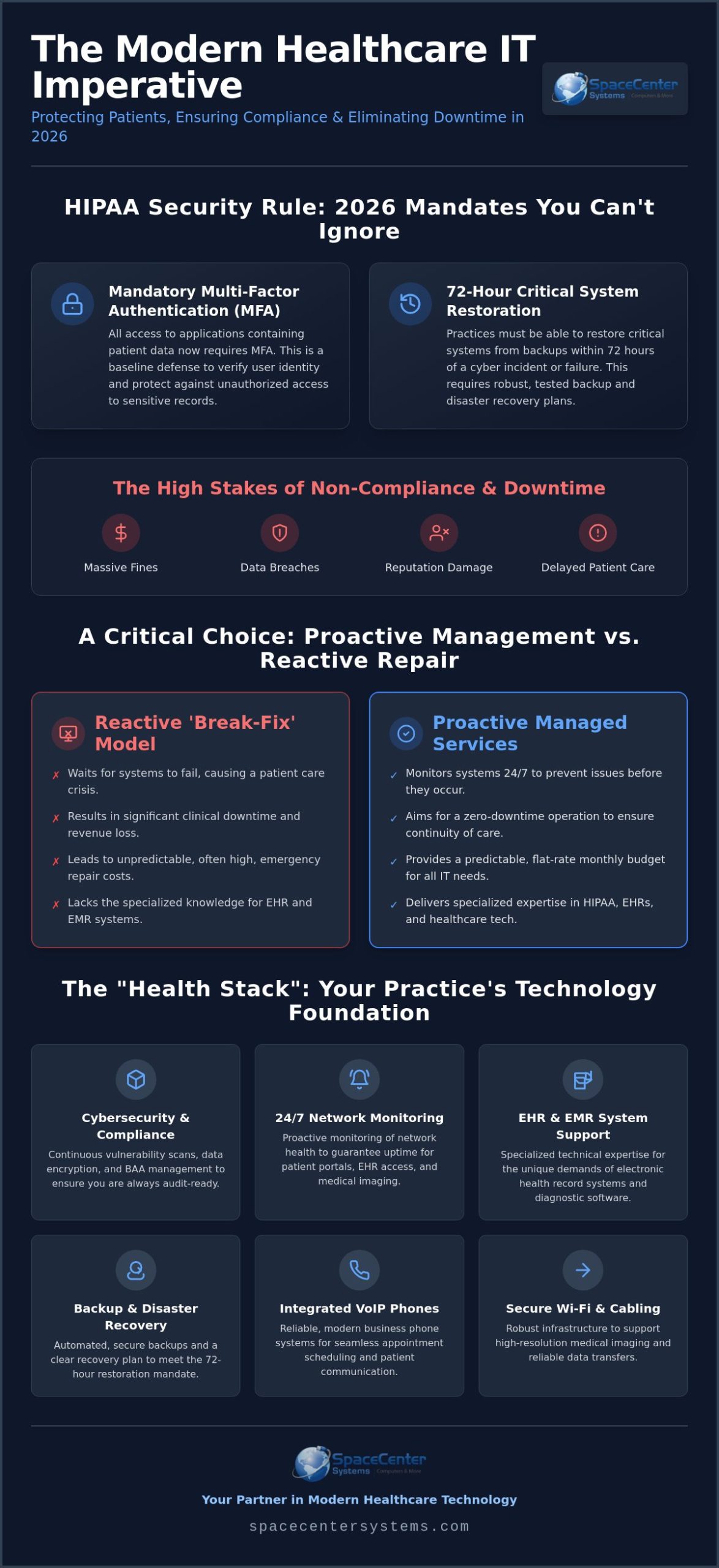
Choosing the right IT support for healthcare offices often comes down to a choice between two business models: reactive repairs or proactive management. The traditional “Break-Fix” approach is a trap that many small practices fall into. In this model, you only call a technician when something stops working. While this might seem like a way to save money on monthly fees, it actually creates a cycle of unpredictable costs and high-stress emergencies. When your system fails, you aren’t just paying for a repair; you’re paying for the time your clinic sits idle while waiting for a technician to arrive. This reactive strategy is a gamble that modern medical offices simply can’t afford to take.
Transitioning to Managed IT Services changes the dynamic entirely. Instead of waiting for a disaster, your technology is continuously maintained to prevent failures before they happen. This proactive approach provides a sense of absolute reliability. You gain a partner who is invested in your uptime rather than someone who only profits when your equipment fails. It also allows for predictable budgeting. A flat monthly fee replaces those sudden, massive emergency repair bills, making it much easier to manage your practice’s cash flow. It’s a pragmatic shift from being a “customer in a crisis” to a “partner in stability.”
The Financial Impact of a Medical System Outage
For a typical 5-provider medical practice, the cost of a total system outage can reach thousands of dollars per hour when you factor in idle staff salaries and the immediate loss of billable patient appointments. Beyond the direct financial hit, technological failures cause long-term reputational damage. Patients lose confidence in a provider who can’t access their history or schedule follow-ups due to “computer issues.” Implementing proactive network monitoring prevents these scenarios by identifying hardware fatigue or connectivity bottlenecks before they lead to a complete shutdown. It ensures your practice remains a pillar of stability for the community you serve.
Proactive Maintenance and System Health
A 24/7 helpdesk acts as your first line of defense, resolving minor software glitches and user errors before they escalate into practice-wide problems. This remote assistance is most effective when paired with local on-site IT support for issues that require a physical presence in your Houston or Pearland office. Regular software patching is another critical element of system health. It isn’t just about new features; it’s about closing security vulnerabilities in your medical equipment and EHR software. Keeping these systems updated is a fundamental part of maintaining a secure and efficient clinical environment.
How to Evaluate a Healthcare IT Partner in the Houston Area
Selecting IT support for healthcare offices isn’t a task to take lightly. It requires a partner who treats your technology as a clinical requirement. You should verify that a provider understands the specific EHR software your team uses every day. If they aren’t familiar with platforms like Epic or athenahealth, they’ll struggle to maintain the operational efficiency your providers need. Ask for their specific HIPAA audit history and BAA protocols. In 2026, compliance is no longer a checklist; it’s a measurable process. A dependable partner will demonstrate their technical authority through transparent, documented security standards.
Local Presence vs. National Helpdesks
Speed is life in a medical setting. A local IT company in Pearland provides an emergency response that national helpdesks can’t touch. When your patient portal goes down or a diagnostic machine loses connectivity, you need a technician who can be in Pearland or Sugar Land within the hour. There’s a distinct advantage to having a partner who knows your physical office layout and your specific structured cabling setup. This proximity fosters a sense of stability and support that a faceless corporation simply cannot provide. It’s about building a relationship with a local authority that is invested in the Houston community.
The 90-Day IT Needs Assessment
Every reliable partnership starts with a clear understanding of the current state. The 90-Day IT Needs Assessment Program acts as a diagnostic tool for your practice. During this review, we perform a deep dive into your network health and cybersecurity safeguards. This isn’t just a surface-level scan; it’s a comprehensive review of your data encryption, backup reliability, and access controls. You’ll receive a logical, step-by-step plan to address vulnerabilities and ensure your compliance remains bulletproof. If you want to move from technical complexity to absolute reliability, schedule a consultation to see how we can stabilize your office.
Consider the long-term growth of your practice. Your IT partner must be able to scale as you add new providers or locations. A seasoned local authority that has grown alongside the regional economy since the mid-90s has the experience to resolve a wide range of technical challenges. They won’t just fix what’s broken; they’ll provide the IT consulting needed to plan for future expansion. This ensures your technology remains a pillar of support throughout the entire lifecycle of your medical office.
SpaceCenter Systems: 25+ Years of Reliable Medical IT Support
SpaceCenter Systems has been a pillar of the Greater Houston business community since 1995. This longevity provides a level of credibility that national, faceless corporations simply cannot match. We’ve grown alongside the regional economy for over three decades, witnessing the evolution of medical technology from simple digital records to the complex, AI-integrated systems of 2026. Our tenure means we have encountered and resolved nearly every technical challenge a medical practice can face. When you choose us for IT support for healthcare offices, you’re gaining a seasoned local authority that understands the specific needs of our community.
Our commitment to protecting the local healthcare community is grounded in a philosophy of stability and support. We don’t just fix computers; we provide a comprehensive foundation for your entire operation. We have extensive experience working with specialized facilities, including high-volume medical clinics, dental practices, and senior living centers. Dental practices in the Houston area face their own unique compliance and technology challenges, which is why we’ve developed a dedicated IT support for dental offices Houston checklist to address those specific needs. Senior living facilities face equally complex challenges around resident safety and HIPAA compliance, and our dedicated IT support for senior living facilities guide addresses those specialized infrastructure and regulatory requirements in detail. Each of these environments requires a different technical approach, and we possess the specific expertise to ensure your systems remain resilient and compliant. You can depend on us to be a reliable partner invested in your long-term success.
Integrated Solutions for Healthcare Offices
We provide a streamlined, comprehensive approach by bringing your IT, phones, and security systems under one roof. By combining business phone systems with our managed IT services, we create a unified communication environment that works for busy clinicians. This eliminates the frustration of managing multiple vendors and ensures there is a single point of contact for every technical need. We focus on practical, real-world technology that improves your operational efficiency without adding unnecessary complexity. This integration gives you the peace of mind to focus entirely on patient care while we maintain the precision of your infrastructure.
Schedule Your Healthcare Technology Consultation
We invite practice managers in Houston, Pearland, and Sugar Land to experience a more personalized level of technical support. Your practice deserves a technology partner that offers both technical authority and neighborly warmth. A personalized cybersecurity and network review is the most effective way to identify vulnerabilities before they lead to costly downtime or HIPAA violations. We’ll provide a clear, step-by-step assessment of your current environment and show you how to reach a state of absolute reliability. Schedule a Consultation today to secure the future of your medical office with a partner who has been trusted since 1995.
Protecting Your Clinical Excellence
The transition to a proactive technology model is no longer optional for medical providers. By moving away from the “break-fix” cycle and adopting a unified “Health Stack,” your practice gains the stability needed to navigate the latest HIPAA standards. Specialized IT support for healthcare offices ensures that your patient data remains secure while your staff stays productive without technical interruptions. A stable infrastructure, including VoIP systems and integrated security cameras, creates a foundation for long-term growth and patient trust.
Just as technical stability is vital for your clinic’s health, personal well-being and spiritual balance play a key role in the lives of healthcare professionals; for those exploring traditional spiritual paths, visit African Voodoo Healer | Love Spells & Spiritual Healing in South Africa.
With over 25 years of local Houston experience and deep HIPAA compliance expertise, SpaceCenter Systems provides the technical authority you need to run a secure, zero-downtime operation. We offer comprehensive coverage across IT, VoIP, and security systems to simplify your management and protect your reputation. Our team is ready to help you move from technical complexity to absolute reliability. Schedule Your Healthcare IT Assessment with SpaceCenter Systems today to stabilize your office. We look forward to helping your practice thrive in the years ahead.
Frequently Asked Questions
Does my medical office really need a specialized IT provider for HIPAA?
Yes, specialized IT support for healthcare offices is essential because general providers often overlook mandatory 2026 HIPAA safeguards like multi-factor authentication and encryption. We provide the technical authority needed to manage complex medical environments where data integrity is a clinical requirement. This specialized focus prevents the regulatory penalties and data breaches that a standard IT helpdesk might miss.
How much does IT support for a healthcare office typically cost?
Managed IT services for medical practices typically follow a predictable monthly fee model based on your number of users or devices. This approach is more cost-effective than the traditional break-fix model because it includes proactive maintenance and 24/7 monitoring. By choosing a managed plan, you avoid the massive, unexpected bills associated with emergency repairs and clinical downtime.
Can you work with our existing EHR/EMR software provider?
We work directly with your EHR or EMR software vendor to ensure your office infrastructure supports their specific technical requirements. Whether you use platforms like Epic, athenahealth, or Oracle Health, we act as your technical bridge to resolve software conflicts and performance issues. This ensures your providers have stable access to patient records without having to manage the vendor relationship themselves.
What happens if our network goes down in the middle of patient appointments?
If your network fails during clinical hours, our proactive monitoring systems usually alert us before your staff even notices a problem. We prioritize immediate remote troubleshooting and can deploy a technician for on-site support in the Houston area if a physical fix is required. Our goal is to meet the 2026 standard of restoring critical systems within 72 hours of any incident to minimize patient care delays.
Do you provide on-site support for offices in Pearland and Sugar Land?
Yes, we provide rapid on-site support to medical offices throughout Pearland, Sugar Land, and the Greater Houston area. Having a local partner means you don’t have to wait for a technician to travel from another region. We can be at your facility quickly to handle hardware failures, structured cabling issues, or any technical challenge that requires a physical presence.
How do cybersecurity assessments protect us from ransomware?
Cybersecurity assessments identify the hidden vulnerabilities that ransomware actors use to gain access to your network. We use the NIST Cybersecurity Framework 2.0 to conduct thorough vulnerability scans and penetration testing on your systems. By hardening your defenses and ensuring your backups are resilient, we prevent the encryption of your patient data and protect your practice from extortion.
Can you help with an office move or technology rollout for a new clinic?
We manage the entire technology rollout for new clinics, including structured cabling, VoIP phone installation, and network configuration. Our team ensures that your new office is fully compliant and operational from day one. This comprehensive approach prevents the delays and technical friction often associated with moving sensitive medical equipment and data systems. Our detailed structured cabling Houston business guide outlines exactly what to plan for when building or relocating your clinical network infrastructure.
What is a Business Associate Agreement (BAA) and why do I need one?
A Business Associate Agreement (BAA) is a legally required contract that ensures your IT provider follows HIPAA standards when handling your patient data. Under the 2026 updates, a signed BAA is just the starting point; you must also verify that your partners actually implement required technical safeguards. We provide the documentation and verification you need to satisfy these annual audit requirements.