


Last Tuesday, a Houston business owner discovered that a simple door prop led to a theft because an unauthorized visitor followed an employee inside. You’ve likely worried about this “tailgating” scenario, but the technical jargon surrounding security portal systems often feels daunting. You deserve a reliable way to protect your assets and data without the recurring expense of a 24/7 manual guard.
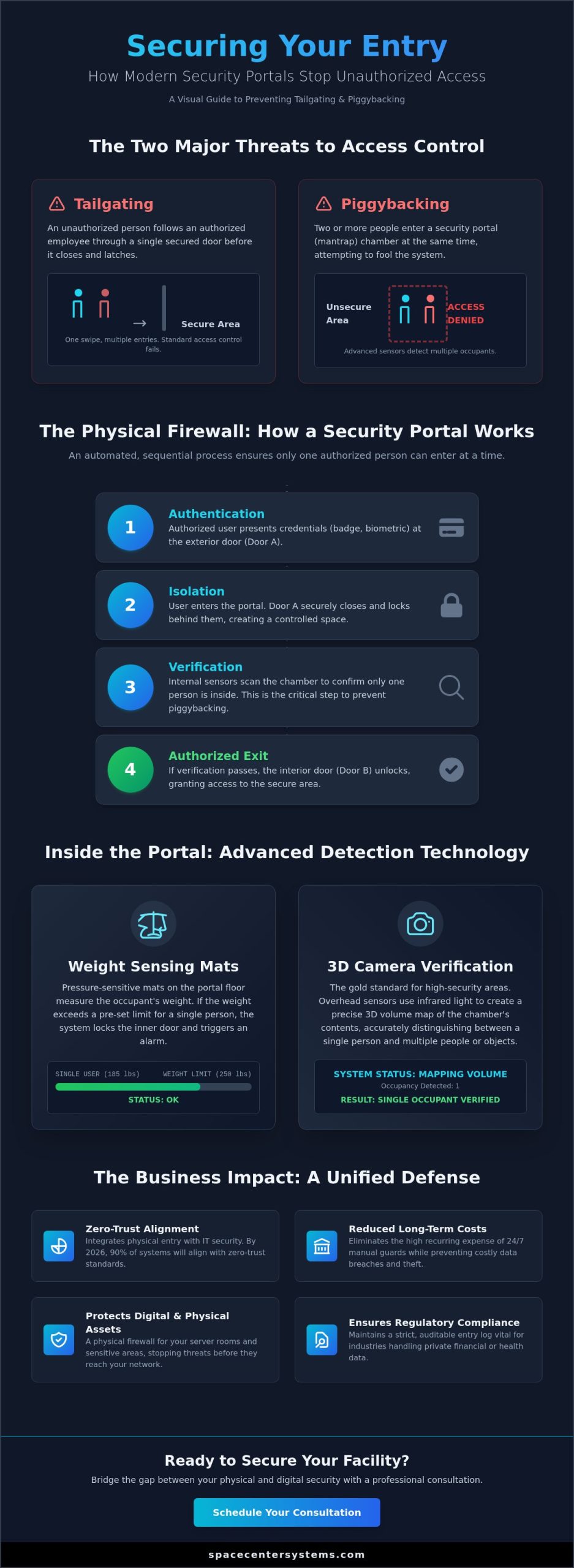
To combat piggybacking, high-security portals use pressure mats and sophisticated sensors. These mats detect multiple sets of feet or a weight profile that exceeds the programmed limit for a single person. If the system senses an extra occupant, it triggers an alert and keeps the interior door locked. 3D camera verification is the gold standard for Houston data centers in 2026. These overhead sensors use infrared light to map the volume of the chamber, identifying unauthorized “backpack” piggybacking where an intruder might try to hide behind a larger individual. This level of precision ensures that only one person passes through at a time. To further enhance your perimeter visibility, you can discover more about Security Camera systems that integrate with your automated entries.
In this guide, you’ll learn how to select and integrate automated entryways that act as a physical firewall for your company. Since 1990, SpaceCenter Systems has helped local firms bridge the gap between physical security and IT infrastructure. We’ll explore how to leverage 2026 trends, such as the 90% of systems now aligned with zero-trust cybersecurity standards, to create a professional entrance that builds brand trust. From ADA compliance to seamless network integration, we provide the roadmap for a more secure office. Reach out to our team today to schedule your professional consultation and experience a more personal level of security support.
Key Takeaways
- Bridge the gap between physical access and digital protection to ensure your company’s data remains as secure as your front door.
- Learn to identify the technical differences between tailgating and piggybacking to choose the most effective interlocking door logic for your facility.
- Evaluate the long-term ROI of security portal systems by identifying hidden costs like data breaches and physical theft that impact your bottom line.
- Use our expert buying criteria to select a portal design that fits your Houston office space while handling the morning rush efficiently.
- Discover the essential steps for integrating your physical security hardware with your current IT network to prevent system failures and downtime.
Security Portal Systems in Houston: Bridging the Physical-Digital Gap
A security portal, often referred to as a mantrap, is a specialized two-door interlocking system designed to prevent unauthorized entry into sensitive areas. The logic is simple but effective: the second door will not unlock until the first door is completely closed and the occupant is verified. This creates a physical buffer zone that forces every individual to be vetted before they gain access to your facility. For businesses in Pearland, this physical barrier is actually the first line of defense for your digital data. If a bad actor gains physical access to your server room, your software firewalls cannot stop them from pulling a hard drive or planting a malicious device.
Since 1990, SpaceCenter Systems has operated with a “safe pair of hands” philosophy. We believe that automated security portal systems provide a level of reliability that manual guard desks simply cannot match. Consider a busy medical clinic in the Houston Museum District. The staff stays focused on patient care, which means they aren’t always watching the front door. An intruder could easily slip past a distracted receptionist to reach rooms containing sensitive patient records. By installing an automated portal, the clinic ensures that every person is vetted by a high-precision system that never takes a lunch break or gets distracted by a phone call.
The Difference Between Access Control and Security Portals
Most small businesses use standard badge readers, but these only secure the door, not the actual entry event. If one employee swipes a card and three people walk in behind them, your access control has failed. Fully enclosed interlocking portals solve this problem by using internal sensors to detect exactly how many people are inside the chamber. This level of precision is vital for maintaining regulatory compliance, especially for firms handling financial data or private health information in the Greater Houston area. It turns a passive door into an active security asset.
Why 2026 is the Year to Automate Your Entry Security
Labor costs for on-site security guards have risen significantly across Texas over the last few years. Small firms with 5 to 50 employees often find the cost of a 24-hour guard prohibitive. In 2026, advancements in AI-driven sensors have made these portals more affordable and accurate for smaller footprints. Modern systems now offer seamless integration with business security systems Houston owners trust for total asset protection. This ensures your physical entry points communicate directly with your IT network, providing a unified defense strategy that saves you time and reduces liability. Contact us today to schedule a consultation and see how we can secure your perimeter.
Core Technologies: How Modern Portals Prevent Tailgating and Piggybacking
Modern security portal systems use a strict sequence of operations to eliminate human error at your entry points. The foundation of this technology is interlocking door logic. This ensures that Door B, the interior entrance, never unlocks until Door A is securely closed and the occupant is verified. This simple mechanism prevents a common security failure where a door is held open for a stranger out of politeness or negligence. By removing the human element, you ensure that every entry event is a controlled, singular occurrence.
Understanding the difference between tailgating and piggybacking is essential for choosing the right system. Tailgating happens when an unauthorized person follows an employee through a door before it fully latches. Piggybacking is more deceptive; it occurs when two people attempt to enter the same portal chamber at the same time, often by standing very close together. Without advanced sensors, a standard badge reader can’t distinguish between one person and two. This vulnerability puts your physical assets and digital infrastructure at risk of theft or tampering.
Weight Sensing and 3D Camera Verification
To combat piggybacking, high-security portals use pressure mats and sophisticated sensors. These mats detect multiple sets of feet or a weight profile that exceeds the programmed limit for a single person. If the system senses an extra occupant, it triggers an alert and keeps the interior door locked. 3D camera verification is the gold standard for Houston data centers in 2026. These overhead sensors use infrared light to map the volume of the chamber, identifying unauthorized “backpack” piggybacking where an intruder might try to hide behind a larger individual. This level of precision ensures that only one person passes through at a time.
Biometric and RFID Integration
Modern portals allow you to move beyond easily lost physical keys. RFID technology provides a smooth experience for Pearland employees, allowing them to enter the first door with a simple tap or even a mobile credential. For areas containing sensitive data, we integrate biometrics like facial recognition or fingerprint scanning into the portal logic. This ensures that the person using the badge is actually the authorized employee. You can even integrate these portals with your existing Business VoIP systems Pearland to provide clear intercom support if an entry is denied. If you’re ready to automate your perimeter, we invite you to consult with our local experts to find a solution that fits your specific workflow.
The Business Impact: Calculating ROI and Reducing Liability Risks
A security breach isn’t just a headache; it’s a line item on the balance sheet. Many owners in the Greater Houston area struggle with the recurring costs of physical guards. A single security guard’s salary often exceeds $40,000 annually. When you invest in security portal systems, you replace that recurring overhead with a one-time capital investment. This transition moves your security from a variable expense to a fixed asset. It also eliminates human errors like fatigue or distraction, providing a consistent “safe pair of hands” for your entry management.
Insurance providers often reward this consistency. Certified installations can lead to reduced premiums for Houston businesses because they demonstrably lower the risk of theft and liability. Beyond the direct savings, there is the value of your brand’s reputation. Clients want to see “Mission-Critical” reliability when they visit your office. A professional, automated entrance signals that you take their data and your own assets seriously. It builds immediate trust with partners who require high-level security protocols before they sign a contract.
Downtime and Revenue Loss: The Tangible Consequences
Consider a Sugar Land warehouse that faced a 48-hour shutdown in early 2025 after a physical security breach. For a 20-employee firm, the “Cost of Insecurity” includes lost wages, missed shipping deadlines, and the high price of emergency IT remediation. Physical breaches often lead directly to digital ones. Security portals ensure cybersecurity for small business Houston by physically locking down the server room. This prevents unauthorized access to the hardware that powers your entire operation, saving you from the catastrophic revenue loss associated with a total system outage.
Compliance and Legal Protections
If your business handles sensitive data, you likely face strict requirements like HIPAA, PCI-DSS, or SOC2. These regulations demand auditable entry logs that prove exactly who entered a secure area and when. Manual logs are easily falsified or lost. Automated portals provide digital, tamper-proof records that satisfy auditors and protect you during legal disputes. This is especially important for businesses in high-traffic areas like Pasadena or League City, where premises liability is a constant concern. Our “safe pair of hands” approach ensures your regulatory documentation is always ready for review. Contact SpaceCenter Systems today to see how we can help you meet these critical standards through a professional consultation.
Buying Criteria: Selecting a Portal System for Your Pearland Facility
Choosing the right hardware for your facility requires balancing strict security needs with the daily flow of your workforce. For a 20-employee office, a single portal usually handles the morning rush effectively. If you have 50 or more people arriving simultaneously, throughput becomes a critical metric. High-performance security portal systems typically process five to seven people per minute. You also need to consider your physical footprint. Circular portals offer a sleek, space-saving design, while square or semi-circular models might fit better against existing masonry or glass partitions.
Aesthetics shouldn’t be an afterthought. Your entrance is often the first thing a client sees. We provide finishes that match your Houston office interior, ensuring the technology feels like a natural part of your brand rather than a cold, industrial addition. Safety is equally paramount. In Texas, all automated entryways must comply with strict fire codes and ADA requirements. This includes emergency override features that allow doors to swing open for immediate egress during an alarm or power failure. Our team ensures your installation meets these legal standards without compromising your perimeter.
Internal vs. External Placement
Where you place the portal determines its technical specifications. External units require robust weatherproofing to withstand the heat and humidity of a typical Gulf Coast summer. If you only need to secure a specific zone, such as a server room or executive suite, an internal “mantrap” is the better choice. We recommend a facility walkthrough with our SpaceCenter Systems Houston team to see these configurations in person and determine what fits your Pearland facility best.
Connectivity and Power Backup
Your security shouldn’t vanish when the lights go out. Houston business owners know that power reliability is a constant concern. Your system needs a dedicated battery backup and a clear “fail-secure” or “fail-safe” configuration based on your specific risk profile. Integrating these portals with local cloud computing services Houston allows for remote monitoring and real-time alerts. This ensures you can manage access from anywhere, even if you aren’t on-site. If you’re ready to upgrade your facility, schedule a professional consultation today to ensure your selection meets every technical and safety requirement.
Expert Implementation: Integrating Security Portals with Managed IT Services
A “hardware-only” approach to security often leads to expensive failures. If your portal isn’t integrated with your internal network, it becomes an isolated island. You can’t track entry logs in real-time or sync access rights with your employee database. This lack of coordination creates a major security vulnerability that leaves your data exposed. Since 1990, SpaceCenter Systems has provided a “safe pair of hands” for local business owners. We ensure your security portal systems are fully integrated with your managed IT infrastructure. This creates a unified defense that protects both your physical office and your digital assets.
Living on the Gulf Coast means we also have to account for the weather. We specialize in hurricane-rated hardware that withstands the extreme conditions common in the Houston area. You don’t want your physical security to fail during the next major storm. Professional installation ensures that your entryways remain operational and secure, regardless of the forecast. By choosing a partner who understands the local climate and technical requirements, you avoid the downtime and revenue loss associated with inferior, non-integrated setups.
The SpaceCenter Integration Process
Our process begins with professional structured cabling to ensure high-speed, reliable communication between your portal and your servers. We don’t just bolt the unit to the floor; we calibrate every sensor to eliminate false alarms and ensure smooth traffic flow. Once the hardware is set, we sync your portal logs directly with your managed IT dashboard. This gives you 24/7 oversight from any device. We proudly serve businesses throughout the region, including those in Sugar Land and League City. This local presence means we understand the specific challenges your neighborhood faces every day.
Ongoing Support and Maintenance
Local support is critical for mission-critical infrastructure. If a sensor malfunctions at 2:00 AM, you can’t wait for a technician to fly in from another state. Our team is right here in the Houston area to provide immediate assistance. We also perform quarterly security audits to ensure your security portal systems remain unhackable and up to date. SpaceCenter Systems provides a “Texas-friendly” service backed by aerospace-grade precision to keep your business running smoothly. You’ve worked hard to build your company; don’t leave its safety to chance. Contact us today to schedule your professional consultation and experience a more personal level of IT and security support.
Secure Your Houston Perimeter Today
Protecting your facility requires more than just a sturdy lock. It demands a system that thinks and reacts in real-time. By implementing automated security portal systems, you eliminate the risks of human error and tailgating while significantly lowering your long-term operational costs. You’ve seen how these systems protect your physical assets and reinforce your digital cybersecurity posture. A reliable entrance builds trust with your clients and keeps your employees safe from unauthorized intruders.
Since 1990, SpaceCenter Systems has brought aerospace-grade precision to the Greater Houston business community. We understand that your security is mission-critical. Our team provides the 24/7 local helpdesk and on-site support you need to maintain absolute uptime. We’re a local partner invested in your success, not a faceless corporation. We’re ready to help you transition from a reactive security posture to a proactive, automated defense that stands up to the unique challenges of the Gulf Coast.
Schedule Your Free Security Portal Consultation with SpaceCenter Systems today. Let’s build a safer future for your business together.
Frequently Asked Questions
What is the average cost of a security portal system for a small business?
High-security portal systems are customized to your facility’s specific needs. While a basic keypad might cost $500 to $1,500 per door, fully automated portals involve hardware, installation, and specialized software. Monthly maintenance and monitoring fees typically range from $20 to over $100 depending on the complexity of the system. We help you calculate the total cost of ownership to ensure your investment matches your security goals.
Can a security portal be integrated with my existing badge readers?
Most modern portals integrate seamlessly with your current access control hardware. We can often link your existing badge readers or mobile credentials to the new portal logic. This saves you the expense of reissuing cards to your entire workforce. It also ensures that your security portal systems communicate effectively with your current IT network for unified management and reporting.
How do security portals handle emergency fire evacuations?
Every installation must comply with the International Building Code and local Houston fire regulations. In an emergency, the fire alarm system sends a signal to the portal controller to release all locks immediately. This allows for unrestricted egress so employees can exit quickly. We test these fail-safe mechanisms regularly to ensure your staff stays safe during a crisis while maintaining compliance with Texas safety standards.
What happens to the security portal during a power outage in Houston?
Reliability during a Houston power outage is a top priority for our team. We install dedicated battery backups that keep the sensors and locks operational during short-term failures. For extended outages, the system can be set to a fail-safe mode where doors remain unlocked for safety. You can also use manual override keys to maintain access until the local grid is restored and your systems reboot.
How many people can a security portal handle per minute without causing a bottleneck?
A standard high-security portal handles approximately 5 to 7 people per minute. For a business with 30 employees, this means the entire team can enter the building in under six minutes. This speed prevents the “morning rush” bottleneck that often leads to employees propping doors open for others. We analyze your peak traffic times to ensure the throughput meets your daily operational needs without sacrificing safety.
Is a security portal the same thing as a mantrap door?
Yes, a mantrap is the technical industry term for a security portal. Both terms describe a two-door chamber where the first door must close before the second one opens. While “mantrap” is the term used in most building codes, “security portal” is often preferred in professional office settings. We use both terms to help business owners identify the specific interlocking logic required for their facility.
Do I need a special structural permit for portal installation in Pearland, TX?
Any company installing these systems in Texas must be licensed by the Texas Department of Public Safety’s Private Security Program. In Pearland, your installation must also adhere to the Americans with Disabilities Act requirements for accessible routes. Since certain revolving portals can’t be part of an accessible path, we ensure your design includes a compliant alternative. This ensures your project meets all local building codes and state regulations.
How does a security portal prevent two people from entering on one badge swipe?
Sensors use volume and weight detection to identify multiple occupants within the chamber. 3D overhead cameras map the area to ensure only one person is present before unlocking the inner door. If the system detects a second person, it triggers an alert and denies entry immediately. This automated process is 76% more effective than manual monitoring at preventing piggybacking in high-traffic environments. Contact SpaceCenter Systems today to schedule a consultation and see these systems in action.