


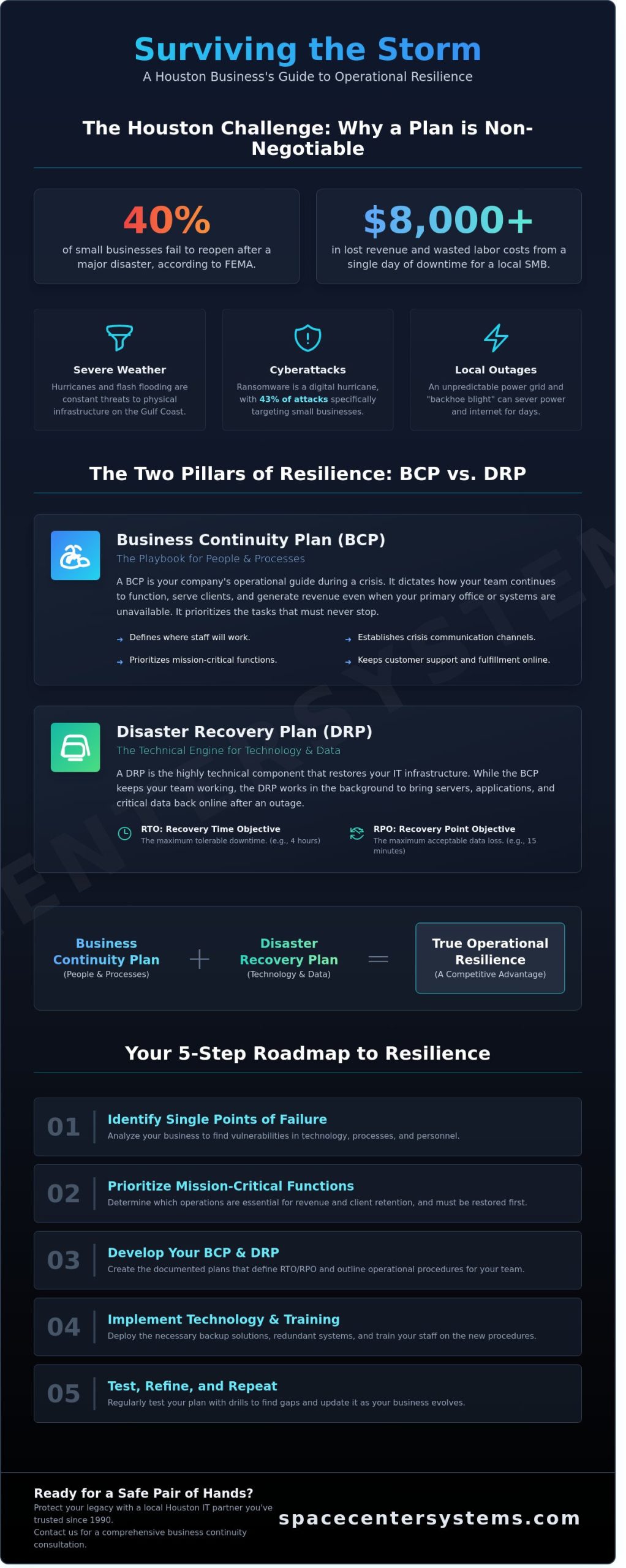
On a humid Tuesday in Pearland, a sudden transformer failure cuts power to your block, instantly silencing your servers and halting your team’s progress. According to FEMA, 40% of small businesses fail to reopen after a major disaster because they lack a tested strategy to recover their operations. You’ve built your reputation in Houston since 1990. You know that a basic file backup isn’t enough to handle the unpredictability of the Texas power grid. To keep your revenue flowing, you need a professional business continuity disaster recovery plan that guarantees your data is safe and your team stays active.
We understand that technical complexities often cause more anxiety than the disasters themselves. This article provides a clear, step-by-step roadmap to protect your company from hurricanes, cyberattacks, and local outages. You’ll learn how to minimize downtime and bridge the gap between simple backups and true operational resilience. We’ll walk you through the essential checklist every local business owner needs to keep employees productive during a crisis. Our mission-critical approach brings high-tech reliability to your neighborhood office. Contact our team to schedule a personalized technology consultation today and secure your business future.
Key Takeaways
- Understand why Houston’s unique weather patterns and grid instability make a resilient strategy essential to avoid losing thousands in daily revenue.
- Discover the critical differences between keeping your operations running and recovering lost data by building a comprehensive business continuity disaster recovery plan.
- Learn how to use a simple formula to calculate your company’s true hourly cost of IT downtime, revealing the hidden financial risks to your bottom line.
- Follow a proven 5-step roadmap to identify single points of failure and prioritize your most mission-critical business functions before the next hurricane season.
- See how a local Houston IT partner provides 24/7 monitoring to stop technical disasters before they disrupt your Pearland or Houston operations.
Why Houston Businesses Need a Business Continuity Disaster Recovery Plan Now
Doing business on the Gulf Coast involves unique challenges that companies in other regions simply don’t face. Hurricanes, flash flooding, and an unpredictable power grid are standard parts of our local environment. For a small business in Pearland, a single day of total downtime often results in $8,000 or more in lost revenue and wasted labor costs. Luck isn’t a strategy. Shifting from a “hope for the best” mindset to a proactive resilience strategy is the only way to protect your legacy. Implementing a comprehensive business continuity disaster recovery plan provides the peace of mind that your operations will persist through the next major storm or system failure.
Local Risks: Beyond Just Weather
While weather dominates the headlines, other threats are just as destructive. Ransomware has become a digital hurricane for businesses in Houston; currently, 43% of cyberattacks target small businesses specifically. Physical infrastructure is also a constant risk. Local road construction projects frequently lead to “backhoe blight,” where fiber optic cables are accidentally severed, killing your internet connection for days. Additionally, localized power grid instability in Sugar Land can halt production lines and leave your team unable to serve customers while overhead costs continue to climb. These incidents happen without warning and require immediate, pre-planned responses to avoid permanent data loss. Understanding the evolving landscape of cyber threats Pearland businesses face in 2026 is crucial for developing comprehensive protection strategies.
The Safe Pair of Hands Philosophy
When the city enters a weather warning, you need an IT partner who is physically present and understands the local landscape. SpaceCenter Systems has served the region since 1990, providing a “safe pair of hands” during mission-critical moments. We focus on direct, functional solutions that protect your bottom line. Reliability becomes your strongest competitive advantage when you are the only business in your niche that stays operational during a crisis. We don’t just provide software; we provide the stability your employees and clients depend on. Don’t wait for the next disaster to find out if your systems are secure.
Is your business ready for the next Big One? Contact SpaceCenter Systems today to schedule a comprehensive business continuity consultation.
BCP vs. DRP: Understanding the Two Pillars of Resilience
Many Houston business owners assume that a nightly cloud backup constitutes a complete safety net. This is a dangerous misconception that often leads to expensive downtime. Relying solely on data storage leaves your operations vulnerable when a hurricane or cyberattack strikes. If your server room in downtown Houston loses power, having your files in the cloud won’t tell your employees how to process payroll from home. You need a unified business continuity disaster recovery plan to bridge the gap between having your data and actually being open for business. This integrated approach ensures your company remains functional even if your physical headquarters is inaccessible.
What is a Business Continuity Plan (BCP)?
A BCP focuses on your people and your processes. It’s the playbook that dictates how your team operates when the unexpected happens. Since 1990, we’ve seen how local firms struggle when they haven’t identified their critical functions. If a pipe bursts and floods your office in League City, your BCP outlines where your staff should report and which communication channels they’ll use to notify clients that you’re still operational. It prioritizes the tasks that must never stop, such as customer support or order fulfillment, ensuring your reputation remains intact while the physical damage is repaired.
What is a Disaster Recovery Plan (DRP)?
The DRP is the technical engine of your resilience strategy. It handles the restoration of your servers, applications, and specific data sets. While the BCP keeps the staff moving, the DRP works in the background to get the systems back online. To build an effective DRP, you must define your recovery goals clearly. Recovery Time Objective (RTO) is the maximum tolerable length of time that a business can be down after a failure. Recovery Point Objective (RPO) determines how much data loss your business can survive, such as the last four hours of transactions versus the last 24 hours.
Integrating these two pillars creates a “safe pair of hands” for your organization. Without this synergy, you might have your data back but no staff who knows how to access it, or a full staff with no working computers. Our team has spent decades refining these strategies to protect local businesses from the $427 per minute cost of unmanaged downtime. You don’t have to tackle these technical complexities alone. We invite you to schedule a professional consultation to evaluate your current readiness and build a dependable business continuity disaster recovery plan that secures your future.
Calculating the High Cost of IT Downtime for Local SMBs
Since 1990, we’ve helped Houston companies stay operational through hurricanes and hardware failures alike. Many owners see a server crash as a simple repair bill, but the real cost is the silent drain on your bank account. A 2023 study by the Uptime Institute revealed that 55% of significant outages cost companies more than $100,000. For an SMB in Sugar Land or downtown Houston, that’s not just a setback; it’s a threat to your company’s survival.
You can calculate your specific risk using a simple formula: (Hourly Lost Revenue + Hourly Labor Costs + Recovery Expenses) x Hours of Downtime. If your 15-person team averages $35 an hour and your daily revenue is $8,000, a single four-hour outage costs you roughly $4,100 in wasted wages and lost sales alone. Investing in a business continuity disaster recovery plan isn’t an extra expense. It’s a calculated move to protect your revenue from unpredictable failures and ensure mission-critical reliability.
Direct vs. Indirect Financial Impacts
Financial damage starts the second your network drops. You’re paying for 100% of your payroll while receiving 0% productivity from staff who can’t log in. If you’re a medical clinic or law firm, data breaches during a chaotic recovery can lead to compliance fines that often exceed $50,000. Beyond that, missed sales opportunities during an outage usually go to competitors who are still online. In the fast-moving Houston market, failing to meet a Service Level Agreement (SLA) can result in immediate contract penalties and lost future business.
The Human Element of a Disaster
IT failures take a heavy toll on your staff’s morale. When systems fail without a clear roadmap, your team enters a state of high-stress panic-mode that leads to burnout. Research shows that workplace stress increases by 33% during technical crises, which can spike your employee turnover rates. Your clients also feel the impact. Reliability is the cornerstone of trust for Houston businesses. If a client can’t reach you during a crisis, their anxiety grows, and your reputation as a dependable partner suffers. A solid business continuity disaster recovery plan keeps your team calm and ensures your reputation remains intact.
Stop guessing about your IT risks and start protecting your bottom line. Reach out to our Houston office today to schedule a consultation and secure your business’s future.
How to Build Your Business Continuity Disaster Recovery Plan: A 5-Step Guide
Since 1990, we’ve helped Houston businesses navigate everything from local floods to unexpected hardware failures. Building a business continuity disaster recovery plan isn’t about checking a box; it’s about ensuring your doors stay open when the unexpected hits. We focus on practical steps that protect your revenue and your reputation.
Step 1: The Business Impact Analysis
A Business Impact Analysis (BIA) predicts the consequences of disruption of a business function. You need to know exactly which software allows you to bill clients today and which can wait until tomorrow. Rank your data from “nice to have” to “survival critical.” For instance, a medical clinic in Sugar Land might prioritize patient records over historical marketing data to stay operational during a server failure. This clarity prevents you from wasting resources on non-essential systems during a crisis.
Identify your single points of failure to prevent a total shutdown. If your entire operation relies on one aging server in a closet, you’re one power surge away from total downtime. Choosing the right recovery technology is the next logical move. Cloud solutions offer flexibility; on-premise hardware provides speed. Often, a hybrid approach is the most reliable path for growing firms in the Houston area. Document the who, what, and where of your emergency response so every employee knows their role before a storm hits. This documentation should include physical locations for temporary offices and clear communication chains.
Step 5: Testing Your Resilience
A plan that hasn’t been tested is just a wish list. We’ve seen businesses lose $10,000 per hour because they assumed their backups worked but never actually tried to restore them. Simulate a hurricane scenario to find the gaps in your strategy. Can every member of your team log into the VoIP system from home right now? Test, train, and update your business continuity disaster recovery plan at least twice a year. As your business grows or you adopt new software, your plan must evolve to remain effective.
Don’t leave your company’s future to chance. Schedule a consultation with our Houston experts to secure your operations today.
Implementing Your Plan with a Trusted Houston IT Partner
Implementing a DIY business continuity disaster recovery plan often leads to a false sense of security. While a written document is a helpful start, it doesn’t provide the real-time response needed when a server fails or a tropical storm hits the Texas coast. Without professional oversight, backup failures often go unnoticed until it’s too late. Industry data indicates that 60% of small businesses that experience major data loss shut down within six months. SpaceCenter Systems removes this risk by providing 24/7 monitoring that stops technical disasters before they disrupt your operations. Our proactive approach ensures your data remains safe. You can focus on your core business goals while we manage the technical heavy lifting.
The SpaceCenter Advantage
Since 1990, we have served the Greater Houston Area with a commitment to reliability and precision. We don’t operate out of a faceless call center; our team is right here in your neighborhood. This local presence means we understand the specific challenges Houston businesses face, from humidity-related hardware issues to regional power grid instability. Our proactive maintenance reduces the likelihood of critical failures by 85% compared to reactive, break-fix models. When you partner with us, you gain a “safe pair of hands” that has managed mission-critical systems for over 34 years. We combine high-tech security with a Texas-friendly attitude that prioritizes your peace of mind.
Your Next Step Toward Resilience
The transition from an at-risk infrastructure to a resilient one doesn’t have to take months. We follow a proven process to secure your business in 30 days or less. It starts with a professional IT audit to identify hidden vulnerabilities in your current setup. This clear roadmap eliminates guesswork and provides a direct path to stability. Downtime can cost a small firm over $10,000 per hour in lost productivity and missed opportunities. We prevent these losses by hardening your defenses before trouble arrives. Whether you are located in Houston, League City, or Sugar Land, we are ready to help.
Don’t wait for a crisis to test your business continuity disaster recovery plan. Contact us today to schedule your comprehensive IT audit and experience a more personal, dependable level of support.
Protect Your Houston Business Legacy Today
For local business owners, a hurricane or a sudden ransomware attack isn’t just an IT problem. It’s a direct threat to your revenue and your team’s livelihood. We’ve outlined how a robust business continuity disaster recovery plan acts as your company’s safety net, preventing the staggering costs of downtime that can exceed $5,000 per hour for small firms. By implementing a 5-step strategy, you move from being reactive to being resilient.
SpaceCenter Systems has served the Houston and Pearland communities since 1995. Our expert local team brings over 25 years of experience to your side, backed by 24/7 proactive network monitoring that keeps your systems running. You deserve a partner who understands the local landscape and the technical demands of your industry. Don’t wait for the next major disruption to test your readiness.
Schedule your free Business Continuity Consultation with SpaceCenter Systems today to secure your operations. Your business is a vital part of the Texas economy, and we’re ready to help you keep it that way.
Frequently Asked Questions
What is the difference between a backup and a business continuity plan?
A backup is a simple copy of your data, while a business continuity plan is the strategy that keeps your entire operation running during a crisis. If a server fails at your Sugar Land office, a backup lets you restore files; however, business continuity ensures your staff can still process payroll and serve customers within minutes. Without a full plan, 40% of small businesses never reopen after a major data loss according to FEMA records.
How much does a business continuity disaster recovery plan cost for a small business?
Small businesses in the Houston area typically invest between $300 and $1,500 per month for a professionally managed business continuity disaster recovery plan. This cost covers automated offsite storage, regular testing, and immediate recovery hardware. Spending $500 a month is a strategic investment compared to the $8,000 hourly cost of downtime reported by the IT Support Board for small firms. We provide fixed pricing to ensure your budget stays predictable.
How often should our Houston business test our disaster recovery plan?
You should test your disaster recovery plan at least once every 90 days to ensure your systems remain resilient. Houston companies often face evolving cyber threats and infrastructure changes that can break older recovery protocols. Regular testing identifies these gaps before a real emergency occurs. This schedule ensures your 2024 recovery time objectives stay accurate and your team remains prepared for any sudden technical failure or local outage.
Can a BCDR plan help my business survive a ransomware attack?
A BCDR plan is your most effective defense against ransomware because it allows you to roll back your systems to a point in time before the infection occurred. In 2023, the average ransomware demand hit $1.5 million, but businesses with verified recovery points avoided paying these ransoms entirely. We use immutable snapshots to ensure your data remains untouched by hackers. This lets you resume work in hours instead of weeks.
Do I need a BCDR plan if all my business data is already in the cloud?
You still need a BCDR plan because cloud providers like Microsoft or Google follow a shared responsibility model where you are responsible for your own data protection. If a Houston employee accidentally deletes a critical folder in OneDrive, Microsoft does not guarantee its recovery after 30 days. A dedicated plan ensures you have a secondary, independent copy of your cloud environment. This prevents permanent revenue loss from simple human errors or cloud service interruptions.
What are RTO and RPO, and why do they matter for my plan?
Recovery Time Objective (RTO) is how quickly you need to be back online, while Recovery Point Objective (RPO) is how much data you can afford to lose. If your RTO is 4 hours, your Houston team must be functional by noon after an 8:00 AM crash. Setting an RPO of 1 hour means you will never lose more than 60 minutes of work. These metrics protect your daily billable hours and client reputation.
How do I start a business impact analysis for my small company?
Start your Business Impact Analysis by listing your five most critical business functions and calculating the dollar amount lost for every hour they are offline. For a local medical clinic, this might include patient scheduling and electronic health records. Identifying these priorities helps us build a business continuity disaster recovery plan that protects your most profitable activities first. This process ensures 100% of your mission-critical tasks survive a localized technical outage.
Is hurricane preparedness part of a standard BCDR plan?
Hurricane preparedness is a fundamental part of a standard BCDR plan for any company in the Greater Houston area. Our plans include specific triggers for moving operations to the cloud when a Category 2 or higher storm enters the Gulf. Since our founding in 1990, we have helped businesses stay operational through every major weather event. We ensure your data is safely replicated to data centers located outside the coastal flood zone.
Ready to protect your company from the unexpected? Contact SpaceCenter Systems today to schedule a comprehensive consultation and build a recovery plan you can trust.