


Did you know that 60 percent of small businesses close their doors within just six months of a significant data loss event? In our community, where Gulf Coast storms and modern cyber threats are constant realities, the stakes for your operations couldn’t be higher. You likely recognize that a simple data backup won’t save your medical office or property management firm if your systems go dark for days. Building a robust business continuity plan Pearland organizations can rely on often feels overwhelming, especially when you are focused on daily growth and client care.
We understand that you need stability and a clear path forward when the unexpected happens. This 2026 guide will show you how to protect your revenue and reputation by creating a localized resilience strategy that prioritizes your specific operational needs. You’ll discover how to assign critical roles, minimize the high cost of downtime, and clearly define your recovery objectives. We will move past technical jargon to provide a usable framework that keeps your business running, no matter what the Texas weather or a ransomware actor throws your way.
Key Takeaways
- Learn the critical difference between fixing your technology and keeping your entire business operational during a crisis.
- Discover how to build a business continuity plan Pearland firms can use to transition from simple daily backups to real-time data replication.
- Identify mission-critical functions through a Business Impact Analysis to establish clear Recovery Time and Recovery Point Objectives for your industry.
- Understand why specialized industries like healthcare require tailored continuity strategies to maintain HIPAA compliance and patient care during local outages.
- See how partnering with a local IT authority provides the on-site support and regional expertise needed to navigate Brazoria County infrastructure challenges.
What is a Business Continuity Plan and Why Does Your Pearland Firm Need One?
For many Pearland business owners, the term “disaster” brings to mind the specific sound of a hurricane warning or the sight of rising water on Broadway Street. However, a true Business continuity planning strategy is about more than just surviving the storm. It’s a comprehensive roadmap designed to keep your doors open and your staff productive when the unexpected strikes. Whether you’re facing a massive Gulf Coast hurricane or a silent ransomware attack, a business continuity plan Pearland professionals trust ensures that your operations don’t grind to a halt just because your primary office or server is compromised.
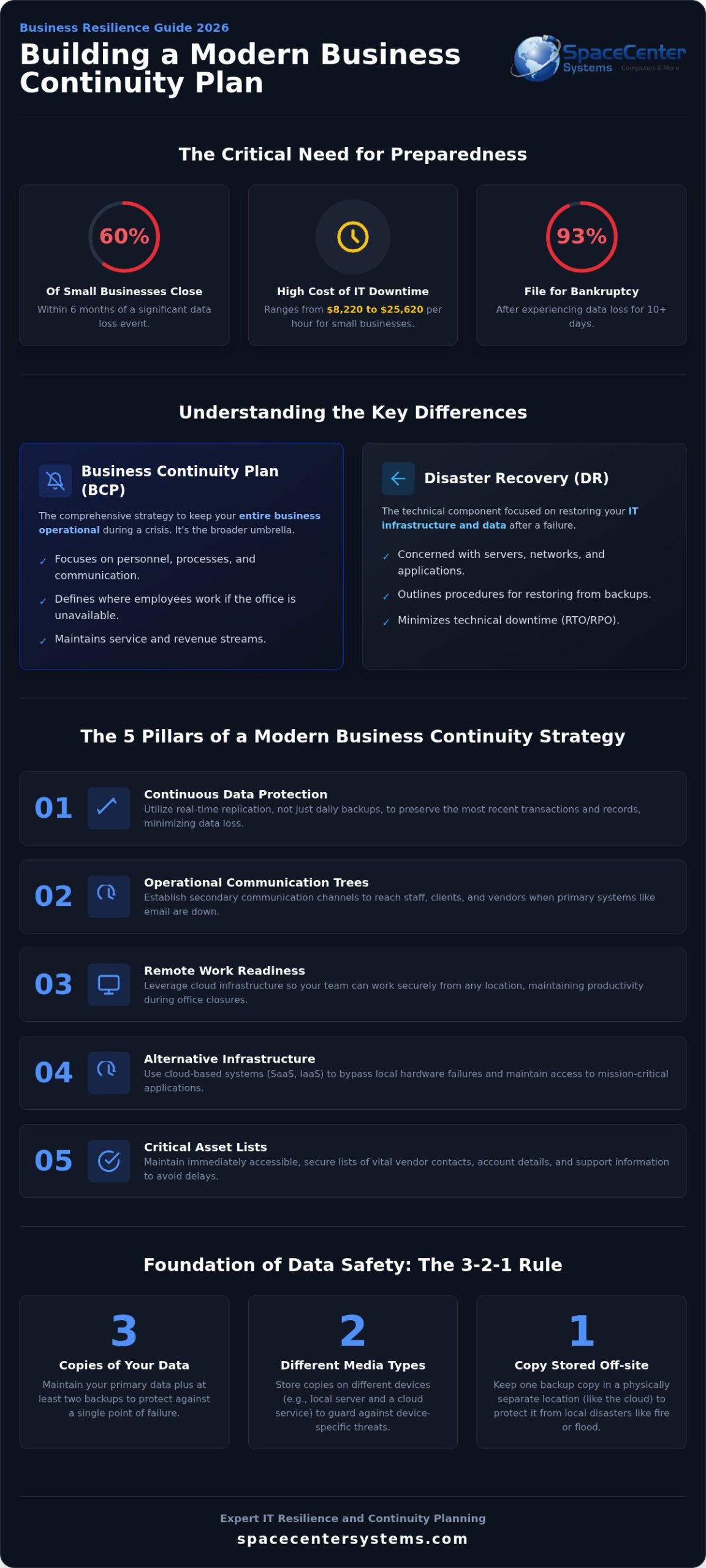
The financial impact of a shutdown is often more severe than the physical damage itself. Research shows the average cost of IT downtime for small businesses ranges from $8,220 to $25,620 per hour. For a medical clinic or a property management office in Brazoria County, losing access to patient records or tenant portals for even half a day can result in thousands of dollars in lost revenue and lasting damage to client trust. Beyond the immediate loss, 93% of companies that experience data loss for 10 or more days file for bankruptcy within a single year. We believe proactive preparedness is the only way to avoid becoming part of that statistic.
BCP vs. Disaster Recovery: Knowing the Difference
It’s common to confuse these two terms, but they serve different roles in your resilience strategy. Disaster Recovery focuses on the technical side, specifically how you restore your IT infrastructure and data from backup-solutions after a failure. Business Continuity is the broader umbrella. It covers how your personnel communicate, where they work if the office is inaccessible, and how you maintain service to your customers while the tech is being fixed. You need both to be truly resilient in 2026.
The Local Risk Profile for Brazoria County Businesses
Living on the Gulf Coast means we face unique challenges that generic plans often overlook. Our local risk profile includes seasonal hurricane threats and localized flooding that can cut off physical access to your business. Additionally, our regional power grid can be unpredictable during extreme weather, leading to sudden outages that corrupt data. Digital threats are also rising, with 44% of organizations now identifying cybersecurity as the biggest threat to their continuity. We have seen how ransomware can paralyze a local firm just as effectively as a flood, making a localized approach essential for survival.
The 5 Essential Pillars of a Modern Business Continuity Strategy
Building a business continuity plan Pearland organizations can rely on requires a shift in mindset. It isn’t enough to simply have a backup of your files. You must have a strategy that keeps your team working even when your primary infrastructure fails. A modern strategy rests on five essential pillars designed to maintain operational momentum:
- Continuous Data Protection: Utilizing real-time replication to preserve the most recent transactions and records.
- Operational Communication Trees: Establishing secondary channels to reach staff and clients when primary email is down.
- Remote Work Readiness: Leveraging cloud-infrastructure-management so your team can work securely from any location.
- Alternative Infrastructure: Using cloud-based systems to bypass local hardware failures during office closures.
- Critical Asset Lists: Maintaining immediate access to vital vendor information and account details.
Continuous data protection moves beyond daily snapshots. It ensures that your most recent records are preserved even if a server crashes mid-afternoon. To make this effective, your team needs remote work readiness. If localized flooding or a prolonged power outage makes your office unusable, your staff can transition to their homes without losing access to mission-critical applications. Finally, keeping an updated list of critical assets and third-party vendors ensures you don’t waste precious time hunting for account numbers or support contacts during a crisis.
High-Availability Data and Backup Solutions
We recommend that local firms follow the 3-2-1 backup rule. This strategy involves maintaining three copies of your data on two different media types, with at least one copy stored offsite. Utilizing cloud-storage-and-backup-solutions provides the geo-redundancy needed to protect your data from regional threats like hurricanes. For added security, we implement immutable backups. Immutable backups are a specialized defense against ransomware because the data cannot be altered or deleted for a set period after it is written. If you haven’t reviewed your current strategy recently, our 90-day IT assessment program can help identify potential gaps in your data redundancy.
Communication and VoIP Failover
Communication is often the first thing to fail during a disaster. When your physical office closes, business continuity and disaster recovery protocols should include a robust VoIP failover system. This technology ensures your phones keep ringing by routing calls to softphones or mobile apps. Your customers stay connected to your team, and your staff can provide support from any location with an internet connection. You should also utilize Ready.gov’s business continuity resources to help build emergency notification trees. These trees ensure that every employee and key vendor receives timely updates via text or secondary channels when your primary email system is down. When refining your business continuity plan Pearland businesses should ensure their communication failover is tested regularly.
Assessing Your Risk: Industry-Specific Continuity Needs
A generic checklist from a search engine often fails because it ignores the unique operational requirements of your specific industry. A business continuity plan Pearland businesses implement must be as specialized as the services they provide. For instance, a law firm’s primary concern might be protecting billable hours and client confidentiality. Conversely, a local manufacturer focuses on supply chain logistics and machinery uptime. If your plan doesn’t account for these nuances, it won’t provide the stability you need during a crisis.
Continuity for Pearland Healthcare Practices
Healthcare providers face the added pressure of maintaining HIPAA compliance even when their primary systems are offline. Accessing Electronic Medical Records (EMR) is mission-critical for patient safety. Your healthcare-it-support strategy should include encrypted, offline access to essential patient data and redundant power for onsite medical equipment. We recommend consulting a business continuity plan resource to understand the baseline requirements for emergency operations. However, a local partner can help you implement the specific network monitoring and system health dashboards required to ensure your clinic remains compliant and functional.
Property Managers and Apartment Communities
For property managers, a disaster isn’t just an IT issue; it’s a resident safety concern. Security remains the priority. When the power fails or the internet goes dark, your surveillance and access control systems must remain operational. A robust plan includes protocols for gate access and intercom systems to prevent residents from being locked out or left vulnerable. Utilizing unified communication platforms allows you to send real-time updates to your entire community. This keeps them informed and calm during regional disasters.
Professional services firms, such as accounting or legal offices, rely heavily on constant connectivity. A few hours of downtime doesn’t just halt work; it erodes client trust and risks the loss of sensitive data. Your plan should prioritize secure, remote access to case files and financial records. This allows your team to maintain productivity from any location. It ensures that even if your Pearland office is inaccessible, your billable hours and client commitments remain protected. Developing a customized business continuity plan Pearland professionals can depend on is the most effective way to safeguard these critical assets.
Building and Testing Your Resilience Framework
Creating a business continuity plan Pearland executives can rely on requires a structured approach that moves beyond theory into practical application. The first step is conducting a Business Impact Analysis (BIA). This process identifies your mission-critical functions and the consequences of their disruption. Once you understand which departments must remain active at all costs, you can document specific names, roles, and backup personnel. Clear ownership ensures that when a crisis hits, your team knows exactly who is authorized to make decisions without waiting for a chain of command that might be offline.
Setting Your Recovery Metrics: RTO and RPO
Recovery Time Objective (RTO) is the maximum tolerable duration of downtime your business can sustain before experiencing significant loss. While RTO focuses on time, Recovery Point Objective (RPO) focuses on data. It defines how much data your business can afford to lose, measured in time from your last successful backup. Every minute counts. Balancing these recovery speeds with your budget is a critical part of the planning phase. Faster recovery often requires more advanced infrastructure, so we help you prioritize resources where they matter most.
The Power of Tabletop Testing
A plan that sits in a binder is just an assumption. We recommend executing “Tabletop Exercises” to simulate real-world scenarios, such as a “Monday Morning Hurricane” or a localized power grid failure. During these sessions, your leadership team walks through the response steps to identify gaps in communication or authority. These exercises are particularly effective for uncovering how a mock cyberattack would disrupt your ability to serve clients. Every simulation provides valuable insights that we use to refine your disaster-recovery-planning document.
Resilience is not a one-time project. Your business continuity plan Pearland strategy must be reviewed and updated quarterly. New staff, updated software, and evolving cybersecurity threats mean your plan needs regular attention to stay effective. By keeping this framework current, you ensure that your business remains stable and supported through any challenge the 2026 landscape presents.
Schedule a consultation to build your resilience framework
Partnering with a Local IT Authority for Continuity
When a regional disaster strikes, national IT firms often struggle with the “last mile” of recovery. They don’t understand the specific nuances of Brazoria County infrastructure or which Pearland neighborhoods are most prone to prolonged utility outages. A business continuity plan Pearland organizations can truly depend on requires a partner who is physically present in the community. At SpaceCenter Systems, we’ve spent over 25 years navigating the unique challenges of the Houston area, ensuring our clients have the on-site support they need when remote tools aren’t enough.
Proactive management is the foundation of resilience. Our managed IT services provide the 24/7 network monitoring and system health dashboards required for early threat detection. By identifying a hardware failure or a security breach before it escalates, we can trigger your continuity protocols instantly. This level of vigilance allows us to integrate your BCP into a broader cybersecurity strategy, protecting your business from both environmental disasters and digital predators.
SpaceCenter Systems: Your Local Continuity Partner
Since our founding in 1995, we’ve established ourselves as a pillar of the local business community. We don’t operate like a faceless corporation; instead, we provide neighborly, approachable support backed by rigorous technical standards. Our team possesses specialized expertise in mission-critical environments, including healthcare clinics and multi-family housing communities. When you partner with us, you gain direct access to a Pearland-based technical team that understands your facility’s specific layout and operational needs. We’ve grown alongside the regional economy and possess the specific experience to resolve technical challenges quickly.
Next Steps: The 90-Day IT Needs Assessment
The best way to begin your journey toward resilience is by identifying your current vulnerabilities. Our 90-day IT assessment program is designed to uncover hidden continuity gaps in your infrastructure. We evaluate your current backup frequency, communication failovers, and remote access security to build a comprehensive roadmap for your future. This assessment provides the data-driven insights needed to create a customized business continuity plan Pearland owners can use to guarantee long-term stability and peace of mind.
Schedule your consultation today to secure your business’s future
Securing Your Pearland Business for the Road Ahead
Resilience isn’t a one-time project; it’s a commitment to your staff, your clients, and your community. By focusing on the five pillars of continuity and establishing clear recovery metrics like RTO and RPO, you move beyond simple backups to a state of total operational readiness. Whether you’re managing a specialized healthcare practice or a busy apartment community, your strategy must reflect the unique infrastructure and risks of the Brazoria County area.
SpaceCenter Systems brings over 25 years of local experience to every partnership. We specialize in protecting healthcare and multi-family housing environments with 24/7 proactive monitoring and dedicated support. Our team ensures that a business continuity plan Pearland professionals trust is always in place, shielding you from the high cost of downtime and the stress of uncertainty. We’ve grown alongside this regional economy and understand exactly what it takes to keep your doors open when others are forced to close.
Schedule a Business Continuity Consultation with SpaceCenter Systems
We’re ready to help you build a stable, supported future where your technology works as hard as you do. Let’s start building your resilience today to ensure your business remains a pillar of our community for years to come.
Frequently Asked Questions
What is the difference between a backup and a business continuity plan?
A backup is simply a copy of your data, whereas a business continuity plan Pearland businesses use is a comprehensive strategy for maintaining operations during a crisis. Backups help you recover lost files, but a BCP ensures your staff can communicate and serve clients even if your primary office is inaccessible. It addresses personnel roles, alternative work locations, and the specific steps required to keep your revenue flowing while your technical infrastructure is restored.
How often should a Pearland business update its BCP?
We recommend that you review and update your plan at least quarterly. Technology environments and staff roles change quickly, and an outdated plan can lead to confusion during an emergency. You should also trigger a review whenever you implement new software, move offices, or experience growth. Regular updates ensure that your contact lists, recovery procedures, and security protocols remain effective against current threats like ransomware or the unpredictable Gulf Coast weather.
What are RTO and RPO, and why do they matter for my IT budget?
Recovery Time Objective (RTO) is the maximum time your business can stay offline, while Recovery Point Objective (RPO) defines how much data you can afford to lose. These metrics are the foundation of your IT budget because they determine the level of redundancy you need. For example, a healthcare practice requiring near-zero downtime will invest more in real-time replication compared to a local firm that can tolerate a few hours of disruption.
Can a small business in Pearland afford a professional continuity plan?
Yes, a professional continuity plan is a scalable investment that prevents the devastating financial impact of a shutdown. Research indicates that the average cost of IT downtime for small businesses can exceed $8,000 per hour. By working with a local provider, you can build a plan that prioritizes your most critical functions first. This approach allows you to manage risks effectively without the overhead of maintaining a massive, internal corporate IT department.
How does a BCP help during a ransomware attack?
A BCP provides a clear roadmap for isolating infected systems and restoring operations from immutable backups. Instead of negotiating with attackers, your team follows a documented process to verify data integrity and bring systems back online. This proactive approach minimizes the duration of the attack and prevents the permanent data loss that often follows a security breach. It ensures your business remains stable and supported throughout the recovery process without paying a ransom.
Does my insurance require a documented business continuity plan?
Many modern cyber insurance providers now require a documented business continuity plan before they will issue or renew a policy. Insurance companies want to see that you have taken active steps to mitigate risk and minimize potential claims. Having a verified plan in place can also help you secure better coverage terms. It serves as professional proof that your organization is prepared to handle disruptions efficiently and maintain your operational integrity.
What happens to my VoIP phone system if my Pearland office loses power?
Your VoIP phone system will remain functional because it operates in the cloud rather than on a physical server in your office. If your Pearland location loses power, calls can be instantly routed to mobile apps on staff smartphones or to secondary locations. This ensures that your customers can still reach you and your team can maintain support services. You won’t miss critical calls just because the local utility grid is currently down.
How do I start a BCP if I don’t have an internal IT department?
The best way to start is by partnering with a local managed IT services provider like SpaceCenter Systems. We help organizations without internal technical staff build and maintain professional resilience strategies. Our 90-day IT assessment program identifies your current vulnerabilities as a first step. From there, we design a plan that includes proactive network monitoring and 24/7 helpdesk support to keep your operations running smoothly through any challenge your business might face.