


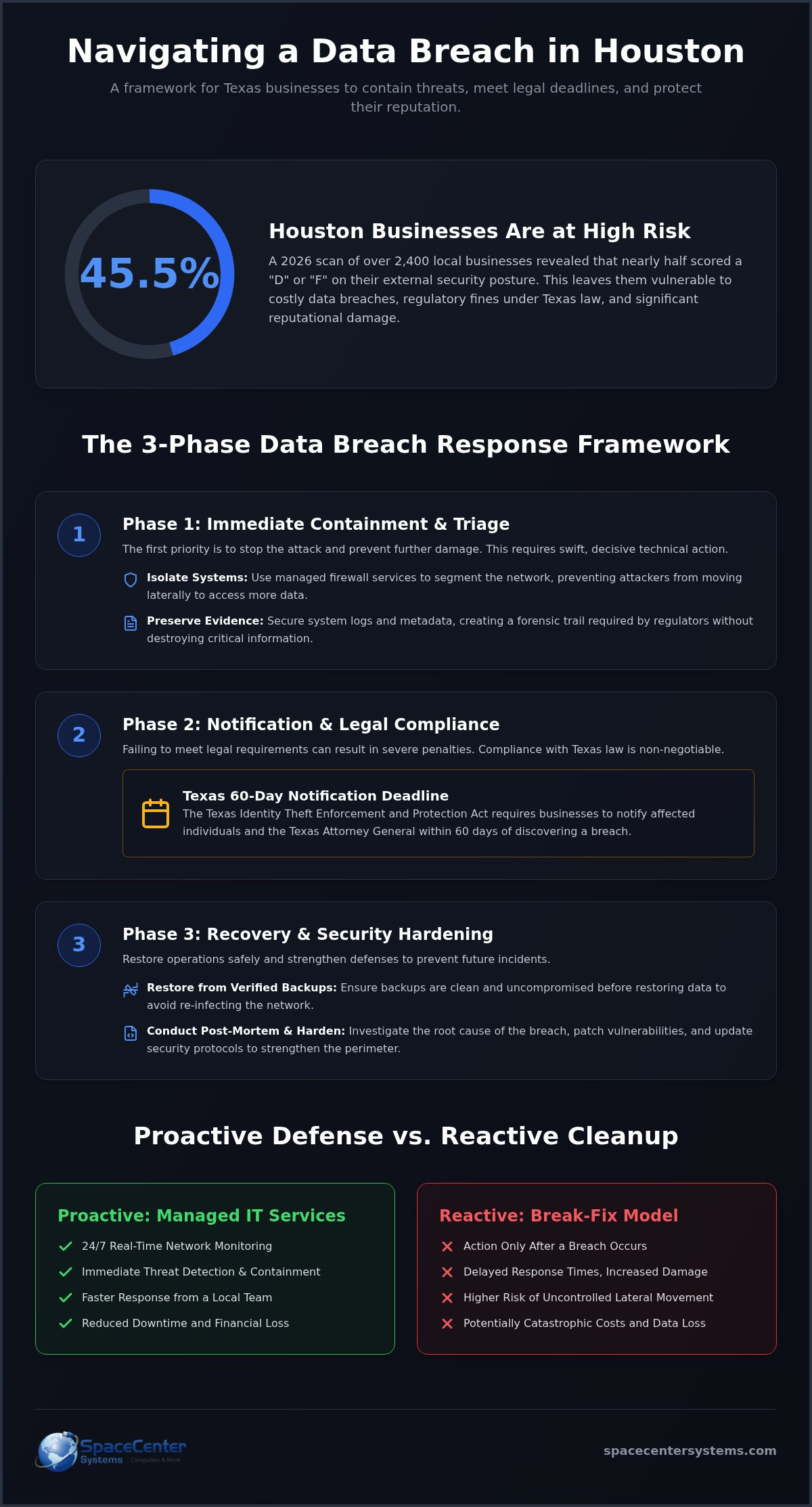
A 2026 scan of over 2,400 Houston area businesses revealed that 45.5% scored a “D” or “F” on their external security. For many local owners, the fear of a data breach isn’t just about lost files; it’s the very real threat of Texas regulatory fines and the damage to a reputation built over decades. You likely feel the pressure to keep up with evolving threats while managing daily operations. It’s frustrating to face technical containment hurdles and legal notification deadlines at the same time.
SpaceCenter Systems understands this burden because we’ve served this community for over 25 years. We’re providing this guide to help you build a localized, compliant response plan that secures your future. By integrating professional managed firewall services Houston businesses can rely on, you’ll gain the technical authority needed to stop attacks before they escalate. We’ll walk you through a clear step by step framework for breach containment, explain the 60 day notification requirements for the Texas Attorney General, and show you how a local team provides the stability your business deserves.
Key Takeaways
- Learn how a documented Data Breach Response Plan protects your Houston firm from the escalating costs of network downtime and reputation loss.
- Discover how to use managed firewall services Houston to isolate compromised systems and stop attackers from moving laterally through your office network.
- Master the legal requirements of the Texas Identity Theft Enforcement and Protection Act, including the critical 60-day notification deadline for affected individuals.
- Establish a secure recovery process that utilizes verified backup solutions to restore operations without the risk of re-infecting your systems.
- Understand why a local IT partner with a 24/7 helpdesk is essential for immediate technical triage and long-term security hardening in specialized industries.
What is a Data Breach Response Plan and Why Does Your Houston Business Need One?
A Data Breach Response Plan (DBRP) is a documented strategy designed to help your business identify, contain, and recover from unauthorized data access. It isn’t just a file sitting on a shelf. It’s a technical drill that ensures your team knows exactly how to react when a security event occurs. For Houston firms, every hour of network inactivity can cost thousands in lost revenue and productivity. You can’t afford to wait until a breach happens to decide who to call. By integrating managed firewall services Houston, you establish a proactive defense that minimizes these risks from the start.
Many business owners in Pearland and Sugar Land believe they aren’t targets for sophisticated cybercriminals. This is a dangerous misconception. Hackers often target smaller firms because they assume security is weaker and response times are slower. Professional managed firewall services Houston businesses utilize act as the first line of defense in any effective plan. These services create a hardened perimeter that stops intruders before they reach your sensitive data, providing the peace of mind you need to focus on your operations.
The 2026 Threat Landscape for Texas Small Businesses
Cybercriminals are increasingly using AI to create highly personalized phishing campaigns that can deceive even cautious employees. Research shows that 36% of all data breaches now start with phishing. Houston accounting and legal firms are prime targets because they handle high-value client data that is easily monetized. Localized ransomware attacks are also on the rise across the Greater Houston area, often exploiting unpatched vulnerabilities in your network. For a deeper look at building business strength, review our Cybersecurity for Small Business in Houston guide to stay ahead of these evolving threats.
Managed IT vs. Break-Fix: The Response Plan Difference
Relying on a break-fix model is a gamble you won’t win during a data breach. If you only call for help when something breaks, you’re already behind the clock. A comprehensive incident response plan requires immediate action to prevent lateral movement within your network. Proactive network monitoring allows us to detect threats in real time through system health dashboards, often stopping a breach before it starts. As a local partner with over 25 years of experience, we provide a faster physical response than any national, faceless helpdesk. We understand the Houston regulatory landscape and ensure your systems remain stable, supported, and secure.
Phase 1: Immediate Containment and Technical Triage
When a security event occurs, your primary goal is to stop the bleeding. You must immediately identify the source of the breach to prevent further damage. This often involves tracking down compromised user credentials or closing an unsecured Wi-Fi access point that served as a backdoor. Once you know where the intruder is, you have to lock them out. We use managed firewall services Houston to isolate infected segments of your network. This containment prevents lateral movement, ensuring a single compromised workstation doesn’t lead to a full server takeover. Without this isolation, an attacker can move freely through your infrastructure, escalating their privileges and accessing your most sensitive client data.
Preservation of evidence is just as important as containment. Texas regulators often require a forensic trail to determine the extent of the data loss and confirm whether sensitive personal information was accessed. Following the FTC’s guide for business ensures you don’t inadvertently destroy logs or metadata that reveal what was stolen. Our 24/7 technical triage team is ready to step in at this stage to stabilize your environment. We focus on securing the scene while preparing for a full investigation, giving you the technical authority needed to satisfy legal requirements.
Securing the Network Perimeter
To harden your defense during an active incident, your technical team should execute several critical tasks. First, disable all compromised user accounts and force a network-wide password reset for all administrative roles. Next, review your firewall logs to determine the intruder’s exact entry point and the duration of their access. This data is vital for understanding the scope of the breach. Finally, verify that your primary and secondary backup solutions are logically isolated from the infected network. If your backups are connected to the main network during a ransomware attack, the intruder may encrypt them, leaving you with no way to restore your business without paying a ransom.
The Role of Your Local Helpdesk
A local partner provides a level of coordination that national providers simply can’t match. During a cybersecurity emergency, our on-site and remote IT support teams work in tandem to secure your hardware and cloud assets. We also guide your internal communication strategy. It’s vital to inform employees about the situation without causing panic or accidentally leaking details that could hamper a criminal investigation. Triage is the process of prioritizing system restoration based on business criticality. To ensure your network remains resilient against future threats, consider scheduling a 90-day IT assessment to identify hidden vulnerabilities before they can be exploited.
Phase 2: Notification and Compliance with Texas Privacy Laws
Once the technical containment is handled by your managed firewall services Houston team, the focus shifts to your legal obligations. In Texas, the Identity Theft Enforcement and Protection Act (ITEPA) dictates your response. You don’t have months to decide on a course of action. Texas law requires you to notify affected individuals without unreasonable delay, and absolutely no later than the 60th day after determining a breach occurred. Failing to meet this window can lead to significant penalties from state regulators. This deadline is a hard limit, not a suggestion, and it applies to any business that experiences unauthorized access to sensitive personal data.
In Texas, Personally Identifiable Information (PII) includes a resident’s name paired with their social security number, driver’s license number, or financial account details. For professional services in Houston, this might include sensitive client files or payroll records. If your breach affects 250 or more Texas residents, you’re legally required to notify the Texas Attorney General within that same 60-day window. Following the FTC’s Data Breach Response Guide helps ensure your reporting is thorough and compliant. It’s essential to document every step of your response to show regulators that you’ve acted in good faith and with due diligence.
Healthcare IT and HIPAA Compliance in Houston
Medical clinics and dental practices in the Houston area face even stricter scrutiny. Under HIPAA, you must distinguish between a minor security incident and a reportable breach. Reportable breaches involving protected health information require notification to the Department of Health and Human Services. Our healthcare IT support ensures you maintain the precise audit trails needed for these federal requirements. Senior living facilities also rely on these logs to prove compliance during annual audits or post-breach investigations. Having a local partner who understands these triggers is critical for avoiding federal fines that can cripple a small practice.
Communicating with Affected Stakeholders
Transparency is the best way to preserve your reputation in communities like Sugar Land or League City. Your notification letters should be clear, professional, and empathetic. Don’t hide behind technical jargon. Explain what happened, what data was involved, and what steps you’ve taken to secure the environment. Offering credit monitoring or identity protection services is a proactive way to show you value your clients’ security. This approach maintains the trust you’ve built over years of local service. While managed firewall services Houston providers handle the technical side, your communication strategy handles the human side of the crisis.
Phase 3: Recovery, Investigation, and Hardening the Perimeter
Recovery begins with a thorough root-cause analysis. You can’t just flip the switch back on. You must ensure the intruder is fully evicted from your Houston office network. We look for persistent backdoors or hidden scripts that could trigger a second wave of attacks. Once the environment is verified as clean, we restore data from your backup solutions. We don’t just pull files; we verify their integrity to avoid re-infection. If your primary backups were compromised during the attack, we pivot to air-gapped or immutable copies to ensure a successful restoration. Implementing Multi-Factor Authentication (MFA) and zero-trust protocols across all business applications is the next mandatory step. This ensures that even if a password is stolen, your data remains locked behind a second layer of verification. Finally, we update your response plan based on lessons learned to prevent a repeat incident. Integrating managed firewall services Houston businesses rely on helps automate this hardening process.
Business Continuity and Disaster Recovery (BCDR)
Effective disaster recovery planning minimizes long-term downtime and keeps your business operational. We test restoration speeds to ensure we meet your specific Recovery Time Objectives (RTO). This is the maximum time your business can afford to be offline before the financial impact becomes catastrophic. If your local hardware is damaged or compromised, we leverage cloud storage and backup solutions for redundant, off-site data protection. This redundancy is what keeps a local firm running when others are forced to close their doors. We focus on getting your team back to work quickly and securely.
Employee Training and Network Hardening
Hardening your perimeter requires looking at both digital and physical vulnerabilities. We conduct a post-breach cybersecurity assessment to identify any remaining weak points in your infrastructure. This includes security awareness training for your staff in Pasadena or Friendswood. Since 36% of data breaches start with phishing, your employees are your most important firewall. We also evaluate your physical infrastructure. Upgrading structured cabling and access control systems prevents unauthorized physical access to your server room. Professional managed firewall services Houston providers ensure these technical details are managed with precision to prevent future gaps.
Strengthen your business continuity plan today.
Building Your 2026 Data Breach Response Plan with SpaceCenter Systems
SpaceCenter Systems doesn’t believe in one-size-fits-all security. A healthcare clinic in the Medical Center has different regulatory needs than a property management firm in Pearland. We build customized response plans that account for these specific industry nuances. By combining robust IT infrastructure with managed firewall services Houston, we create a unified defense for your business. Our 24/7 proactive managed IT services detect anomalies through system health dashboards before they can escalate into a full-scale crisis. With over 25 years of local reliability, we’ve grown alongside the regional economy. We understand that for a small business, a data breach isn’t just a technical glitch; it’s a threat to your livelihood.
Our integrated approach ensures that every part of your technology stack works together. We bridge the gap between IT infrastructure and physical security, offering a comprehensive view of your environment. This includes everything from email security to surveillance systems. You gain a seasoned local authority as a partner, providing the stability and support needed to project absolute reliability to your own clients. We don’t just fix problems. We prevent them by maintaining a realistic and grounded perspective on the threats facing our community.
The 90-Day IT Needs Assessment Program
Our 90-day IT assessment is the foundation of a resilient business. We don’t just look at software. We review your entire network health, backup integrity, and current security protocols with a local expert. This program identifies hidden vulnerabilities in your existing response plan that could lead to costly downtime. We provide a clear roadmap for scalable growth, ensuring your technology supports your goals rather than hindering them. It’s a pragmatic approach designed for logical decision-makers who value transparency and stability.
Why a Local Houston Partner Matters
Proximity is a critical asset during a network emergency. When your systems are down, you don’t want to wait for a technician flying in from another state. Our team can be on-site in Sugar Land, League City, or Pasadena within hours to resolve mission-critical issues. We focus on practical, business-focused solutions that reflect our roots in the community. You get a partner who understands the Houston regulatory landscape and the specific challenges of our regional economy. Whether you’re hardening your managed firewall services Houston or upgrading your business phones, we provide the personalized support you deserve. Contact SpaceCenter Systems today to schedule your comprehensive cybersecurity review.
Securing Your Business Future in Houston
Protecting your organization from the devastating costs of a data breach requires more than just a document. It demands a technical drill backed by professional managed firewall services Houston businesses can rely on to isolate threats in real time. We’ve explained how staying compliant with the Texas Identity Theft Enforcement and Protection Act’s 60 day notification rule protects your reputation and your bottom line. By prioritizing containment and recovery today, you prevent the chaos of an unmanaged crisis tomorrow.
SpaceCenter Systems provides the stability and support you need to navigate these complexities. With over 25 years of local Houston experience, we’ve developed specialized expertise for healthcare clinics and property managers who face unique regulatory pressures. Our 24/7 proactive network monitoring and helpdesk ensure that your systems remain secure and operational around the clock. We’re proud to serve as a pillar of the community, helping our peers succeed through reliable technology.
Schedule Your 90-Day IT Needs Assessment Today
You don’t have to manage these technical challenges alone. We’re here to serve as your seasoned local partner and provide the peace of mind you deserve.
Frequently Asked Questions
What is the first thing a Houston business should do after a data breach?
The first step is to contain the breach to stop ongoing data loss. Isolate affected systems immediately from the rest of your network. You shouldn’t shut down servers entirely as this can destroy forensic evidence. Instead, disconnect them from the internet and your internal local area network. Contact your IT partner to begin technical triage and secure your perimeter before unauthorized access spreads to other sensitive company files or client records.
How long does a company have to report a data breach in Texas?
Under the Texas Identity Theft Enforcement and Protection Act, you must notify affected individuals no later than the 60th day after determining a breach occurred. If the incident impacts 250 or more Texas residents, you’re also required to notify the Texas Attorney General within that same 60 day window. Failing to meet these strict deadlines can result in heavy state level fines and increased legal liability for your local business.
Does my small business in Pearland really need a formal response plan?
Yes, every small business in Pearland needs a formal response plan to manage risk and maintain compliance. Small firms are often targeted because hackers assume their defenses are weaker. Having a plan in place before a breach occurs can qualify you for the Texas SB 2610 safe harbor, which provides protection from punitive damages. It ensures your team knows exactly how to respond without wasting precious time during a high stress event.
What is the difference between a data breach and a security incident?
A security incident is any event that threatens the integrity or availability of your network, such as a failed login attempt or a malware detection. A data breach is a specific type of incident where unauthorized access to sensitive personal information is confirmed. While every breach is an incident, not every incident results in a breach. Distinguishing between the two is critical for determining whether you have a legal obligation to notify regulators.
Can managed firewall services Houston prevent data breaches entirely?
No security solution can guarantee 100% protection, but managed firewall services Houston businesses utilize significantly reduce the likelihood of a successful attack. These services provide active perimeter defense and deep packet inspection to block known threats. By monitoring your traffic 24/7, a managed firewall identifies suspicious patterns and allows for immediate containment. This proactive layer of cybersecurity is your best defense against unauthorized access and lateral movement within your office network.
Is a data breach response plan required by HIPAA for healthcare offices?
Yes, the HIPAA Security Rule requires healthcare providers to have formal procedures for responding to security incidents. This includes identifying, containing, and documenting any unauthorized access to protected health information. For Houston medical clinics and dental practices, a documented plan isn’t just a best practice; it’s a federal requirement. Failing to maintain these audit trails and response protocols can lead to massive HIPAA violations and the loss of patient trust.
What are the most common causes of data breaches for Houston businesses in 2026?
In 2026, phishing remains the leading cause of data breaches, accounting for 36% of all recorded incidents. Cybercriminals are now using AI to create highly personalized messages that are difficult for employees to spot. Other common causes include the use of compromised credentials and unsecured third party vendor access. Houston businesses often face these threats through social engineering or unpatched software vulnerabilities that allow attackers to bypass traditional perimeter security measures.
How often should we test our data breach response plan?
You should test your response plan at least once a year through tabletop exercises or simulated drills. It’s also important to review and update the plan after any major change to your IT infrastructure, such as moving to a new office or migrating to the cloud. Regular testing ensures that your staff understands their roles and that your technical containment strategies, like those provided by managed firewall services Houston, are still effective against current threats.