


A single click from a distracted employee on a Monday morning can bypass millions of dollars in security software and hand the keys to your company’s bank account directly to a cybercriminal. You’ve likely felt that knot in your stomach every time a news report breaks about another local data breach or a Business Email Compromise (BEC) attack costing a neighbor their livelihood. It’s frustrating to invest in technology only to feel like your team is still one wrong choice away from a catastrophe. We know that effective phishing prevention for businesses Houston requires more than just a generic filter. It demands a layered defense built for the specific threats our local economy faces in 2026.
This guide provides a clear, actionable roadmap to secure your organization and significantly reduce your risk of a data breach. We’ll walk you through a comprehensive strategy that bridges the gap between AI-driven technical controls and local human accountability. From evaluating your current email security to implementing proactive network monitoring, you’ll gain the insights needed to protect your assets. By the end of this checklist, you’ll have a reliable plan that brings stability to your operations and lets you focus on growing your business instead of fearing your inbox.
Key Takeaways
- Identify how AI-generated deepfakes and hyper-personalized spear phishing have evolved to target Houston’s specific energy and healthcare sectors.
- Follow a step-by-step roadmap for phishing prevention for businesses Houston, beginning with a professional cybersecurity assessment to uncover hidden network vulnerabilities.
- Learn why a layered defense must bridge the gap between digital email security and physical access control systems to stop sophisticated “tech support” walk-in scams.
- Establish a clear response protocol for immediate device containment and session revocation to minimize financial loss if a malicious link is clicked.
- Understand the advantage of partnering with a local IT authority that offers proactive network monitoring and 30 years of experience in the regional threat landscape.
The Evolution of Phishing: Why Houston Businesses are Targets in 2026
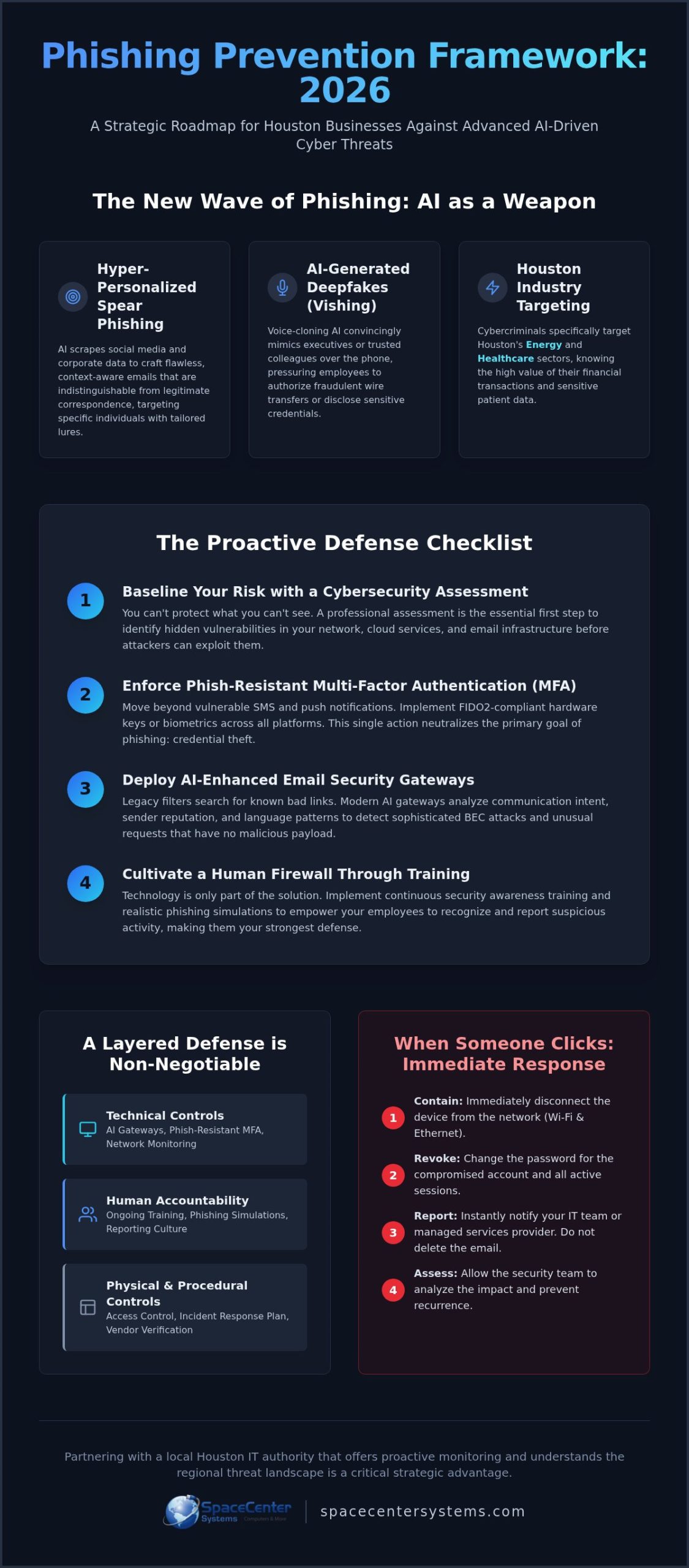
The days of spotting a phishing attempt by its poor spelling and broken English are over. In 2026, cybercriminals use advanced Large Language Models (LLMs) to craft emails that are indistinguishable from professional corporate correspondence. These attackers have moved beyond broad, generic campaigns to hyper-personalized spear phishing and AI-generated deepfakes that can mimic the voice or face of a trusted executive. In the 2026 Houston business environment, spear phishing is a highly targeted cyberattack where a criminal uses stolen personal or professional details to craft a convincing message aimed at a specific individual within a local organization.
Houston is a global hub for energy and healthcare, making our local economy a primary target for Business Email Compromise (BEC). Attackers know that a single fraudulent wire transfer in the oil and gas sector or a breached patient database in the Texas Medical Center can yield massive payouts. We’ve seen a sharp rise in “local impersonation” scams where an attacker might pose as a well-known vendor from Sugar Land or a logistics partner in Pearland. They use familiar names and local references to lower your guard. This regional focus is why effective phishing prevention for businesses Houston must account for the specific industries and geographical nuances of our community.
The Rise of AI-Driven Phishing in Texas
The Real Cost of a Breach in the Greater Houston Area
A successful phishing attack does more than drain a bank account. For local firms, the long-term reputation damage can be far more costly than the initial financial loss. Trust is hard to rebuild. If your clients can’t trust you with their data, they’ll find a partner who takes cybersecurity seriously. For healthcare providers and legal offices, the stakes are even higher. A breach often leads to severe compliance implications under HIPAA or state privacy laws, resulting in heavy fines and mandatory audits. Implementing comprehensive phishing prevention for businesses Houston isn’t just about software; it’s about safeguarding your professional standing in a competitive market. Understanding the real cost of downtime is the first step toward building a resilient defense.
The 2026 Phishing Prevention Checklist for Houston Business Owners
Securing a modern organization requires a shift from reactive patching to proactive strategy. In 2026, the complexity of attacks means you can’t rely on a single software solution. This checklist serves as a roadmap for robust phishing prevention for businesses Houston, ensuring your team and technology work in tandem to repel threats.
- Step 1: Baseline Your Risk. You can’t fix what you haven’t measured. Start with a comprehensive cybersecurity assessment in Houston to identify where your current defenses are most vulnerable to modern exploits.
- Step 2: Enforce Phish-Resistant MFA. Standard multi-factor authentication using SMS or simple push notifications is no longer enough. Implement FIDO2-compliant, hardware-based, or biometric MFA across all cloud platforms to neutralize credential theft.
- Step 3: Deploy AI-Enhanced Gateways. Traditional filters look for bad links; modern gateways analyze communication intent. These systems flag unusual requests, such as a sudden change in wire transfer instructions, even if the email comes from a “clean” domain.
- Step 4: Build a Human Firewall. Technology is your first line of defense, but your employees are the last. Establish recurring security awareness training to keep your staff sharp against evolving social engineering tactics.
Technical Infrastructure Audit
Your backend configuration often determines whether a spoofed email reaches an inbox or the junk folder. Verify that your DMARC, SPF, and DKIM records are correctly configured to prevent attackers from using your own domain against you. Regularly audit server management logs to spot unauthorized access patterns or unusual login locations. Additionally, ensure all networking equipment is running the latest firmware with legacy protocols disabled to close entry points for lateral movement within your office.
Employee Protocol and Policy Review
Human error is often a result of poor process rather than lack of care. Create a strict “Verification Protocol” requiring a secondary communication channel, like a phone call or in-person confirmation, for any financial changes. Foster a “No-Blame” reporting culture where employees feel safe reporting a suspicious click immediately. This transparency allows your IT team to contain threats before they spread. Scheduling quarterly phishing simulations that mimic real Houston business scenarios helps maintain this vigilance. If you’re unsure where to start, an IT consulting session can help tailor these policies to your specific operational needs.
Layered Defense: Integrating Digital and Physical Security
A sophisticated phishing attack often serves as the reconnaissance phase for a larger physical security breach. Cybercriminals may use a successful email lure to learn your office layout or the names of your on-site maintenance staff. This is why phishing prevention for businesses Houston must extend beyond the computer screen. When a digital “tech support” scam fails, attackers sometimes attempt a physical walk-in, betting that your staff will be more trusting in person. Integrating your IT strategy with robust access control systems ensures that only authorized personnel can enter sensitive areas, effectively stopping social engineering attempts at the door.
Your physical environment can also inadvertently leak digital secrets. Modern security camera systems should be strategically positioned to monitor high-traffic areas and shared workspaces. This isn’t just about theft; it prevents “shoulder surfing” where visitors or unauthorized vendors might see passwords on a screen. Your VoIP phone systems require the same level of scrutiny as your email. Attackers often use “vishing” to manipulate employees into revealing credentials over the phone, making it vital to secure your communication infrastructure against external spoofing.
Securing the Remote and Hybrid Workforce
The boundary of your office has expanded. For Houston employees working from home in League City or Friendswood, the home network becomes a part of your corporate perimeter. We implement endpoint protection to ensure that a single compromised personal device doesn’t become a gateway to your servers. Field technicians and mobile staff must also use secure Wi-Fi protocols to prevent data interception in public spaces. Reliable cloud infrastructure management allows your team to access data securely from any location, maintaining a stable and protected environment regardless of where they log in.
Credential Protection Beyond the Inbox
Attackers are getting creative with “Quishing,” or QR code phishing. They place malicious codes in physical office spaces, such as on breakroom flyers or “tech support” stickers, hoping a curious employee will scan them. These physical traps are a growing part of the threat landscape, making phishing prevention for businesses Houston a multi-dimensional challenge. Use intercoms and gate technology to vet every visitor before they ever step foot in your building. A secure physical badge system acts as a prerequisite for digital safety; if an unauthorized person can’t reach a workstation, they can’t exploit the logged-in accounts of your staff.
Phishing Response Plan: What to Do When Someone Clicks
Even with a robust strategy for phishing prevention for businesses Houston, a single successful click can happen. When it does, your response speed determines whether the incident is a minor hiccup or a major disaster. The first priority is containment. You must immediately isolate the compromised device from your local network to prevent the threat from spreading to other workstations or your central server. Physically unplug the ethernet cable or disable the Wi-Fi on the affected machine.
A password reset is a necessary step, but it’s rarely enough on its own. For organizations using Microsoft 365 or Google Workspace, you must perform a global session revocation. This forces the attacker out by invalidating any active login tokens they may have stolen. If the phishing attempt was a precursor to ransomware, your backup solutions become your most valuable asset. Having an off-site, immutable backup allows you to restore your data without even considering a ransom payment. Texas law requires businesses to notify the Office of the Attorney General if a breach affects 250 or more residents; you should also contact local Houston law enforcement to document the crime for insurance purposes.
Incident Containment Steps
Effective containment relies on visibility. We use proactive network monitoring to trace the lateral movement of an attacker once they’ve gained an initial foothold. By reviewing system health dashboards, we can see which files were accessed and if data was exfiltrated. When handling a compromised account, disable the user’s access rather than deleting the account entirely. Deletion can destroy the forensic data needed to understand the scope of the breach. Clear communication is also vital. Inform your team about the incident immediately so they can stay vigilant, but keep the tone professional and calm to avoid unnecessary panic.
Recovery and Business Continuity
If a click leads to system-wide encryption, your disaster recovery planning must kick in instantly. This plan should outline the specific order of operations for restoring critical services to minimize downtime. Our helpdesk services provide rapid endpoint remediation, wiping infected machines and re-imaging them from clean backups. After the immediate threat is gone, conduct a “Post-Mortem” analysis. This deep dive identifies exactly where the layered defense failed and how to strengthen your phishing prevention for businesses Houston to prevent a recurrence. If you need immediate assistance with a suspected breach, contact our incident response team for professional support.
Why a Local Houston IT Partner is Essential for Phishing Prevention
Choosing a partner for phishing prevention for businesses Houston is a decision that impacts your organization’s long-term stability. While national helpdesks offer generic scripts, they often lack the contextual understanding of the local threat landscape. SpaceCenter Systems has been part of the Greater Houston community since 1995. Our 30-year history gives us unique insight into the specific tactics local threat actors use to target the energy, legal, and medical sectors in our region. When a suspicious email bypasses your filters, you need more than a ticket number; you need the neighborly warmth and absolute reliability of a local team that can provide on-site IT consulting in Pearland or Houston within hours, not days.
Managed IT Services: Proactive vs. Reactive
The traditional “Break-Fix” model is a dangerous strategy in 2026. If you only call for help after a phishing link has been clicked, the financial and reputational damage is already done. Our managed IT services shift the focus from reactive repairs to proactive defense. This model provides predictable security costs and ensures your systems are always patched and monitored. We provide customized security protocols for specialized sectors, such as healthcare IT support to maintain HIPAA compliance and manufacturing IT support to protect critical supply chain data. Proximity matters during a crisis, and having a local partner means your recovery is our priority.
Start Your Security Journey in Houston
Securing your business starts with understanding your current gaps. A professional network security audit reveals where your infrastructure is vulnerable to modern phishing exploits. We invite you to experience a more personalized level of support through our 90-Day IT Needs Assessment Program. This program provides a clear roadmap for your technology, moving you from uncertainty to a state of mission-critical reliability. You’ll gain the peace of mind that comes from knowing your organization is protected by 24/7 local monitoring and a team invested in your success. Whether you operate in Sugar Land, Pasadena, or the heart of Houston, schedule a consultation today to build a strategy that protects your peers and your profits.
Securing Your Houston Business for a Resilient 2026
The threat landscape of 2026 doesn’t wait for a convenient time to strike. Protecting your organization requires a shift from simple spam filters to a comprehensive strategy that integrates digital email security with physical access control systems. You’ve seen how AI can now mimic voices and faces; it’s time to build a defense that stands up to these sophisticated tactics. By following the roadmap we’ve discussed, you’re not just checking boxes. You’re building a culture of vigilance and stability that protects your bottom line and your employees.
Effective phishing prevention for businesses Houston is a collective effort. Since 1995, we’ve provided local support to our neighbors in Pearland, Sugar Land, and League City, helping them navigate technical complexities with confidence. Our 30 years of Houston IT experience ensures that your network monitoring and disaster recovery plans are built on a foundation of absolute reliability. Don’t leave your reputation to chance. Schedule Your 2026 Houston Cybersecurity Assessment to secure your organization today. We’re proud to be your local partner, and we look forward to helping your business thrive in a safer digital environment.
Frequently Asked Questions
How can I tell if an email is a phishing attempt in 2026?
Look for subtle inconsistencies in sender addresses and unexpected requests for sensitive data. Modern attempts use AI to create perfect grammar, so you must verify the “from” field and any unusual urgency. Check for “Quishing” or links that don’t match the stated destination. Always use a secondary channel to confirm requests for financial changes. You can’t rely on spotting typos anymore; you must verify the source.
What is the most common type of phishing targeting Houston businesses?
Business Email Compromise (BEC) is currently the most prevalent threat, especially within Houston’s energy and healthcare sectors. Attackers impersonate high-level executives or local vendors from areas like Sugar Land to authorize fraudulent wire transfers. These campaigns are often hyper-personalized, using stolen data to make the lure appear legitimate to a specific employee. This targeted approach makes them much harder to detect than generic spam.
Is multi-factor authentication (MFA) enough to stop phishing?
MFA is a critical layer, but it isn’t a silver bullet. Sophisticated “MFA fatigue” attacks or session hijacking can bypass basic SMS-based codes. To strengthen phishing prevention for businesses Houston, you should implement phish-resistant MFA, such as hardware security keys or biometric verification. This ensures that even if a password is stolen, the attacker cannot gain access. It’s about building a defense that remains stable even under pressure.
How often should Houston employees undergo security awareness training?
Training should occur at least quarterly to keep up with evolving threats like AI deepfakes. Annual sessions are no longer sufficient because cybercriminal tactics change rapidly. Short, monthly micro-learning modules combined with periodic phishing simulations are the most effective way to build a “human firewall.” Regular updates ensure your team remains a dependable line of defense against social engineering. Consistency is the key to long-term organizational safety.
What should I do if I think I clicked on a phishing link?
Disconnect your device from the network immediately and report the incident to your IT department. Prompt reporting is essential for containment. Your IT team will perform a global session revocation for your accounts and scan the system for malware. Quick action prevents the threat from moving laterally through your office network or compromising sensitive client data. Don’t wait to see if something happens; act as soon as you’re suspicious.
Does my small business in Pearland really need a professional cybersecurity assessment?
Yes, because small businesses are often viewed as easier targets by cybercriminals. A professional assessment identifies hidden vulnerabilities in your network and email security before an attacker exploits them. For a Pearland business, this local audit provides a clear roadmap for investment. It ensures you aren’t spending money on tools you don’t need while leaving critical gaps open. Proactive steps provide a foundation of absolute reliability.
What is the difference between a spam filter and a phishing protection gateway?
A spam filter blocks bulk junk mail, while a phishing protection gateway uses AI to analyze the intent of individual messages. Spam filters look for known “bad” signatures or keywords. Phishing gateways detect subtle social engineering patterns, such as a fake invoice from a local vendor. These gateways are essential for modern phishing prevention for businesses Houston as they stop zero-day threats. They provide a more advanced level of infrastructure security.
How much does a managed phishing prevention service cost in Houston?
Costs vary based on the number of users and the depth of the security layers required. You should consult with a local provider to get a quote tailored to your specific infrastructure. Managed services typically offer predictable monthly pricing, which is more cost-effective than the recovery expenses following a major breach. Investing in professional oversight provides the stability and support your business needs to grow without fear of technical setbacks.