


Did you know that 60% of small businesses that endure a major cyberattack are forced to close their doors within just six months? It’s a sobering reality for local owners from the Energy Corridor to the Port of Houston. If you’re feeling anxious about the rising threat of AI-powered phishing or massive fines from the Texas Attorney General, you aren’t alone. Protecting your livelihood requires more than just good intentions; it demands a comprehensive data breach response plan Houston companies can execute the moment a crisis hits.
We understand that the gap between technical jargon and legal requirements feels wider than ever. You shouldn’t have to be a lawyer or a software engineer to protect your reputation in the local community. In this guide, you’ll learn how to shield your business from financial ruin and maintain compliance with the Texas Data Privacy and Security Act. We’ll provide a clear checklist for immediate action, helping you minimize downtime and avoid the civil penalties of up to $7,500 per violation that can follow a mishandled incident. By the end, you’ll have a roadmap to navigate these challenges with the confidence of a seasoned local authority.
Key Takeaways
- Learn why Houston’s status as a global energy and medical hub puts local small businesses in the crosshairs of complex supply chain cyberattacks.
- Discover the five essential phases of a data breach response plan Houston leaders use to move from panic to precision during a digital emergency.
- Understand your specific notification obligations under the Texas Business and Commerce Code to avoid state penalties that can reach $250,000.
- Identify the critical internal and external roles needed to manage an incident, including the specific support provided by your IT consulting and cybersecurity partners.
- Find out how to transition from a reactive security posture to proactive resilience through annual tabletop exercises and strategic network hardening.
The High Stakes of Data Breaches for Houston Businesses
Think of a data breach response plan Houston businesses rely on as a documented fire drill for digital emergencies. Just as you wouldn’t wait for smoke to fill your office before identifying the nearest exits, you shouldn’t wait for a ransomware notification to decide who calls the authorities. This plan is a proactive strategy that outlines exactly how your team should react when your data is compromised. It bridges the gap between technical recovery and the legal requirements set by Texas law, ensuring your response is both fast and compliant.
Houston is a high stakes environment for any business owner. As a global hub for the energy and medical sectors, our city is a constant target for cybercriminals. Small and mid sized businesses (SMBs) are often the “backdoor” for these attacks. Hackers target smaller vendors to gain access to the larger corporate networks of their clients in the Energy Corridor or the Texas Medical Center. Without a battle tested incident response plan, a single breach can lead to permanent data loss and a total collapse of local trust.
Why Houston SMBs are Prime Targets in 2026
The “trickle down” effect of cybercrime is a major threat to our local economy. When a major entity like the Port of Houston is the ultimate goal, hackers often start with the smaller logistics or service companies that support them. These supply chain attacks are rising because smaller firms often have fewer defenses than their enterprise partners. For a business in Sugar Land or Pearland, the cost of silence following a breach is the total destruction of your reputation in the local community.
The Tangible Costs of Being Unprepared
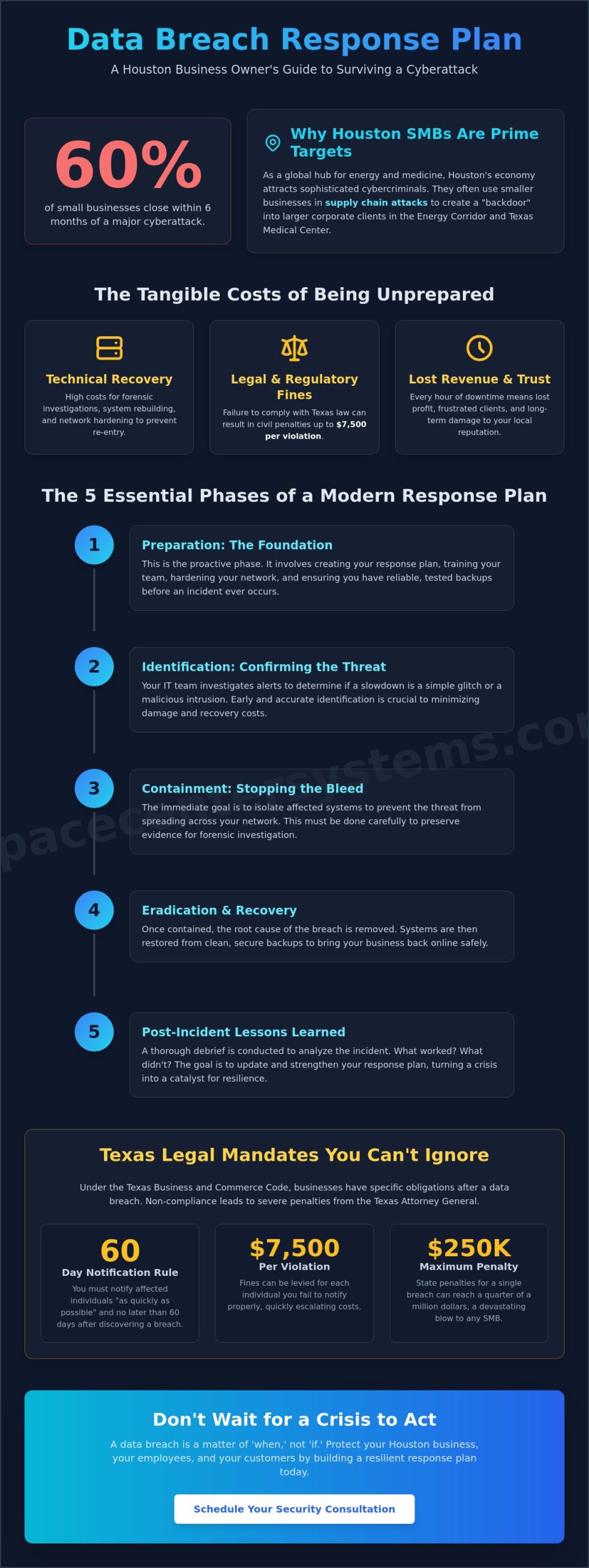
Being caught off guard by a breach carries a price tag that many small businesses simply can’t survive. We categorize these costs into three main buckets. Technical recovery includes the high price of forensic investigations and rebuilding your infrastructure. Legal fines are the second bucket; failing to meet Texas notification laws can lead to penalties that reach hundreds of thousands of dollars. Finally, there’s lost revenue. Every hour your systems are down is an hour of lost profit and mounting frustration for your clients.
The risks aren’t just theoretical. Verified research shows that 60% of small businesses that suffer a significant cyberattack are forced to close within six months. Beyond the immediate financial hit, failing to have a formal response plan can cause your cyber insurance premiums to skyrocket; in some cases, carriers may even deny your claim if you haven’t taken the necessary steps to prepare. Developing a comprehensive data breach response plan Houston companies can trust is the first step toward long term stability. If you’re ready to protect your operations from these risks, contact our team to schedule a consultation and secure your business future.
The 5 Essential Phases of a Modern Response Plan
Managing a security incident without a structured process is like trying to navigate a Houston thunderstorm without windshield wipers. You can’t see the road, and every move feels like a gamble. A professional data breach response plan Houston businesses use provides a clear sequence of events to restore order. This process moves through five distinct phases: Preparation, Identification, Containment, Eradication, and Post-Incident Lessons. By following this roadmap, you replace chaos with a disciplined, step by step recovery.
Preparation is the foundation. It involves hardening your network and training your team before a crisis occurs. Identification follows, where your IT team determines if a system slowdown is just a technical glitch or a malicious intrusion. Knowing the difference early can save you thousands in unnecessary recovery costs. Once a breach is confirmed, the focus shifts to containment to stop the threat from spreading across your entire office network. Finally, you move into eradication and recovery, where you remove the “root cause” and restore your operations from secure backups. The final phase is a debriefing to ensure your plan is even stronger for the future.
Immediate Containment: Stopping the Bleed
The first hour of a suspected breach is critical. Your goal is to isolate the threat without destroying the very evidence needed for a forensic investigation. Many owners instinctively want to “unplug everything” from the wall. While this stops the hacker, it also wipes out volatile memory that contains clues about how the intruder got in. Instead, follow this 60 minute checklist:
- Isolate the affected device: Disconnect the specific computer from the Wi-Fi or network cable rather than shutting it down completely.
- Document the timeline: Note exactly when the suspicious activity was first spotted and by whom.
- Alert your response lead: Immediately contact your internal incident commander and your cybersecurity partner.
A major part of this phase involves verifying your “Clean Backups.” These are data copies stored offsite that have not been touched by the current breach. According to the FTC’s data breach response guide, securing your physical and digital perimeter is the first step toward a successful recovery. If you aren’t sure where your backups are stored, our local IT consulting team can help you verify your recovery points.
Eradication and System Hardening
Once the threat is contained, you must ensure the hacker hasn’t left a “backdoor” to return later. Eradication involves identifying the root cause, such as a weak password or an unpatched software vulnerability. This is the time to implement mandatory password resets across your entire company and enforce Multi-Factor Authentication (MFA). MFA acts as a second lock on your digital doors, requiring a code from a mobile device in addition to a password. For a deeper look at how these tools fit into your overall defense, see our guide on Cybersecurity for Small Business in Houston. Hardening your systems now ensures that your recovery is permanent, protecting your revenue and your reputation in the local community.
Texas Legal Mandates: SB 271 and the 60-Day Rule
Ignoring the legal side of a cyberattack is a gamble that can cost you your company. In Texas, the Identity Theft Enforcement and Protection Act (TITEPA) sets the clock the moment you determine a breach occurred. Having a data breach response plan Houston businesses can execute quickly is no longer optional; it’s a statutory requirement. Under Texas Business and Commerce Code Section 521.053, you must notify affected individuals within 60 days. If you miss this window, the financial consequences are severe. Failing to provide timely notice can lead to civil penalties ranging from $2,000 to $50,000 per violation. For a small business, these numbers multiply quickly, with a maximum cap of $250,000 for a single incident.
The legal landscape changed again with the Texas Data Privacy and Security Act (TDPSA), which became effective on July 1, 2024. This law grants residents new rights over their personal data and places stricter obligations on how you process it. A data breach response plan Houston owners trust helps ensure these deadlines and requirements are never missed. When you’re managing the technical stress of an attack, having these legal milestones pre-mapped allows you to focus on recovery without fearing a surprise visit from state regulators.
Reporting to the Texas Attorney General
Recent updates to Texas law have tightened the timeline for state level reporting. If a breach affects 250 or more Texas residents, you must notify the Texas Attorney General no later than 30 days after discovering the incident. This report must be submitted electronically through the Attorney General’s online portal. Compliance is complex, especially when you’re already managing technical downtime. We recommend working with local legal counsel in Houston to ensure every box is checked. Staying ahead of these deadlines protects you from the $7,500 per violation fines introduced by the TDPSA.
Customer and Employee Notification Best Practices
The way you communicate a breach determines whether your clients stay or leave. A well drafted notification letter should be transparent but calm. According to the FTC’s data breach response guide, you should clearly explain what happened, what data was involved, and what steps you’re taking to protect those affected. In Texas, your notice must include a description of the breach and advice on how individuals can protect themselves. Handling this incorrectly doesn’t just invite state fines; it opens the door to class action lawsuits that can drain your remaining capital. A professional approach preserves your reputation and shows your commitment to the local community.
Building Your Houston Incident Response Team
Most small business owners in Houston think they need an enterprise sized security team to survive a breach. That’s simply not true. For a company with 10 or 30 employees, success comes down to a few key people knowing exactly what to do. A data breach response plan Houston firms can actually use identifies these leaders before the first alert sounds. Without this structure, the first hour of a breach is often wasted in a cloud of confusion and overlapping questions.
You need an “Incident Commander.” In a small office, this is often the owner or an office manager. This person doesn’t fix the servers; they make the hard calls, such as when to notify the bank or when to authorize emergency spending. You also need your external partners ready to go. This includes your insurance agent and your technical team. Keep a physical contact sheet in your desk. If ransomware locks your computer, you won’t be able to look up your insurance policy number or your IT provider’s emergency line. Having this list on paper ensures you can start the recovery process immediately.
The Role of Your IT Partner
Your IT partner is your technical first responder. There’s a major difference between standard IT support and incident response. Standard support keeps your email running; incident response stops an active digital intruder. An experienced partner like SpaceCenter Systems provides the specialized tools needed to hunt for threats and secure your perimeter. We integrate these security protocols into our broader Managed IT Services in Pearland to ensure your business remains resilient against evolving threats. If you want to ensure your team is ready for anything, schedule a consultation with our local experts today.
Communications: Protecting Your Local Reputation
Don’t try to hide a breach from your clients in Sugar Land or League City. News travels fast in the local business community, and being caught in a cover up is far more damaging than the breach itself. You must also communicate clearly with your employees. Ensure they know not to discuss the details of an active investigation on social media or with unauthorized callers. A simple “holding statement” can buy you time while you gather facts. For example:
“We are currently investigating a technical issue that has impacted some of our systems. Our priority is the security of our clients’ data, and we are working with cybersecurity experts to resolve the situation. We will provide updates as more information becomes available.”
This professional approach projects stability and shows your peers that you have the situation under control. It protects your revenue by maintaining client confidence during a difficult time.
Proactive Resilience: Beyond the Response Plan
A written document is a vital first step, but a data breach response plan Houston businesses can actually rely on must be lived and breathed. The goal is to move your organization from a state of reactive panic to a posture of resilient confidence. When you know your team is prepared, the anxiety of a potential cyberattack begins to fade. True resilience comes from layering proactive measures like 24/7 monitoring over your foundational plan. For example, CyberOne offers Managed Extended Detection and Response (MXDR) solutions that provide the continuous oversight needed to secure Microsoft Security environments. This allows our team to catch suspicious activity before it ever escalates into a full scale breach that threatens your revenue.
Stability in business isn’t accidental; it’s the result of intentional practice. By moving beyond a “set it and forget it” mentality, you protect your company from the security vulnerabilities that naturally emerge as technology evolves. This proactive approach ensures your operations stay smooth, your data stays secure, and your reputation in the Houston community remains untarnished. It’s about building a business that can withstand any digital storm with absolute reliability.
Testing Your Plan with Tabletop Exercises
A tabletop exercise is essentially a “what if” session where your leadership team walks through a simulated security crisis. It isn’t a technical test of your hardware; it’s a test of your people and your processes. We recommend running these sessions on a quiet Tuesday morning when everyone is focused. You don’t want to find the holes in your strategy during a hurricane or a holiday weekend when resources are thin. During these simulations, we typically identify three common points of failure:
- Outdated Communication Chains: Discovering that a key emergency contact is no longer with the company.
- Decision Paralysis: Realizing that nobody knows who has the authority to shut down the main server during an active intrusion.
- Access Issues: Finding out that the physical copy of the response plan is locked in an office that nobody can access after hours.
The SpaceCenter Systems Approach to 2026 Security
Our team has spent over 25 years growing alongside the local economy in Pearland and Houston. This long history gives us a unique perspective on the specific challenges our neighbors face every day. We don’t just provide technical fixes; we provide a pillar of support for your entire organization. Our Business Continuity & Disaster Recovery services act as the ultimate safety net, ensuring your systems can be restored quickly even after a major incident. We invite you to experience a more personalized level of support and technical authority. Schedule a Cybersecurity Consultation with our local experts today to start with a professional audit of your current defenses.
Secure Your Houston Business Future Today
Protecting your company from the financial impact of a cyberattack requires more than just luck. It demands a battle tested data breach response plan Houston owners can deploy at a moment’s notice. By understanding your legal obligations under Texas law and building a dedicated incident team, you’ve already taken the first steps toward true digital resilience. You don’t have to navigate these technical complexities alone or risk the massive fines that follow a mishandled breach.
At SpaceCenter Systems, we’ve spent over 25 years serving Greater Houston businesses with a focus on stability and comprehensive care. Our local Pearland based 24/7 support team specializes in Texas data privacy compliance, ensuring your operations remain secure and your reputation stays intact. We invite you to move from reactive anxiety to proactive confidence. Schedule Your Free Houston Cybersecurity Audit Today to verify your defenses and protect your livelihood. We’re here to grow alongside you and ensure your continued success in our local community.
Frequently Asked Questions
What is the very first thing I should do if I suspect a data breach?
Isolate the affected device immediately by disconnecting it from the Wi-Fi or network cable. Do not shut the computer down or unplug it from the power source, as this can destroy volatile memory that contains critical evidence for forensic investigators. Once the device is isolated, follow your internal communication chain to alert your incident commander and your IT partner.
Taking these quick steps prevents the threat from spreading to other systems in your Houston office. It allows your technical team to begin the identification phase while preserving the data needed to understand how the intruder gained access. Moving fast helps minimize the total downtime and potential revenue loss associated with the event.
Does Texas law require small businesses to report breaches to the state?
Yes, any business operating in Texas must report a breach to the Texas Attorney General if it affects 250 or more Texas residents. This report must be submitted electronically through the state’s online portal no later than 30 days after you discover the breach. This requirement applies to all private entities, regardless of whether you have five employees or fifty.
Failing to report a qualifying breach can lead to significant civil penalties under the Texas Data Privacy and Security Act. These fines can reach up to $7,500 per violation. Staying compliant ensures you avoid these unnecessary financial burdens while maintaining your reputation as a dependable local business.
How much does a typical data breach response plan cost for a small business?
The cost of a data breach response plan Houston companies implement varies based on the complexity of your IT infrastructure and the amount of sensitive data you handle. While there is an initial investment in consulting and documentation, it is a fraction of the average $254,000 loss that small businesses face after a successful attack. A proactive plan is an investment in your company’s stability.
Verified research shows that having a tested incident response plan can save organizations an average of $2.66 million in total breach costs. By reducing the time it takes to contain a threat, you lower technical recovery fees and prevent the long term revenue loss caused by extended operational downtime.
What is the 60-day notification rule in Texas?
The Texas Identity Theft Enforcement and Protection Act requires businesses to notify affected individuals of a data breach no later than 60 days after determining the breach occurred. This notice must be sent without unreasonable delay to allow individuals to protect their personal information. If your business in Sugar Land or League City misses this window, you face serious legal risks.
Penalties for failing to provide timely notification range from $2,000 to $50,000 per violation. For a single incident, these fines are capped at a maximum of $250,000. Following the 60 day rule is a critical part of your legal defense and shows your commitment to protecting your clients.
Can my business be sued if we have a data breach response plan in place?
While a plan cannot prevent someone from filing a lawsuit, it provides a powerful defense in court. Having a documented and tested response strategy demonstrates that your business exercised “reasonable security” and due diligence. This can significantly reduce your liability and help protect you against claims of negligence following a cyberattack.
In many cases, the legal “outcome” depends on how well you followed your own procedures and state mandates. A professional plan ensures you meet all notification deadlines and technical standards. This transparency helps preserve local trust and can often discourage class action litigation by showing that you took immediate, responsible action to mitigate the damage.
Do I need to report a ransomware attack if no data was actually stolen?
You may still have a legal obligation to report the incident if unauthorized access to sensitive data occurred. Texas law often triggers notification requirements based on the “access” to information, even if the hacker did not successfully download or transfer the files. A thorough forensic investigation is required to determine the exact scope of the intruder’s activity.
If the ransomware encrypted files containing personal information, the state may view this as a compromise of that data’s integrity. Under the Texas Data Privacy and Security Act, any unauthorized access that puts resident data at risk should be evaluated by legal counsel. It is always safer to consult with specialists to ensure you aren’t violating state reporting mandates.
How often should our Houston business update our response plan?
You should review and update your data breach response plan Houston strategy at least once a year. Regular updates are necessary because cyber threats and state regulations evolve quickly. A plan that worked in 2024 may not address the AI powered phishing attacks or new notification portals used in 2026.
In addition to annual reviews, update your plan whenever you make significant changes to your network, such as moving to the cloud or switching IT providers. You must also update the contact list whenever a member of your incident response team leaves the company. Keeping the document current ensures your team can act with absolute reliability during a crisis.
What is the difference between a data breach and a security incident?
A security incident is a broad term for any attempted or successful unauthorized access to your systems, such as a failed login attempt or a malware infection. A data breach is a specific, more severe type of incident where sensitive or protected information is actually viewed, stolen, or used by an unauthorized person. All breaches are incidents, but not all incidents become breaches.
Understanding this distinction helps you manage the “pain” of a technical event without unnecessary panic. Your IT partner will investigate an incident to see if it crossed the threshold into a breach. If it did, your response plan moves from technical recovery into the legal notification phases required by Texas law to protect your business and your clients.