


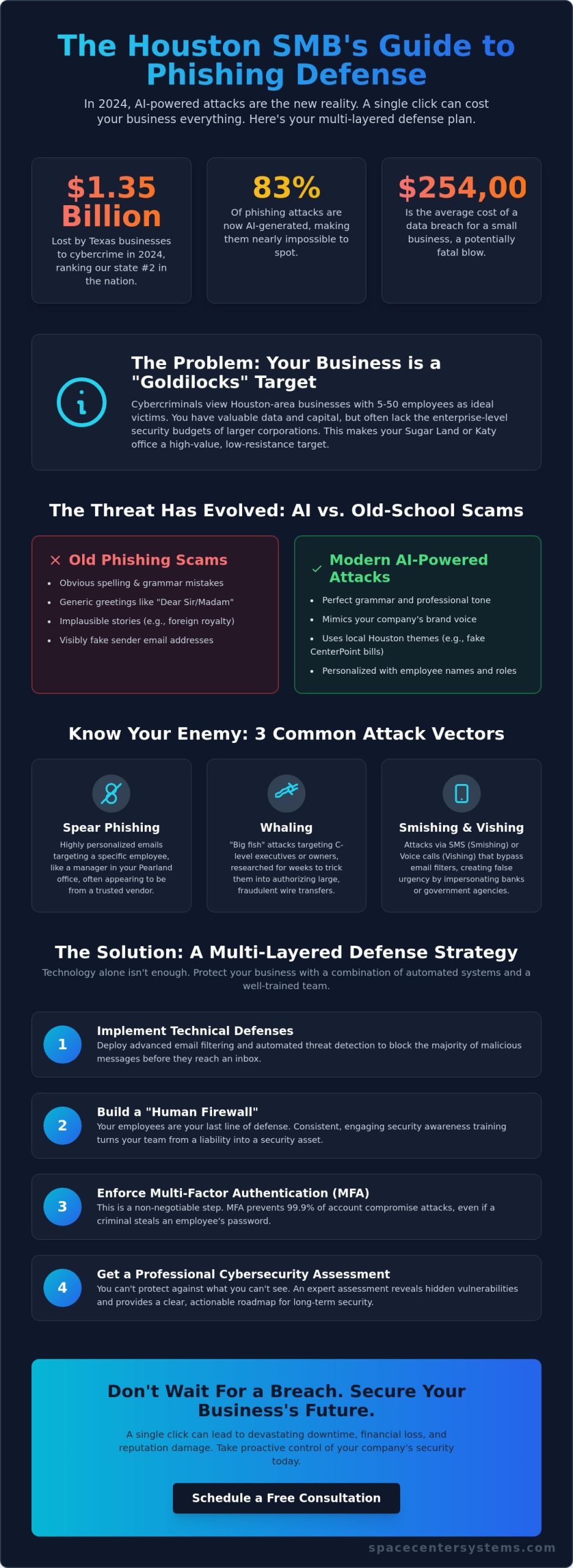
In 2024, Texas businesses lost over $1.35 billion to cybercrime, ranking our state second in the nation for these devastating financial hits. For a Houston business owner, the question is no longer if you’ll be targeted, but how to protect my business from phishing attacks that are now 83% AI-generated. You likely feel the weight of this reality every time a suspicious email hits your inbox. It’s a constant battle to stay ahead of threats that could lead to costly wire fraud or business-halting ransomware in an era where the average small business breach costs nearly $254,000.
We understand the anxiety that comes with technical complexity and the fear of a single employee mistake in your Sugar Land or Katy office causing a total shutdown. You need more than just software; you need a dependable strategy that works for a growing team of five to fifty people. This guide outlines the exact multi-layered defenses and local Houston resources required to shield your operations from evolving threats. By following this clear action plan, you can reduce the risk of human error and gain the stability your business deserves. We’ll show you how to build a resilient company culture where security is a point of pride rather than a source of confusion.
Key Takeaways
- Discover why SMBs with 5 to 50 employees are frequently targeted and learn exactly how to protect my business from phishing attacks using a multi-layered defense strategy.
- Identify the shift toward sophisticated, AI-driven social engineering tactics that allow attackers to mimic your brand voice and trick even experienced staff.
- Understand the critical balance between automated technical blocks and building a “Human Firewall” through consistent employee awareness training.
- Learn the immediate benefits of enforcing Multi-Factor Authentication (MFA) across all business applications to prevent unauthorized access and costly data breaches.
- See how a professional cybersecurity assessment can reveal hidden vulnerabilities and provide a clear roadmap for long-term operational resilience in the Houston area.
The Growing Threat: Why Phishing Targets Houston Businesses in 2026
Phishing is a deceptive tactic where cybercriminals use fraudulent emails, texts, or phone calls to trick you into revealing sensitive data or installing malicious software. For a comprehensive overview of phishing and its history, it is clear that these attacks have evolved from simple scams into highly targeted operations. Today, small and medium-sized businesses in Houston are often seen as “Goldilocks” targets. You have enough digital assets and capital to make a theft profitable, but you likely lack the massive cybersecurity budgets of enterprise-level corporations. This creates a vulnerability that attackers are eager to exploit.
The primary danger lies in the simplicity of the attack. A single employee in your Pearland office clicking one bad link can lead to a total system lockout. This isn’t just a minor IT glitch; it often results in weeks of downtime and lost revenue. In 2026, cybercriminals are leveraging local relevance to increase their success rates. We see attackers using regional themes that feel familiar, such as fake CenterPoint Energy notices or fraudulent hurricane relief fund requests. These local touches lower your team’s guard, making them more likely to fall for the trap.
The Real Cost of a Successful Attack
A successful breach carries a heavy price tag. Beyond the immediate financial loss from Business Email Compromise (BEC), which accounted for nearly $2.8 billion in losses nationally in 2024, you face significant hidden costs. A breach can shatter client trust and damage your reputation across the Texas Gulf Coast. When your systems go dark, the average cost of downtime for an SMB in 2026 can be devastating. Research shows the average data breach loss for a small business is nearly $254,000, a figure that includes recovery efforts, legal liabilities, and lost productivity.
Common Phishing Variants You Must Know
Understanding the different methods attackers use is the first step in learning how to protect my business from phishing attacks. Here are the most common variants targeting local firms:
- Spear Phishing: These are highly personalized attacks. The criminal researches a specific manager in your Sugar Land office to craft an email that looks like it’s from a trusted vendor or partner.
- Smishing and Vishing: Attackers use SMS texts (smishing) or voice calls (vishing) to bypass your company’s email filters. They often pretend to be from a bank or a government agency to create a false sense of urgency.
- Whaling: This targets the “Big Fish” in your organization. If you are an owner or executive, criminals will spend weeks researching you to craft a message that could trick you into authorizing a large wire transfer.
Knowing these threats is essential for any leader who wants to know how to protect my business from phishing attacks. By recognizing the local risks and the high stakes involved, you can begin implementing the stable, multi-layered defenses your business needs to remain resilient.
The Anatomy of a Modern Phishing Attack
The danger often begins with social engineering. Criminals research your team on LinkedIn or your company website to build rapport. They identify your office manager in Pearland or your head of finance in Sugar Land. By using real names and professional roles, they create believable stories that bypass natural skepticism. The ultimate goal is credential theft, which provides unauthorized access to your cloud storage, sensitive client data, or company bank accounts.
Consider a real-world scenario we often see in the Houston area. An employee receives a “past due” invoice that looks exactly like the ones sent by a local vendor. The logo is correct, the tone is professional, and the amount is realistic for your operations. When the employee clicks “view invoice” to investigate the charge, they’ve unknowingly opened the door to your entire network. This simple action can lead to a devastating breach that halts your business for days.
Beyond the Inbox: How Links Turn Into Ransomware
Clicking a link triggers a dangerous technical chain. The link directs the user to a malicious landing page that looks exactly like a standard Microsoft 365 or banking login screen. Once your employee types in their credentials, the attacker harvests them and gains network entry. In many cases, malware sits dormant for months, quietly mapping your network and identifying your most valuable data before activating. This hidden threat highlights why Business Continuity Planning is a vital component of modern business resilience.
Why Traditional Filters Often Fail
Many business owners believe their standard email filter is a complete solution. However, criminals now use “zero-day” phishing links that haven’t been flagged by global security databases yet. These links are brand new and pass through basic technical barriers with ease. Because these automated blocks can be bypassed, your employees’ judgment remains the final line of defense. If you’re concerned about your current vulnerabilities, a quick consultation regarding Managed IT Services can help you identify and close these gaps before they’re exploited.
Technical vs. Human Defense: Which Protects Your Business Better?
Many business owners believe they must choose between high-end software and employee training. Some assume their team is simply “too smart” to fall for a scam. However, even the most tech-savvy professionals can be deceived by a perfectly timed, AI-crafted message. Relying on one defense while ignoring the other leaves a massive gap in your security. A truly effective strategy for how to protect my business from phishing attacks requires a hybrid approach. Technology should act as a massive filter to catch the “noise,” ensuring your staff only has to evaluate a tiny fraction of highly sophisticated threats.
When you combine robust technical blocks with a well-trained team, you create a culture of resilience. Your employees no longer feel like the weakest link; they become an active part of your defense. This dual-layered strategy ensures that even if a malicious link bypasses your firewall, your staff has the skills to spot it and the confidence to report it immediately. This proactive stance significantly reduces the risk of a single click turning into a company-wide crisis. It’s about building a stable environment where technology and people work in tandem to secure your assets.
Essential Technical Safeguards
The first layer of defense is purely technical. Multi-Factor Authentication (MFA) is the single most effective tool in your arsenal, as it blocks more than 99% of account compromise attacks. You should also implement email authentication protocols like SPF, DKIM, and DMARC. Think of these as digital passports that verify your email is actually from you, preventing criminals from spoofing your domain to trick your clients. For businesses with remote teams in League City or Sugar Land, endpoint protection is vital. This secures individual laptops and mobile devices, ensuring that a threat on a home network doesn’t migrate to your main office server in Houston.
Building Your Human Firewall
A 5-Step Phishing Protection Plan for Houston SMBs
Protecting your company requires moving beyond general awareness and into a proactive, structured defense. For many local owners, the primary concern is determining exactly how to protect my business from phishing attacks without disrupting daily operations. A successful plan balances high-level technical precision with practical steps your team can follow. By implementing this five-step framework, you can transform your security from a source of anxiety into a stable foundation for growth.
- Step 1: Audit your vulnerabilities. You can’t fix what you haven’t identified. Start with a professional Cybersecurity for small business Houston assessment. This review uncovers hidden gaps in your network and provides a clear roadmap for improvement.
- Step 2: Enforce Multi-Factor Authentication (MFA). Require MFA for every business application, especially email and accounting software. This ensures that even if a password is stolen, the attacker cannot access your data.
- Step 3: Implement advanced filtering. Use DNS and email filtering tools to intercept malicious links before they ever reach an inbox in your Pearland or Sugar Land office.
- Step 4: Conduct monthly training. Move away from annual seminars. Use real-world scenarios relevant to the Greater Houston landscape, such as fake shipping alerts or local utility notices, to keep your team sharp.
- Step 5: Establish a response plan. Create a simple, one-page document that tells employees exactly who to call if they click a suspicious link. Rapid reporting is the key to minimizing damage.
Securing the Cloud Environment
Most Houston firms now rely on Microsoft 365 or Google Workspace. While these platforms are powerful, they require specific security tuning to block sophisticated phishing attempts. A common risk involves third-party app permissions, where “harmless” calendar or productivity add-ons are granted access to sensitive data. Proper configuration is essential to ensure your cloud environment remains a secure asset. For deeper integration advice, explore our Cloud Computing Services in Houston to see how we align security with performance.
Incident Response: What to Do If You’ve Been Phished
If a breach occurs, immediate action is critical. First, disconnect the affected device from the network to prevent the threat from spreading. Next, change all passwords and immediately alert your Managed IT provider. You should also report the incident to the FBI’s Internet Crime Complaint Center (IC3) to help authorities track local trends. Finally, rely on your Business Continuity & Disaster Recovery system. A robust backup allows you to restore your data and resume operations quickly without ever considering a ransom payment. If you’re ready to secure your operations, schedule a consultation with our local experts today.
Partnering with SpaceCenter Systems: Mission-Critical Security
Managing cybersecurity while running a daily operation is a heavy burden for any owner. You shouldn’t have to spend your weekends worrying about how to protect my business from phishing attacks. Since our founding over 25 years ago, SpaceCenter Systems has grown alongside the regional economy. We’ve seen every iteration of email fraud and network threats. We position ourselves as a pillar of the community, offering the technical authority of a high-end firm with the neighborly warmth of a local partner who truly understands the Houston business climate.
Our Managed IT Services model shifts the focus from reactive repairs to proactive stability. We monitor your network constantly. This means we often identify and block malicious activity before it can cause the kind of downtime that halts your revenue. When you partner with us, you regain the freedom to focus on your core mission. We handle the mission-critical security and technical complexities so you can focus on your clients and your company’s growth. It’s a relationship built on absolute reliability and a shared commitment to your success.
Professional Security Audits and Monitoring
Our 24/7 helpdesk serves as a vital safety net for teams of 5 to 50 employees. We don’t believe in one-size-fits-all security. A law firm in Pearland has different compliance needs than a healthcare clinic in Sugar Land. We tailor our cybersecurity solutions to your specific industry requirements, ensuring your defenses are both high-tech and practical. If you’re unsure where your current defenses stand after reading our guide, we invite you to schedule a professional audit to identify exactly where your business is most vulnerable.
The Advantage of Local Support
When a security emergency strikes, every minute of downtime translates to lost revenue and damaged trust. Having a technician in Houston makes a tangible difference in response times and personalized care. We aren’t a faceless corporation; we are your neighbors who are personally invested in the success of our regional peers. We possess the specific experience to resolve complex technical challenges while maintaining the hospitality you expect from a local partner. This combination of proficiency and proximity ensures your business remains resilient against any threat.
Protect your business today—Contact SpaceCenter Systems for a Cybersecurity Consultation.
Secure Your Houston Business Against Evolving Threats
We’ve explored the shift to AI-driven social engineering and the necessity of a “Human Firewall” paired with technical blocks like MFA. Understanding how to protect my business from phishing attacks is no longer a luxury for Houston SMBs; it’s a fundamental requirement for operational stability. A single breach can lead to devastating downtime and financial loss, but you don’t have to face these risks alone. By shifting from a reactive stance to a proactive defense, you ensure your company’s longevity in an increasingly digital landscape.
SpaceCenter Systems brings over 25 years of local IT experience to your doorstep. We specialize in securing businesses with 5 to 50 employees, providing proactive 24/7 network monitoring and dedicated helpdesk support. This mission-critical care ensures that your company remains resilient while you focus on serving our community. Our neighbors in Pearland, Sugar Land, and across the Greater Houston area deserve the peace of mind that comes with dependable technical support.
Secure Your Business Today—Schedule a Cybersecurity Consultation with SpaceCenter Systems
You’ve built a strong business here in the Houston area, and we’re here to help you keep it that way. Let’s work together to build a more secure and stable future for your team.
Frequently Asked Questions
How can I tell if an email is a phishing attempt if it looks professional?
Professional phishing emails often hide their true intent in the link destination. Always hover your mouse over any button or link to see the actual web address before clicking. If the address doesn’t match the company’s official domain, it’s a scam. You should also verify the sender’s full email address rather than just looking at the display name. These simple checks are vital steps in learning how to protect my business from phishing attacks.
Is my small business really a target for international hackers?
Cybercriminals target small businesses because they often have weaker defenses than large corporations. Attackers use automated scripts to probe thousands of networks in cities like League City and Pearland every day. They see your business as a profitable target for ransomware or a way to access larger partners in your supply chain. No business is too small to be noticed by international hacking syndicates.
Does Multi-Factor Authentication (MFA) really stop phishing?
Multi-Factor Authentication is your most powerful technical defense against stolen credentials. It blocks the vast majority of account compromise attacks by requiring a second form of verification. Even if a hacker steals your password through a link, they still lack the second piece of evidence, like a fingerprint or a code sent to your phone. It’s a foundational tool for any business owner concerned about long-term security.
What is the difference between phishing and spear phishing?
Phishing is a generic attack sent to thousands of people at once, like a fake Netflix bill. Spear phishing is a surgical strike where the attacker researches you specifically. They might mention your role at a Houston firm or a local charity you support to win your trust. This personalization makes spear phishing much harder to detect than standard, mass-produced scams that rely on generic templates.
Should I fire an employee who clicks on a phishing link?
A “no-blame” culture is actually safer for your business than a punitive one. If employees fear for their jobs, they will hide their mistakes, allowing a virus to sit in your network for weeks. When staff feel safe reporting an error immediately, your IT team can contain the threat in minutes. Education and simulations are far more effective than termination for building a resilient company culture.
How much does professional phishing protection cost for a small business?
The investment for professional protection depends on your team size and the specific security tools you need, such as email filtering or 24/7 monitoring. Rather than a one-size-fits-all price, local providers offer scalable packages that grow with your business. You should consult with a specialist to find a balance that provides mission-critical security without straining your operational budget or affecting your bottom line.
What should I do immediately after clicking a suspicious link?
You must act quickly to limit the damage. First, physically disconnect your computer from the network by unplugging the Ethernet cable or turning off Wi-Fi. This stops any malware from spreading to your server or other office computers. Next, use a separate device to change the passwords for any accounts that might be compromised. Finally, alert your Managed IT provider so they can begin a professional cleanup.
Can phishing attacks happen over a business VoIP phone system?
Criminals frequently use VoIP phone systems to conduct “vishing” attacks, where they pose as tech support or bank officials. They use caller ID spoofing to make the call look like it is coming from a local Houston area code. Training your staff to never share passwords or sensitive data over the phone is a key part of how to protect my business from phishing attacks in a modern office.