


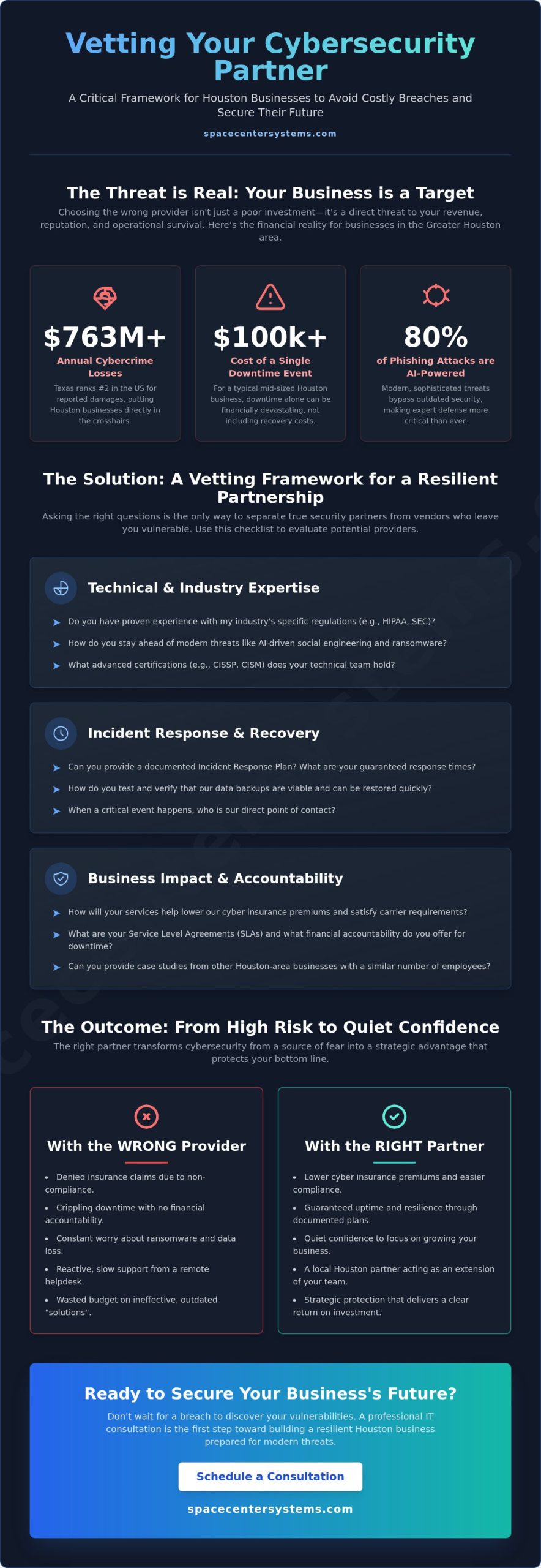
Texas ranks second in the United States for cybercrime losses, with over $763 million in reported damages in a single year. For a Houston business owner, these aren’t just numbers. They represent the real threat of devastating downtime and skyrocketing insurance premiums. You likely feel that protecting your operations requires more than basic software, but finding a partner you can trust often feels overwhelming. Knowing the right questions to ask a cybersecurity company is the only way to separate dependable local experts from high-risk vendors who might leave you vulnerable to a $9.44 million data breach.
We understand that technical requirements like MFA or SOC 2 compliance can feel like a foreign language. You need a clear framework to vet providers so you can focus on growing your business instead of worrying about ransomware. This guide provides 21 critical questions to ask a cybersecurity company to ensure they meet the standards of the Texas Data Privacy and Security Act and the “Safe Harbor” provisions of Texas SB 2610. You’ll gain the clarity needed to lower your risk, satisfy insurance carriers, and secure your company’s future. To start building a more resilient business, contact us today to schedule a professional IT consulting session.
Key Takeaways
- Understand why viewing security as a strategic partnership is the only way to avoid the $100,000 downtime costs currently threatening local businesses.
- Discover the specific questions to ask a cybersecurity company to verify they can defend against AI-driven threats and navigate your industry’s specific regulatory requirements.
- Protect your operations by demanding a documented Incident Response Plan and guaranteed response times for any critical security event.
- Learn how the right partner can help you lower cyber insurance premiums and provide financial accountability for system downtime through clear Service Level Agreements.
- See why local expertise in the Greater Houston area is vital for managing physical hardware and maintaining network stability when remote-only firms cannot reach you.
Why Vetting Your Cybersecurity Partner is Critical for Houston Businesses
Choosing a cybersecurity provider is one of the most significant decisions you’ll make for your company’s longevity. In 2026, a cybersecurity company isn’t just a vendor that installs software; they are a strategic partner responsible for your operational survival. Selecting the right questions to ask a cybersecurity company is about more than comparing prices. It’s about finding a team that acts as a mission-critical extension of your own staff. When a breach occurs, you don’t need a help desk ticket number. You need a dependable local authority that understands your specific risks and can restore your revenue-generating activities immediately.
The Reality of Cyber Threats in the Greater Houston Area
Hackers in 2026 specifically target mid-sized firms in Sugar Land and Pearland because they often lack the enterprise-grade defenses of larger corporations. These attackers look for windows of opportunity, such as the chaos following a major hurricane or local weather event, when your focus might be on physical recovery rather than digital defense. Following a comprehensive Cybersecurity for small business Houston strategy is the only way to stay ahead of these opportunistic threats. A single breach today can easily cost a local business over $100,000 in downtime alone, making a reactive “break-fix” approach a recipe for financial disaster.
Cost Implications of Choosing the Wrong Provider
Cheap security often ends up being the most expensive mistake a business owner can make. If your provider fails to implement basic standards like MFA or SOC 2, your cyber insurance carrier may deny your claim after a breach, leaving you to cover the entire recovery cost out of pocket. You can verify a provider’s proficiency by asking if they perform a regular information security audit to identify vulnerabilities before they are exploited. For a business with 20 employees, the Total Cost of Risk includes the price of protection plus the potential financial devastation of lost productivity, legal fees, and client attrition following a breach.
A professional partner moves you from a state of constant fear to a position of quiet confidence. Instead of wondering if your backups will work, you’ll have documented proof of your resilience. Protecting your reputation and your revenue starts with arming yourself with the right questions to ask a cybersecurity company before signing a contract. To ensure your business is prepared for the challenges of the 2026 threat environment, contact us today to schedule a professional IT consulting session.
Questions to Ask About Technical Expertise and Industry Experience
When you evaluate potential partners, the first set of questions to ask a cybersecurity company should focus on their technical depth and familiarity with your specific business environment. General IT knowledge is no longer sufficient to protect a company in 2026. For example, a law firm in downtown Houston has vastly different compliance requirements than a manufacturing facility in Pasadena. You must ask: “Do you have experience with my specific industry regulations, such as HIPAA for medical practices or SEC requirements for finance?”
With AI-generated content now powering 80% of phishing attacks, you need to know how they plan to defend your team. Ask: “How do you stay ahead of 2026-specific threats like AI-generated social engineering?” A provider that relies on tactics from two years ago will leave you exposed to modern, highly convincing scams that bypass traditional filters. You can use CISA’s cybersecurity questions as a benchmark to ensure your provider’s answers align with federal security standards for risk management.
Don’t hesitate to ask about the specific certifications their team holds, such as CISSP or CISM. These represent a verified level of proficiency in managing complex security infrastructures. Finally, request case studies from businesses your size in the Houston area. Seeing how they helped a peer in Pearland or Sugar Land provides tangible proof of their reliability and local commitment.
Verifying Industry-Specific Knowledge
A “one-size-fits-all” approach is a major red flag. If a vendor claims security is universal and doesn’t ask about your specific data workflows, they likely lack the expertise to protect you. A quality provider will instead offer to audit your current cloud computing services Houston to identify gaps unique to your industry. They should understand that a medical clinic needs different access controls than a retail shop.
Staff Vetting and Internal Security Protocols
Your provider’s internal security is just as important as your own. Ask how they screen the employees who will have access to your sensitive data. They should perform rigorous background checks and follow the principle of “least privilege” access. This means their staff only sees the data absolutely necessary to perform their jobs. This transparency ensures that the people managing your systems are as dependable as the technology itself. Our IT consulting team can help you establish these same rigorous standards to protect your internal operations.
Questions for Incident Management and Data Recovery
While prevention is the primary goal, your company’s survival depends on what happens after a security failure. In 2026, the question isn’t just if you have a firewall, but how quickly you can resume operations after an attack. When interviewing providers, the most vital questions to ask a cybersecurity company should focus on their ability to manage a crisis. You need to know their guaranteed response time for a critical security incident. A vague promise to “get to it quickly” isn’t sufficient when your team is idle and your revenue has stopped. Demand to see a documented Incident Response Plan (IRP) that outlines the specific steps they take to isolate a threat and protect your remaining data.
You should also ask how often they test your backups for recoverability. Many business owners mistakenly believe they are safe because a backup software shows a green “success” icon. However, if that data hasn’t been actively tested, it might be corrupted or incomplete when you need it most. Finally, clarify their process for notifying you and your clients if a breach occurs. Transparent communication is essential for maintaining trust and meeting the legal requirements of the Texas Data Privacy and Security Act. Reviewing these questions to ask your cybersecurity provider as suggested by NIST can help you verify if a vendor has the technical maturity to handle these high-pressure scenarios.
The ‘What If’ Scenario: From Breach to Recovery
Imagine arriving at your office in Sugar Land on a Monday morning only to find your files encrypted by ransomware. In this high-stress moment, a professional partner follows a strict 60-minute protocol to isolate infected devices and prevent the malware from spreading. This rapid response is the difference between a minor disruption and a total business collapse. With the average cost to remediate a ransomware attack reaching $1.82 million, you cannot afford a partner who is learning on the fly. They must prove that your data is not just “backed up” in a storage locker, but is “recoverable” and ready for immediate use.
Business Continuity vs. Basic Cybersecurity
Basic security blocks threats, but business continuity planning services keep your doors open. Ask your provider: “How quickly can you have our staff back online after a total system wipe?” A dependable partner focuses on minimizing downtime to preserve your revenue streams. The ultimate outcome of a rigorous vetting process is the peace of mind that comes from knowing your business can withstand a digital disaster without losing its reputation or its bottom line. To see how a tailored recovery plan can protect your specific operations, contact us today for a professional consultation.
Evaluating the Business Impact: Compliance, Costs, and Accountability
Beyond technical defensive measures, you must evaluate how a provider impacts your bottom line. Cybersecurity in 2026 is a financial strategy as much as a technical one. When considering your options, the business-focused questions to ask a cybersecurity company should center on accountability and cost control. For instance, ask if they’re willing to sign a Service Level Agreement (SLA) that includes financial penalties for downtime. This ensures their interests are perfectly aligned with yours; they only succeed when your business is running smoothly. Accountability matters in a professional partnership.
You should also verify if the provider undergoes their own third-party audits, such as SOC 2 Type II. If they aren’t securing their own house, they can’t effectively secure yours. Additionally, they should have a clear process for hardware and software lifecycle management. Using outdated equipment in a Sugar Land office creates easy entry points for hackers that no software can fully patch. Proactive replacement schedules prevent these vulnerabilities before they become expensive emergencies.
Navigating Cyber Insurance and Compliance
Insurance carriers are watching your security protocols closely. Many Houston business owners face the pain of rising premiums or, worse, denied claims because MFA wasn’t properly implemented. You need to ask your provider how they document compliance for your annual insurance renewal. Under the “Safe Harbor” provisions of Texas SB 2610, implementing reasonable practices can protect you from punitive damages. A dependable partner provides the necessary documentation to satisfy insurers, which leads to the positive outcome of guaranteed coverage and reduced liability for your firm.
Transparency in Pricing and ROI
Surprise emergency bills are a major pain for small businesses with 5 to 50 employees. A flat-fee managed IT model provides predictable spending and eliminates the conflict of interest found in “break-fix” services. Ask exactly what’s included in your monthly fee and what triggers an extra project charge. This transparency allows you to treat IT as a fixed utility rather than a fluctuating risk. When your provider isn’t billing by the hour, they’re incentivized to keep your systems stable and secure. This alignment of goals is the foundation of a long-term, neighborly business relationship.
To see how our team can help you navigate these complex insurance and compliance requirements, schedule a professional IT consulting session today.
Making the Right Choice: Why a Local Pearland Partner Matters
Proximity is often the most overlooked factor when business owners brainstorm questions to ask a cybersecurity company. While many national firms claim they can manage everything from the cloud, a remote-only model fails the moment your physical infrastructure requires hands-on attention. If a critical server in League City fails or a network switch in Pasadena stops responding, a technician sitting in a different time zone cannot help you. You need a partner who understands the local business landscape and can arrive at your facility within hours to restore your revenue-generating activities. Physical security and hardware stability are the foundations of digital safety.
SpaceCenter Systems has served the Greater Houston area since 1995. We have grown alongside the regional economy for over 25 years, providing the stability and support that local business owners depend on. This longevity isn’t just a number; it represents decades of resolving technical challenges for peers in our own community. When you choose a local expert, you aren’t just another ticket in a global queue. You are a neighbor whose success directly impacts our shared economy. We’ve seen every version of the threat landscape and have the specific experience to keep your business resilient.
The SpaceCenter Systems Difference: Stability and Support
We follow an action-benefit approach to IT management that prioritizes your operational efficiency. We don’t just secure your data; we enable your company to scale without technical friction. This includes integrating your security with reliable communication tools like Business VoIP systems Pearland. By unifying your technology strategy, we ensure that your security measures never become a bottleneck for your staff’s productivity. A dependable network allows your team to work with absolute peace of mind and focus on serving your customers.
Your Next Step: The Cybersecurity Audit
Don’t leave your company’s future to guesswork. A professional baseline is the only way to know if your current defenses meet the 2026 standards for Texas businesses. We invite you to sit down with our team and ask these 21 questions to ask a cybersecurity company directly. We’ll provide transparent, straightforward answers that focus on your specific risk profile and operational goals. This consultation is an opportunity to experience a more personalized level of support from a firm invested in the success of its peers. You’ll walk away with a clear understanding of your vulnerabilities and a logical path to resolving them.
Schedule Your Cybersecurity Consultation with SpaceCenter Systems Today
Secure Your Houston Business with Confidence
Protecting your company in 2026 requires moving beyond basic software to finding a true strategic partner. You’ve seen that vetting a provider involves more than checking a box; it’s about ensuring your revenue and reputation are safe from multi-million dollar data breaches. Armed with the right questions to ask a cybersecurity company, you can now identify which vendors offer mission-critical protection and which ones only provide surface-level solutions. This clarity is your best defense against downtime and rising insurance premiums.
SpaceCenter Systems has spent over 25 years supporting the local economy. We specialize in businesses with 5 to 50 employees, providing the stability you need to grow without technical fear. Our proactive network monitoring ensures your systems stay operational whether you operate in Sugar Land, Pearland, or downtown Houston. Secure your Houston business today; schedule a consultation with SpaceCenter Systems to build a more resilient future. We’re here to ensure your technology remains a dependable asset for years to come.
Frequently Asked Questions
What is the most important question to ask a cybersecurity company?
The most important question is how their security strategy aligns with your specific business continuity goals. You need to know if they understand your operational risks in Houston or if they are simply selling a generic software package. A dependable partner will explain how their Managed IT Services prevent downtime and protect your revenue during a crisis. This ensures you aren’t just buying a product but investing in a long-term, supportive relationship.
How do I know if a cybersecurity provider is actually compliant with SOC 2?
You should request a copy of their most recent SOC 2 Type II audit report rather than taking their word for it. This document provides third-party verification that the provider follows strict security, availability, and confidentiality standards. If a firm cannot produce this report, it is a significant red flag. Verifying these credentials ensures the team managing your sensitive data maintains the same high standards they promise to implement for your business.
Can a small business in Houston really afford professional cybersecurity?
Professional cybersecurity is an essential investment that costs significantly less than the $9.44 million average price of a U.S. data breach. For small businesses in Pearland or Sugar Land, Managed IT Services provide enterprise-level protection at a predictable monthly rate. This approach eliminates the pain of surprise emergency bills and protects you from devastating revenue loss. Investing in proactive defense today prevents the financial ruin that often follows a successful ransomware attack.
What happens if my cybersecurity company gets hacked?
Your provider must have a documented internal incident response plan that includes immediate notification protocols for their clients. During your interview, one of the vital questions to ask a cybersecurity company is how they isolate their own systems to prevent a “supply chain” attack on your network. A transparent partner will openly discuss their own security layers and how they ensure your data remains protected even if their primary systems face a threat.
How often should a cybersecurity company perform a risk assessment?
A professional risk assessment should be performed at least once a year or whenever you make significant changes to your IT infrastructure. In a fast-moving market like Houston, quarterly reviews are often better for identifying new vulnerabilities created by AI-driven threats. These assessments provide a clear roadmap for upgrades, ensuring your security measures stay ahead of hackers. Regular audits result in a hardened defense and can lead to lower cyber insurance premiums for your company.
Is there a difference between an MSP and an MSSP?
Do I still need cybersecurity if all my data is in the cloud?
Yes, because cloud providers only secure the underlying infrastructure, not your specific data or user access points. Most breaches in 2026 occur due to compromised credentials or misconfigured settings, which are your responsibility to manage. A local cybersecurity expert will secure your cloud environment with MFA and encrypted backups. This prevents unauthorized access and ensures your team can safely access files from League City, Pasadena, or anywhere your business operates.
What are the red flags to look for when interviewing IT security firms?
Major red flags include a lack of a physical local office, vague answers regarding response times, and a refusal to sign a Service Level Agreement (SLA). If a firm cannot explain their process for testing backups or doesn’t ask about your industry regulations, they likely lack the expertise you need. These gaps often lead to insurance claim denials and prolonged downtime. Choosing a partner with a transparent, action-oriented approach ensures your business remains stable and supported. Contact us today to schedule a professional IT consulting session.