


Imagine it’s a humid Tuesday morning in August, and instead of starting your day at your shop on Fairmont Parkway, you’re staring at a locked server screen. According to FEMA, 40% of small businesses never reopen their doors after a major data loss event. It’s a sobering reality. You likely agree that a robust plan for data backup and recovery in Pasadena is the only thing standing between a temporary setback and a permanent closure. Since 1990, SpaceCenter Systems has helped our neighbors navigate these technical hurdles with a “safe pair of hands” approach that prioritizes your stability.
We understand that the choice between cloud storage and local hardware feels overwhelming, especially with the 2026 threat landscape bringing sophisticated cyberattacks and unpredictable Gulf Coast hurricane seasons. This guide will show you how to protect your Pasadena business from devastating data loss using a professional strategy built for modern risks. You’ll learn the exact steps to achieve zero data loss and a recovery time that keeps your operations running. Let’s secure your company’s future; contact us today to schedule a consultation and ensure your systems are mission-ready.
Key Takeaways
- Identify why Pasadena businesses face unique dual risks from Gulf Coast weather and modern cybercrime to avoid the devastating costs of operational downtime.
- Master the distinction between basic file copies and a robust strategy for data backup and recovery in Pasadena that ensures your business stays functional during a disaster.
- Evaluate the performance benefits of local, cloud, and hybrid solutions to find the right balance of recovery speed and geographic resilience for your critical applications.
- Learn how to conduct a thorough data audit and assign a “Disaster Leader” to prepare your 5-50 person team for the evolving 2026 threat landscape.
- Leverage over 25 years of local Houston-area expertise to implement a dependable approach that protects your revenue and secures your company’s future.
Why Pasadena Businesses Face Unique Data Risks in 2026
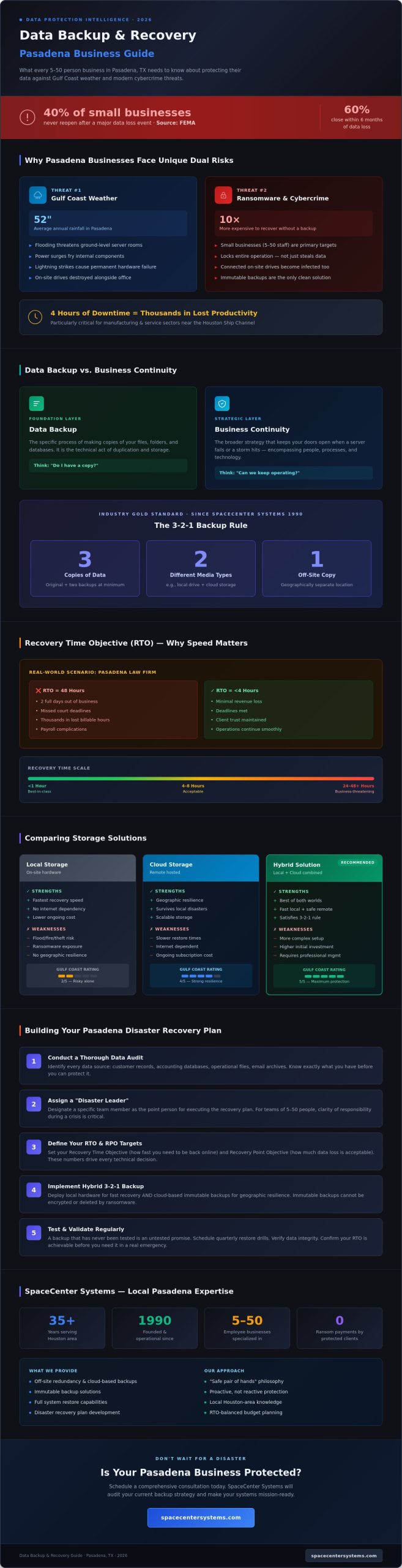
Pasadena businesses operate in a high-stakes industrial environment where stability is everything. Since 1990, SpaceCenter Systems has helped local firms navigate the technical hurdles that threaten their daily operations. By 2026, the threats have evolved into a dual challenge of unpredictable Gulf Coast weather and aggressive cybercrime. Relying on an aging external drive sitting on a desk isn’t a viable strategy anymore. If that drive is physically present during a flood or connected during a ransomware attack, your safety net vanishes instantly.
Effective Business Continuity Planning requires a proactive approach that prioritizes local resilience. For the manufacturing and service sectors near the Houston Ship Channel, even four hours of downtime can result in thousands of dollars in lost productivity. Beyond the financial hit, data loss shatters customer trust. When a local client calls and you can’t access their records, your professional reputation takes a hit that’s difficult to repair. Implementing professional data backup and recovery Pasadena solutions protects your revenue and your brand.
The Impact of Gulf Coast Weather on Local Infrastructure
Pasadena sees an average of 52 inches of rainfall annually, making flooding a constant concern for ground-level server rooms. Power surges during seasonal storms frequently fry internal components, leading to permanent hardware failure. We’ve seen businesses lose years of accounting data because of a single lightning strike. SpaceCenter Systems advocates for off-site redundancy and cloud-based backups. This ensures that even if your physical office in Houston or Pasadena is inaccessible, your data remains safe and retrievable from a secure, remote location.
The Rising Threat of Ransomware in the Houston Area
Hackers now target small businesses with 5 to 50 employees more than large corporations because they often lack enterprise-grade security. In 2026, ransomware doesn’t just steal data; it locks your entire operation until a ransom is paid. The pain of a frozen system is immediate and paralyzing. However, the solution is a clean, immutable backup that allows for a full system restore. Industry data shows that recovering from a breach without a backup is 10 times more expensive than maintaining a proactive service. We provide the “safe pair of hands” needed to ensure you never have to negotiate with a criminal to get your files back.
Don’t wait for a disaster to test your defenses. Contact SpaceCenter Systems today to schedule a comprehensive consultation and secure your business’s future.
Understanding Data Backup vs. Business Continuity
Data backup and business continuity aren’t the same thing, though many people use the terms interchangeably. Backup is the foundation. It refers to the specific process of making a copy of your files, folders, and databases. Business continuity is the broader strategy that keeps your doors open when a server fails or a storm hits the Gulf Coast. For reliable data backup and recovery Pasadena owners need to understand how these two concepts work together to prevent permanent closure. Statistics show that 60% of small businesses that lose their data close within six months of the disaster. We work to ensure you aren’t part of that number.
SpaceCenter Systems has protected local firms since 1990 using the 3-2-1 rule. This proven standard requires you to keep three copies of your data, use two different types of storage media, and maintain at least one copy off-site. Implementing modern data backup strategies ensures that even if your physical office is inaccessible, your business survives. This approach moves you beyond simple file saving and into true operational resilience.
What is a Recovery Time Objective (RTO)?
RTO measures how quickly you need to be back online after a failure. Think of it as your recovery speed. Imagine a Pasadena law firm loses access to its case files on a Monday morning. If their RTO is 48 hours, they’re effectively out of business for two full days. This downtime leads to missed court deadlines, thousands in lost billable hours, and major complications with Friday’s payroll. A shorter RTO means less revenue loss and a faster return to serving your clients. We help you set an RTO that balances your need for speed with your IT budget.
What is a Recovery Point Objective (RPO)?
RPO focuses on the freshness of your data. It’s the maximum tolerable age of unrecovered data your business can handle before the loss becomes catastrophic. If you only perform daily backups at midnight, a system crash at 4:00 PM means you lose an entire day of work. For a high-volume medical office in Houston, losing eight hours of patient records is devastating. Real-time continuous data protection reduces this gap to minutes. We customize your data backup and recovery Pasadena plan to ensure your RPO aligns with your daily transaction volume.
If you’re unsure if your current setup can meet these goals, you can request a local IT assessment to find the gaps in your protection. Identifying these vulnerabilities now is much cheaper than discovering them during a crisis.
Comparing Data Recovery Solutions: Cloud, Local, and Hybrid
Choosing the right architecture for data backup and recovery Pasadena businesses rely on is a critical decision that impacts your bottom line. Since 1990, SpaceCenter Systems has helped local firms move away from fragile storage methods toward resilient systems. Without a clear strategy, a simple hardware failure can turn into a week of lost productivity and thousands in missed revenue. You must evaluate how quickly you need your files back and where those files live when disaster strikes.
The Pros and Cons of On-Premise Backup
Local backups involve storing data on physical hardware, such as a Network Attached Storage (NAS) device or external drives, located right in your Pasadena office. The primary benefit is speed. If an employee accidentally deletes a 2GB presentation, you can restore it almost instantly over your local network. This immediate access is vital for businesses with 20 or more employees who can’t afford to wait for large downloads.
However, local-only storage is a single point of failure. Physical drives are vulnerable to theft, hardware degradation, and environmental hazards like high Texas humidity or office fires. Managing these systems also carries hidden costs. Your team must spend hours every week rotating drives and verifying that the hardware hasn’t failed. If a tropical storm floods your facility, a local-only backup provides zero protection because the source and the backup are destroyed simultaneously.
Why Cloud Computing is the Backbone of Modern Recovery
Cloud backups provide geographic redundancy by sending your data to secure, off-site data centers. This ensures that even if Pasadena is offline due to a grid failure, your business information remains safe and accessible from any internet connection. It’s a scalable solution that grows with your company; you don’t have to buy new hard drives every time your database expands. You can learn more about integrating these tools through our Cloud Computing Services in Houston.
To ensure your business stays operational, you should incorporate these off-site tools into a comprehensive disaster recovery plan. This federal standard emphasizes that data must be stored far enough away that a single regional event doesn’t impact both copies. While cloud recovery can be slower for massive datasets, it’s the only way to guarantee survival against catastrophic events.
We recommend a hybrid approach for maximum reliability. This model keeps a local copy for instant restores and a cloud copy for disaster resilience. It addresses security vulnerabilities by using end-to-end encryption, meaning your data is scrambled before it even leaves your building. This “safe pair of hands” approach eliminates the stress of choosing between speed and safety.
- Local: Recovers individual files in minutes.
- Cloud: Restores your entire operation after a total site loss.
- Security: AES-256 encryption protects both copies from ransomware.
Don’t wait for a server crash to find out your backup system is inadequate. Contact SpaceCenter Systems today to schedule a comprehensive technology assessment and build a recovery strategy that protects your Pasadena business.
Building Your Pasadena Disaster Recovery Plan: A Step-by-Step Approach
A disaster recovery plan is the difference between a two-hour recovery and a two-week shutdown. In Pasadena, local businesses face risks ranging from Gulf Coast weather events to simple hardware failures. Without a documented strategy, your team will likely panic when a server goes dark or a database becomes inaccessible. A structured approach ensures that data backup and recovery Pasadena services work exactly as intended when the clock is ticking.
Step 1: Identifying Mission-Critical Assets
You can’t protect what you haven’t cataloged. Start by creating a full inventory of every software application and data set your business uses. This includes your accounting databases, customer relationship management (CRM) tools, and communication platforms like Business VoIP Systems in Pearland. Prioritize these assets based on their impact on your revenue. Most firms find that restoring the ability to invoice clients is the top priority, followed by accessing active project files.
For teams of 5 to 50 people, you must assign a “Disaster Leader.” This person isn’t necessarily a technical expert; they’re the point of contact who knows where the plan is kept and who to call first. They work directly with your IT partner to execute the recovery steps. To eliminate the risk of human error, which accounts for roughly 25% of data loss incidents according to industry data, your backup schedules must be fully automated and encrypted. We implement systems that require zero daily effort from your staff, ensuring your data is safe without anyone having to remember to push a button.
Step 2: Testing and Validation
A backup that hasn’t been tested is just a hope. It’s like keeping a fire extinguisher in the hallway but never checking the pressure gauge. You don’t want to discover a corrupted file during an actual emergency. At SpaceCenter Systems, we perform regular recovery testing to verify that every bit of data is usable. Our approach to data backup and recovery Pasadena focuses on total transparency and verifiable results. “Regular testing turns a disaster into a minor technical hiccup.”
We recommend scheduling quarterly fire drills. These drills simulate a total system failure to see how quickly your data actually recovers. This process identifies bottlenecks in your internet speed or hardware that could slow down your return to normal operations. By partnering with a local expert, you gain the peace of mind that comes from a “safe pair of hands” managing the technical heavy lifting. Since 1990, we’ve helped businesses stay resilient through every challenge by providing dependable, neighborhood-focused support.
Don’t wait for a crisis to find out if your plan works. Contact us today to schedule a professional data audit and secure your business continuity.
SpaceCenter Systems: Your Local Pasadena Data Recovery Partner
SpaceCenter Systems has protected local businesses since 1990. We provide a safe pair of hands for Pasadena business owners who cannot afford a single hour of downtime. When a server fails or a ransomware attack hits, you don’t need a call center in another time zone. You need a local partner who can be on-site at your Pasadena office in minutes. Our 25+ years of experience in the Greater Houston area means we have seen every type of failure imaginable, from simple drive crashes to complex network breaches. We deliver mission-critical reliability that mirrors the precision of the nearby aerospace industry. Our team ensures your data backup and recovery Pasadena strategy is airtight; this allows you to focus on growth instead of technical failures. We understand that for a business with 15 or 40 employees, a data loss event isn’t just an inconvenience. It is a threat to the livelihoods of your entire staff.
A Neighborly Approach to Enterprise-Grade IT
Jim S. founded SpaceCenter Systems to bring enterprise-level technology to small businesses with a neighborly touch. National IT firms often treat you like a ticket number, but we treat you like a neighbor. We’ve spent over three decades supporting the local economy across Houston and Sugar Land. This local presence means we understand the specific challenges Texas businesses face, such as hurricane season preparation and local compliance needs. We don’t just fix computers; we build relationships. We invite you to experience this difference through a free IT and Cybersecurity audit to identify gaps in your current defense before they become expensive liabilities.
Investing in Peace of Mind
Investing in a professional continuity plan eliminates the stress that keeps owners awake at night. You gain predictable IT costs and a resilient infrastructure that survives hardware crashes or human errors. A 2024 industry report found that 60% of small businesses close within six months of a major data loss. We make sure you aren’t part of that statistic. Our systems provide a clear path from disaster to full operation. By choosing a local partner, you ensure that your data backup and recovery Pasadena needs are met with speed and expertise. This proactive approach saves thousands in potential recovery fees and lost revenue. We provide the stability your business needs to thrive in a volatile digital environment.
Schedule your Pasadena business continuity consultation today.
Secure Your Company’s Future with a Resilient Continuity Plan
Waiting for a hurricane or a cyberattack to test your systems is a gamble that costs Houston area businesses thousands of dollars in lost productivity every hour. For small businesses with 5 to 50 employees, a single day of downtime can threaten your entire operation. You’ve learned that standard backups aren’t enough; true resilience requires a hybrid approach that keeps your data accessible regardless of local outages. SpaceCenter Systems has provided data backup and recovery Pasadena services since 1990, ensuring local companies stay operational through every challenge.
Our team brings over 25 years of local IT experience to your office. We provide proactive 24/7 network monitoring to stop threats before they cause a crash. This mission-critical approach gives you the reliable support you need to focus on growth instead of technical failures. Protecting your revenue and reputation starts with a proven strategy tailored to the unique risks of the Texas Gulf Coast. We’ve seen how the right plan saves businesses from the high costs of data loss and security vulnerabilities.
Contact SpaceCenter Systems today to schedule your Pasadena Business Continuity consultation.
We’re ready to help your business stay strong, secure, and protected.
Frequently Asked Questions
How much does data recovery cost for a Pasadena business?
Professional data recovery costs depend on the severity of the hardware failure, but industry reports from 2024 show lab-based recovery often starts at $500 and can exceed $2,000 per drive. For a local firm, the actual cost includes the $8,000 average daily loss small businesses face during unexpected downtime. We implement proactive data backup and recovery Pasadena solutions to eliminate these high-stress emergency expenses and keep your budget predictable.
Is cloud backup alone enough for my small business?
No, relying only on the cloud creates a single point of failure and often results in slow recovery speeds during a crisis. We recommend the 3-2-1 strategy: keep three copies of your data, on two different media types, with one stored offsite. If your local internet connection fails, you’ll need a local copy to resume operations immediately. This hybrid approach ensures you aren’t waiting days to download terabytes of critical files.
How often should our business data be backed up?
Your systems should perform backups at least every 15 minutes to minimize the risk of significant data loss. If you only run backups once a day at 5:00 PM and your server crashes at 4:00 PM, you lose an entire day of billable work and progress. Frequent snapshots ensure your team only loses minutes of data, protecting your revenue and maintaining your commitments to Houston area clients without interruption.
What happens if our Pasadena office is flooded and the servers are destroyed?
Your business continues to operate by running virtual versions of your servers in a secure, offsite data center. Since 1990, we’ve helped local companies navigate Gulf Coast weather challenges that threaten physical hardware. With a solid business continuity plan, your employees can work from home or a temporary site while you repair your office. This prevents a physical disaster from becoming a permanent business closure.
Can you recover data from a ransomware attack without paying the ransom?
Yes, you can successfully recover your files if you have immutable backups that attackers cannot modify or delete. Ransomware hit a new organization every 11 seconds in 2023, making clean recovery points essential for survival. We use isolated snapshots to roll your systems back to the moment before the infection occurred. This strategy keeps your money out of criminal hands and gets your staff back to work within hours.
What is the difference between a backup and an archive?
A backup is a short-term copy used for rapid recovery after a failure, while an archive is for long-term storage of inactive data. You use backups to restore a deleted file or a crashed server today. You use archives to meet 7-year tax requirements or industry compliance standards. Separating these functions improves your data backup and recovery Pasadena performance and reduces your monthly storage costs by 20 percent or more.
How long does it take to restore a full server?
Recovery times range from 15 minutes to several days depending on your specific recovery tools and data volume. With an image-based backup system, we can often virtualize a failed server in under 30 minutes to restore immediate access. If you rely on older, file-level backups, you might face 48 hours of downtime while waiting for new hardware and data transfers. Faster recovery saves you thousands in lost employee productivity.
Do we need a business continuity plan if we only have 10 employees?
Yes, because a 10-person firm typically lacks the deep cash reserves to survive the $10,000 average daily cost of total operational stoppage. Smaller teams are often hit harder by data loss because they don’t have redundant staff to manually recreate lost work. We build scalable plans that protect your local reputation and ensure your business stays resilient. Contact SpaceCenter Systems today to schedule a consultation and secure your company’s future.