


On July 8, 2024, a local manufacturing firm discovered that their backups weren’t as “cloud-ready” as they originally thought. You likely understand that in our region, it isn’t a matter of if a disruption will occur, but when. Whether you’re facing a sudden grid failure during a summer heatwave or a sophisticated ransomware attack, the fear of losing years of client data is a heavy burden for any owner. You need a disaster recovery plan Houston businesses can actually execute when the lights go out.
Hurricane season in the Gulf Coast brings more than wind and rain. It brings prolonged power instability that wreaks havoc on sensitive electronics. For a business in Houston, a single power surge can destroy a server in seconds. Implementing robust power quality solutions from Energy Control Systems is an essential step in protecting your physical assets from these electrical threats. SpaceCenter Systems has protected local infrastructure since 1990, and we’ve learned that “Texas-friendly” service means being honest about these risks. We focus on hardening your local hardware and ensuring your data resides in geographically diverse locations. This approach ensures your business stays operational even if the local grid fails for a week.
We’ve spent over 30 years as a trusted local expert, and we promise that protecting your livelihood doesn’t have to be a technical headache. This guide shows you how to achieve zero data loss and resume operations within hours, not weeks, by using a professional IT roadmap. We’ll clarify the confusion between cloud and local backups while providing a step-by-step resilience strategy for 2026. Since 1990, SpaceCenter Systems has acted as a safe pair of hands for the local community, applying mission-critical precision to every system we manage. Contact us today to schedule your professional consultation.
Key Takeaways
- Understand why standard backups are no longer enough to protect your business from the unique challenges of the Texas power grid and recent extreme weather events.
- Learn how to build a comprehensive disaster recovery plan Houston companies can rely on to restore mission-critical systems in minutes rather than days.
- Calculate your ideal Recovery Time Objective (RTO) and Recovery Point Objective (RPO) to eliminate the high costs of unexpected downtime and data loss.
- Identify the five essential components of a modern resilience strategy that moves your business beyond simple data storage to full operational continuity.
- Discover how a proactive partnership with local experts can safeguard your revenue and reputation by identifying technical threats before they trigger a crisis.
Why Houston Businesses Need a Disaster Recovery Plan in 2026
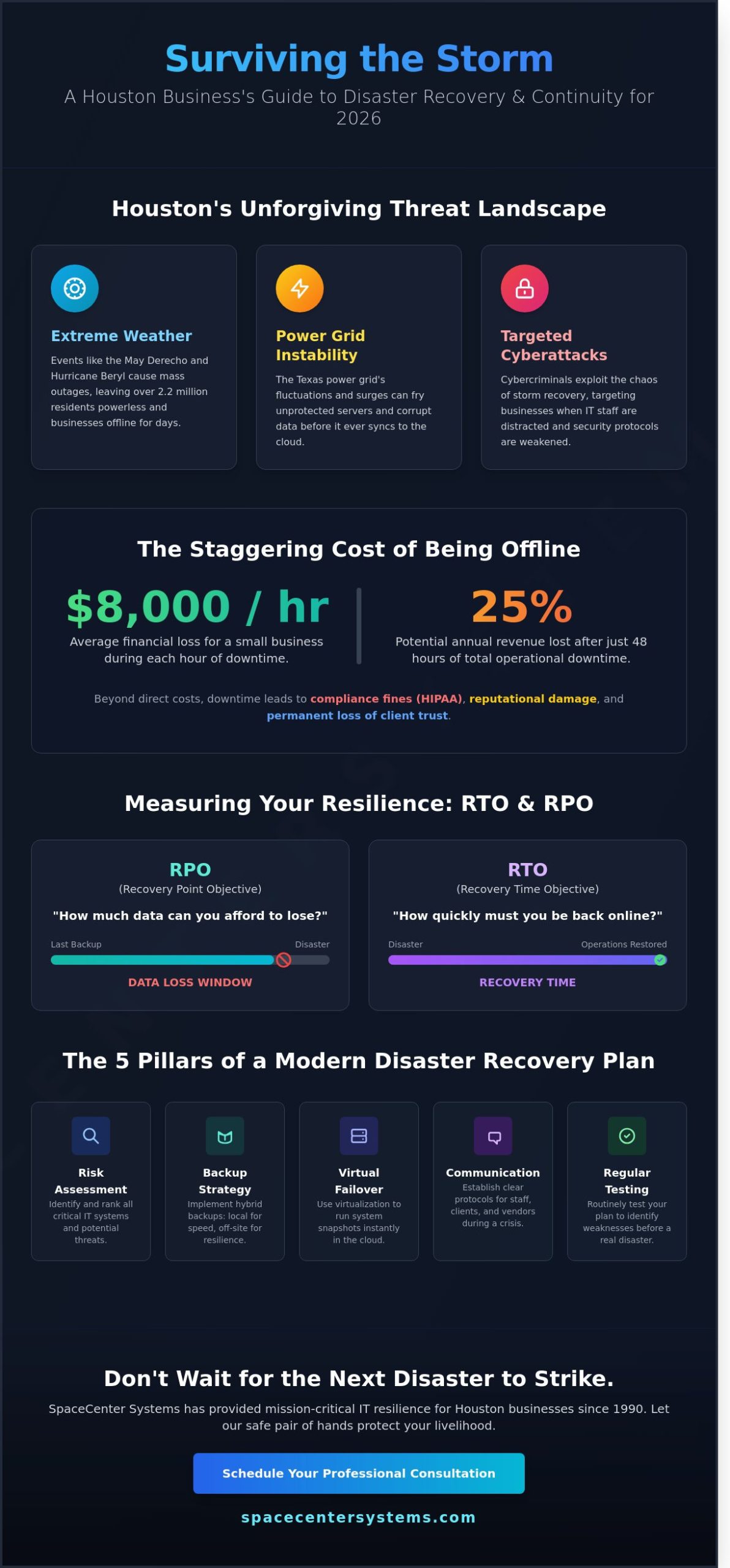
Houston businesses faced a harsh reality check in 2024. The May Derecho and Hurricane Beryl proved that traditional preparations are no longer enough to keep doors open. These events left over 2.2 million residents without power and forced thousands of local companies to halt operations for days. In 2026, a disaster recovery plan Houston is a survival requirement rather than a luxury. Many owners rely on basic cloud backups, but these often fail during extended Texas power grid fluctuations. When the grid oscillates, it can fry local server hardware or corrupt data before it ever syncs to the cloud. This leaves your business with “backups” that are either incomplete or inaccessible when you need them most.
Physical disasters also invite digital threats. Cybercriminals frequently target Houston firms during storm recovery periods. They know IT staff are distracted and security protocols are often weakened by temporary setups. This intersection of weather and crime creates a high-stakes environment where a single mistake leads to permanent data loss. According to the foundational principles of Disaster Recovery, businesses must define clear metrics for how quickly they can return to operations to avoid total failure. We’ve seen that a 48-hour window of total downtime can lead to a 25% loss in annual revenue for a small Pearland business, a blow that many never recover from.
The Reality of Local Environmental Threats
Hurricane season in the Gulf Coast brings more than wind and rain. It brings prolonged power instability that wreaks havoc on sensitive electronics. For a business in Houston, a single power surge can destroy a server in seconds. SpaceCenter Systems has protected local infrastructure since 1990, and we’ve learned that “Texas-friendly” service means being honest about these risks. We focus on hardening your local hardware and ensuring your data resides in geographically diverse locations. This approach ensures your business stays operational even if the local grid fails for a week.
The True Cost of Business Downtime
Downtime is a quiet profit killer. For a professional service firm in Sugar Land, losing access to client files for just two days can be catastrophic. If your clients can’t reach you, they’ll find a competitor who is online. Beyond lost revenue, medical and law firms face severe legal and compliance risks. Data loss can lead to heavy fines under HIPAA or state bar regulations. Implementing a disaster recovery plan Houston prevents these financial and legal hits. Our goal is to move your company from a state of vulnerability to absolute reliability. Contact SpaceCenter Systems today to schedule a comprehensive consultation and secure your business future.
The 5 Essential Components of a Modern IT Disaster Recovery Plan
A disaster recovery plan Houston businesses use to survive unexpected outages is a formal, documented process designed to restore IT systems after a catastrophe. Many business owners mistakenly believe that having a daily backup is enough. It isn’t. Data backup is simply saving a copy of your files; disaster recovery is the strategy that gets your entire operation back online. Without a clear plan, the average small business loses $8,000 for every hour of downtime according to industry research. This financial drain can permanently close a company that isn’t prepared for a quick reboot.
Modern recovery relies heavily on virtualization. This technology allows us to take a digital “snapshot” of your entire server environment. If your physical hardware fails, we can run that snapshot on different hardware or in the cloud almost instantly. Finding the right balance between off-site physical storage and cloud-based systems is vital for local companies. While cloud storage offers flexibility, having local off-site copies in a secure Houston facility ensures faster data retrieval when internet speeds are throttled or unavailable after a major storm.
A comprehensive IT Disaster Recovery Plan must account for every technical and human variable. Our team has provided these “safe pair of hands” services since 1990, ensuring that technical complexities don’t stop your growth. We focus on creating a resilient disaster recovery plan Houston owners can trust to work the first time it is needed.
Inventory and Risk Assessment
You can’t protect what you haven’t documented. We start by identifying your mission-critical applications, such as your CRM, email, and proprietary software. We also map your hardware footprint in Pearland or League City to ensure every workstation and server is accounted for. By prioritizing systems based on their business impact, you avoid wasting resources on low-priority data while your primary revenue-generating tools remain dark. This structured approach reduces recovery time by up to 50% compared to unplanned, reactive attempts.
Communication and Roles
Chaos often follows a disaster, so your plan must define exactly who has the authority to “flip the switch” to backup systems. Clear roles prevent overlapping efforts and confusion during high-stress moments. Maintaining client communication is equally vital. If local phone lines go down, your business can’t stop. Integrating Business VoIP systems in Pearland into your recovery plan allows your team to answer calls from any location with an internet connection. This keeps your reputation intact and your clients reassured. If you’re unsure where your current strategy stands, you can request a local IT review to identify any gaps in your protection.
RTO vs. RPO: Measuring Your Resilience Goals
Every disaster recovery plan Houston businesses implement must hinge on two critical metrics: Recovery Time Objective (RTO) and Recovery Point Objective (RPO). Think of RTO as your stopwatch. It measures the duration of time your business can afford to be offline before the financial impact becomes terminal. If your systems go down at 8:00 AM and your RTO is four hours, you must be operational by noon to meet your goals.
RPO is your rewind button. It determines how much data you can afford to lose, measured in time. If you back up your servers once every 24 hours at midnight and a crash occurs at 11:00 PM, you lose 23 hours of work. For a high-volume business, that loss is catastrophic. Balancing these goals involves a direct trade-off between cost and speed. High-speed recovery often requires mirrored servers and real-time replication, while budget-friendly storage might rely on daily snapshots that take longer to restore.
Consider a law firm in downtown Houston. If they face a server failure with a 4-hour RTO, their staff can be back to filing motions and logging billable hours by the afternoon. However, a firm with a 4-day RTO faces a different reality. They risk missing court deadlines, losing client trust, and suffering roughly 96 hours of zero productivity. SpaceCenter Systems has provided this level of precision and reliability to local firms since 1990, ensuring technology supports your bottom line rather than draining it.
Setting Realistic Recovery Benchmarks
A “zero-hour” RTO is the gold standard for mission-critical data, but not every file requires it. You should tailor your RPO by department. Your accounting team might need updates every 15 minutes to protect financial integrity, while marketing assets might only need a weekly backup. Utilizing Cloud Computing Services in Houston significantly accelerates RTO. Virtual environments allow us to spin up your entire office infrastructure in a secure cloud setting, bypassing the need to wait for physical hardware repairs.
Testing Your Benchmarks
The most dangerous approach to disaster recovery is a “set it and forget it” mentality. Static plans fail when real-world variables change. The SBA emergency preparedness guide emphasizes that regular drills are the only way to ensure your team is ready for a crisis. We recommend quarterly testing protocols for Houston small businesses. These simulations reveal if your 4-hour RTO is actually achievable or if hidden bottlenecks exist. Refining your plan based on these results ensures that when a hurricane or cyberattack hits, your recovery is a practiced routine rather than a frantic guessing game.
Don’t leave your business continuity to chance. Contact SpaceCenter Systems today to schedule a comprehensive consultation and build a recovery plan that protects your future.
How to Build Your Houston Business Continuity Strategy
Creating a resilient disaster recovery plan Houston business owners can trust requires more than just buying a backup drive. It involves a systematic approach to protecting your livelihood. According to FEMA, roughly 40% of small businesses do not reopen following a disaster. To avoid becoming a statistic, follow these five essential steps to secure your operations.
- Step 1: Conduct a comprehensive IT audit. You cannot protect what you haven’t documented. Catalog every local workstation in your Houston office and all remote assets used by staff in League City or Pearland.
- Step 2: Partner with a local MSP. Choose a “safe pair of hands” to manage your systems. Having a local team means you get a technician on-site when remote fixes are not enough.
- Step 3: Implement redundant backups. Data must exist in three places: the original source, a local backup for speed, and a geographically separated cloud version for safety.
- Step 4: Train your staff. Technology only works if people know how to use it. Run drills so employees know exactly how to access files when the office is inaccessible.
- Step 5: Schedule annual plan reviews. A plan written in 2022 will not cover the new cloud applications you added in 2024. Update your strategy every 12 months to match your business growth.
Geographic Redundancy for Houston Firms
If your backup server sits in the same building as your primary equipment, a single pipe burst or localized fire can wipe out everything. True resilience requires distance. We recommend storing critical data in data centers located far from the Gulf Coast to avoid regional power outages or hurricane damage. By leveraging Houston-based IT support, you gain the benefit of rapid physical response for local hardware while maintaining the safety of out-of-region cloud storage for hurricane resilience.
Employee Training and Access
When a storm hits the Houston area, your office might be closed, but your business does not have to stop. Providing secure remote access ensures your team stays productive from home. However, chaos often invites hackers. Implementing Cybersecurity for Small Business in Houston prevents breaches during these vulnerable times. We help you create a “Disaster Kit” for administrators, including offline copies of passwords and emergency contact lists, so you are never locked out of your own systems during a crisis.
Don’t wait for the next storm warning to find the gaps in your disaster recovery plan Houston. Since 1990, we have helped local businesses stay operational through every major event. Contact us today to schedule your disaster recovery consultation and protect your company’s future.
SpaceCenter Systems: Your Local Houston Disaster Recovery Partner
Since 1990, SpaceCenter Systems has served as a pillar of the local business community. We’ve spent over 25 years protecting Pearland and Houston companies from the devastating effects of data loss. Our approach is inspired by the mission-critical standards of the nearby aerospace industry. We treat your business data with the same precision and urgency required for a flight launch. This “safe pair of hands” philosophy ensures that your disaster recovery plan Houston isn’t just a document on a shelf; it’s a living, breathing shield for your revenue.
Many business owners with 5 to 50 employees feel overwhelmed by technical jargon. We cut through the noise with proactive monitoring that stops threats before they turn into expensive disasters. Imagine a scenario where a local power surge hits your office on a Friday afternoon. Without proactive care, you might not realize your backups failed until Monday morning. We prevent those losses by identifying vulnerabilities in real time. A single hour of lost productivity can cost a small firm thousands of dollars in missed opportunities and payroll, but our systems keep your doors open.
- Over 25 years of proven experience protecting the Houston metro area.
- Proactive monitoring that identifies hardware failures before they crash.
- Mission-critical reliability inspired by NASA’s high-performance standards.
- Texas-friendly service combined with rigorous technical expertise.
Why a Local Partner Matters During a Crisis
When a server fails or a tropical storm hits, physical proximity is your greatest asset. National “big box” providers can’t send a technician to your office in 30 minutes to swap hardware. We can. We have a deep understanding of the Sugar Land and Pearland business environment. This allows us to provide personalized support that faceless corporations can’t match. We’re your neighbors, and we’re personally invested in the success of your business.
Get Your Free Disaster Recovery Audit
Don’t wait for a system failure to find the gaps in your security. Our comprehensive IT resilience assessment identifies “low-hanging fruit” that can improve your safety immediately. During the audit, we’ll evaluate your current disaster recovery plan Houston, check your backup integrity, and spot security holes that could lead to ransomware. You’ll walk away with a clear roadmap to protect your business from revenue loss and security breaches.
It’s time to secure your company’s future with a partner who understands the local landscape and the high stakes of your industry. Schedule your free IT audit with SpaceCenter Systems today and gain the peace of mind that comes with professional, local expertise.
Protect Your Houston Business Operations for 2026
Houston business owners face constant pressure from unpredictable weather and evolving cyber threats. Statistics from the Small Business Administration show that 90% of companies fail within a year if they can’t resume operations within five days of a disaster. You don’t have to leave your company’s future to chance. By prioritizing a disaster recovery plan Houston leaders trust, you ensure that your team remains productive and your revenue stays protected even during a crisis.
Our team brings over 25 years of local experience to every partnership. We apply mission-critical reliability standards and 24/7 proactive monitoring to ensure your systems never skip a beat. This approach transforms IT from a source of stress into a stable foundation for growth. We’ve been a pillar of the local business community since 1990, helping our neighbors navigate technical complexities with confidence and ease. You deserve a partner who’s invested in your long-term success right here in the Space City.
Secure Your Houston Business Today – Schedule a Free IT Resilience Audit
Let’s work together to build a more resilient future for your company.
Frequently Asked Questions
What is the difference between a backup and a disaster recovery plan?
A backup is simply a copy of your data, while a disaster recovery plan Houston is the complete strategy to restore your entire business operation. Think of a backup as a spare tire and the recovery plan as the roadside assistance service that gets you back on the road. Without a documented process, your Houston business could face 10 days of downtime even if your data is safe. We ensure your systems return to service quickly.
How much does a disaster recovery plan cost for a small business in Houston?
Costs vary based on your data volume and how quickly you need to be back online, but the cost of inaction is much higher. Industry research from the Ponemon Institute shows that downtime costs small businesses an average of $137 to $427 per minute. Investing in a plan is a fraction of the cost of a single day of lost revenue. Our team helps you balance your budget with the protection your specific office requires.
How often should my Houston business test its disaster recovery plan?
You should test your recovery procedures at least every six months to ensure they actually work. Since SpaceCenter Systems began serving the local community in 1990, we’ve seen many outdated plans fail during real emergencies. Regular testing identifies gaps in your strategy before a hurricane or cyberattack strikes. This proactive approach ensures your 5 to 50 employees can continue working without expensive interruptions or data loss during a crisis.
Does my business need a disaster recovery plan if we are 100% in the cloud?
Yes, because cloud providers follow a shared responsibility model where you are responsible for your own data integrity. If an employee accidentally deletes files or a phishing attack encrypts your cloud drive, the provider doesn’t always guarantee recovery. A dedicated disaster recovery plan Houston ensures your cloud data is backed up to a separate, secure location. This protects your business from internal errors and external threats that cloud providers won’t fix.
What are the most common causes of IT disasters in Houston?
Hardware failures and localized weather events are the primary drivers of IT downtime for businesses in the Houston area. Statistics show that hardware failure causes 45% of all unplanned outages, followed closely by human error at 35%. Whether it’s a server crashing in Pasadena or a power surge during a summer storm, these events can halt your revenue. We design systems that bypass these common failure points to keep you operational.
Can SpaceCenter Systems help with hurricane-specific IT preparation?
We offer specific hurricane preparation services that move your critical operations to the cloud before the storm makes landfall. If your office in Clear Lake or Pearland faces flooding, our protocols allow your team to transition to remote work seamlessly. We’ve managed local IT through every major event since 1990. Our experience means we can secure your hardware and data long before the first warning is issued by local officials.
How long does it take to implement a full business continuity plan?
It takes between 30 and 60 days to build and verify a professional business continuity plan for most small to mid-sized firms. This timeline includes a full audit of your current IT setup, data migration, and a live test of the recovery process. Starting now ensures you’re ready before the next peak storm season hits the Gulf Coast. Contact SpaceCenter Systems today to schedule a consultation and secure your business’s future with a proven partner.