


Last Tuesday morning, a Pearland business owner approved an $18,400 wire transfer, only to discover the request came from a sophisticated spoofing attack instead of their actual vendor. This type of fraud contributed to over $2.7 billion in reported business losses last year according to the FBI. You need a reliable email security checklist to ensure your Houston company doesn’t become another statistic. Since 1990, SpaceCenter Systems has provided a safe pair of hands for local firms, helping them avoid the reputation damage and financial sting of a data breach.
You likely feel that keeping up with hackers is a full-time job that pulls you away from your actual work. We promise to remove that anxiety by providing a straightforward, non-technical guide to securing your communications. This post covers everything from blocking phishing attempts to explaining essential safeguards in plain English. It’s time to gain peace of mind and protect your bottom line. If you want to verify your current defenses right now, we invite you to schedule a consultation with our local experts today to ensure your team stays protected and productive.
Key Takeaways
- Understand why Houston’s energy and medical sectors are prime targets for supply chain attacks and how to safeguard your company’s hard-earned reputation.
- Learn how to use SPF, DKIM, and DMARC as digital “ID cards” to prevent hackers from sending fraudulent emails that look like they came from your domain.
- Follow a comprehensive email security checklist to implement multi-factor authentication and encryption, effectively closing the door on unauthorized access.
- Discover how regular, bite-sized training can transform your Pearland team into a “human firewall” capable of spotting phishing attempts before they cause costly downtime.
- Get a clear, actionable roadmap for securing your business communications so you can focus on growth while local experts handle the technical heavy lifting.
Why Your Houston Business Needs a Modern Email Security Checklist
Email security is the collective technology and policy framework that protects your sensitive data and brand reputation from digital threats. It’s more than just a strong password; it’s a multi-layered defense system. At SpaceCenter Systems, we’ve provided this “safe pair of hands” for Houston business owners since 1990. We understand that your email is the lifeblood of your operations. A modern email security checklist ensures that your communication remains a tool for growth rather than a gateway for criminals.
Houston is a global powerhouse for the energy and medical sectors. This status makes our local small businesses prime targets for supply chain attacks. Hackers often target a smaller vendor to gain access to a larger corporate partner. If you provide services to the Texas Medical Center or an energy firm in the Energy Corridor, your inboxes are high-value targets. The risk is not theoretical. A single compromised inbox can lead to devastating wire fraud or a ransomware attack that locks your entire network. By moving from a reactive “hope for the best” stance to a proactive posture, you protect your bottom line and your professional standing.
Implementing a rigorous email security checklist starts with technical foundations. You must verify that your system uses modern Email Authentication Standards to prevent hackers from spoofing your domain. These protocols act like a digital seal on an envelope, proving to the recipient that the message is authentic. This level of precision is exactly what we focus on at SpaceCenter Systems, bringing the same reliability to your IT that the nearby aerospace industry brings to space flight.
Regional Threats in Pearland and Houston
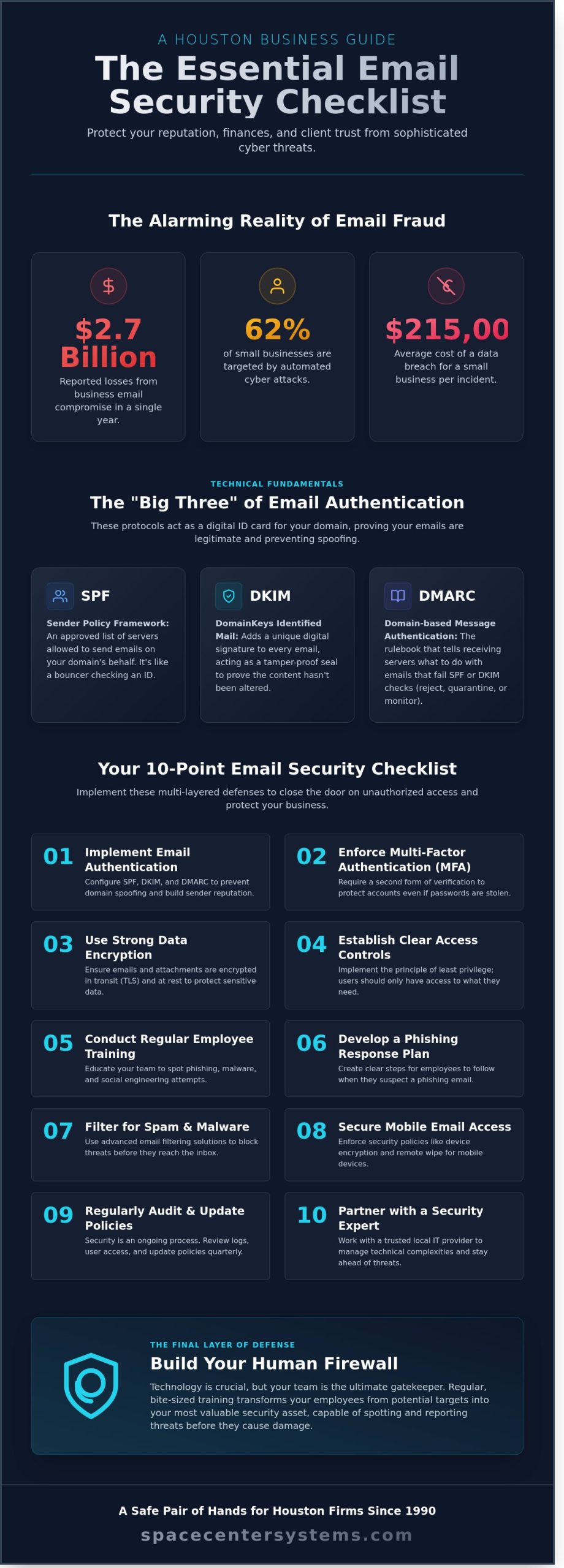
Small businesses in the Houston area face specific scams that generic security filters often miss. We frequently see “urgent wire transfer” requests that target local real estate firms and law offices during high-pressure closing periods. Cybercriminals also use our local environment against us. During hurricane season, they often send fake “emergency facility updates” or “relief fund” links to trick employees into entering their credentials. In 2026, the idea that a company is “too small to be a target” is a dangerous myth. Data shows that 62 percent of small businesses are targeted by automated bots that don’t care about your company size; they only care about your vulnerabilities. For a comprehensive analysis of the specific threats facing local businesses, our cyber threats Pearland trend analysis provides detailed insights into the evolving attack patterns targeting the Houston area.
The Tangible Costs of an Email Breach
An email breach causes immediate financial damage that goes far beyond a simple IT fix. For a 20-person firm in the Houston area, a total system lockout results in an average of $12,000 per day in lost productivity and operational downtime. You also face hidden costs including legal fees, mandatory data breach notification requirements, and the permanent loss of client trust. In 2026, the average cost of a small business data breach has reached $215,000 per incident. These numbers represent a significant threat to the longevity of any local business.
Don’t leave your company’s future to chance. Our team is here to provide the local, expert support you need to stay secure. Contact SpaceCenter Systems today to schedule a professional security consultation and ensure your business is protected by a proven team that has served the Houston community for over three decades.
Technical Fundamentals: The “Big Three” of Email Authentication
Imagine a local Houston business owner receiving a frantic call from a client. The client just sent a $15,000 wire transfer to an account they thought belonged to the business, but the invoice was a fake sent from a spoofed @company.com address. This isn’t a hypothetical scenario. In 2023, the FBI reported that Business Email Compromise (BEC) cost organizations over $2.9 billion. Without proper authentication, your domain is an open door. Anyone can send an email that looks exactly like it came from your office. This technical setup is a vital part of your email security checklist, acting as a digital ID card that proves you are who you say you are.
The solution lies in three protocols that work together to verify your identity. These tools ensure your messages reach the inbox instead of the spam folder. They protect your brand from being used by hackers to scam your customers or employees. Since 1990, we’ve seen how these settings provide a “safe pair of hands” for growing companies, turning a vulnerable communication channel into a secure asset.
SPF and DKIM: Your First Line of Defense
Sender Policy Framework (SPF) is essentially an authorized guest list for your domain. It tells the receiving server exactly which IP addresses or services, like Microsoft 365 or Google Workspace, have permission to send mail on your behalf. If an email arrives from a source not on that list, it’s flagged as suspicious. This simple list prevents random servers in distant countries from successfully pretending to be your Houston-based headquarters.
DomainKeys Identified Mail (DKIM) adds a second layer of verification through a digital signature. Think of it like a wax seal on a medieval letter. If the seal is broken or missing, the recipient knows the contents were tampered with during transit. DKIM uses a cryptographic key to sign every outgoing message. The receiving server checks this key against your domain records to confirm the email hasn’t been altered by a middleman. This level of precision is exactly what the Small Business Cybersecurity Guide recommends for protecting digital assets from evolving threats.
DMARC: The Ultimate Guard for Your Business Reputation
DMARC (Domain-based Message Authentication, Reporting, and Conformance) is the instruction manual that ties everything together. While SPF and DKIM provide the ID cards, DMARC tells the receiving server what to do if those IDs don’t match. You can set your policy to “none” for monitoring, “quarantine” to send suspicious mail to spam, or “reject” to block unauthorized emails entirely. Most businesses start with monitoring to ensure their legitimate tools, like payroll or marketing software, are correctly configured before moving to a strict rejection policy.
Managing these reports is a complex task that requires constant oversight. A single mistake in your DMARC record can cause all your legitimate business emails to bounce. This is why managed IT services in Houston are critical for small businesses. We monitor these technical reports daily to identify attempted spoofing attacks and ensure your communication remains uninterrupted. It’s a proactive approach that saves you from the stress of a hijacked reputation and the financial loss of a successful phishing campaign.
Implementing these protocols results in a 20% to 30% improvement in email deliverability for many organizations. You’ll gain the peace of mind that comes from knowing your brand is shielded by industry-standard defenses. If you aren’t sure if your current email security checklist includes these “Big Three” configurations, it’s time to verify your settings. You can schedule a consultation with our team to review your domain health and lock down your email security today.
Securing the Perimeter: Access Controls and Encryption
Weak passwords remain the primary entry point for cybercriminals targeting Houston businesses. According to the 2023 Verizon Data Breach Investigations Report, 74% of all breaches involve a human element, which most often manifests as stolen or guessed credentials. For a business owner in Sugar Land, a single compromised password can lead to a complete system takeover, resulting in an average breach cost of $4.45 million. This is why your email security checklist must prioritize robust access controls over simple login screens. By deploying Multi-Factor Authentication (MFA) and end-to-end encryption, you create a layered defense that protects your revenue and reputation. Even if an intruder successfully steals a password, your sensitive data remains encrypted and inaccessible. This outcome transforms a potentially devastating hack into a blocked attempt that your team can manage without downtime.
The Non-Negotiable Rule: Multi-Factor Authentication (MFA)
Standard passwords don’t provide enough protection against modern brute-force attacks. While many companies still rely on SMS-based codes, these are increasingly vulnerable to SIM-swapping tactics. Authenticator apps are the gold standard for Houston businesses because they generate time-sensitive codes directly on a physical device. You must also prepare your staff for “MFA Fatigue” attacks. In this scenario, a hacker who has stolen a password bombards an employee’s phone with dozens of push notifications, hoping they’ll click “Approve” out of sheer frustration. Training your team to recognize this pattern is vital for maintaining a secure perimeter. MFA is the single most effective deterrent against unauthorized account access, blocking 99% of automated attacks.
Email Encryption for Sensitive Houston Industries
For medical offices and law firms in League City, encryption is a mandatory requirement for HIPAA and legal compliance. Implementing a formal SANS Institute Email Security Policy ensures your organization meets these rigorous standards for data handling. Encryption functions in two distinct states that you need to understand. “At-rest” encryption protects your archived emails sitting on a server, while “in-transit” encryption secures the message as it moves across the web. Without these protections, your business communications are vulnerable to interception.
Consider a real-world scenario where a local firm sends a sensitive contract via an unencrypted connection. A hacker using a “man-in-the-middle” attack can intercept that email, change the wire transfer instructions, and send it to the client. The client pays the wrong account, and the firm loses both the funds and the client’s trust. Using encryption ensures that only the person with the correct digital key can read the message. It’s a dependable way to keep your proprietary information private, regardless of where it’s stored or how it’s sent. This level of precision is a core part of any professional email security checklist.
SpaceCenter Systems has served as a trusted local expert since 1990, providing the high-performance security solutions Houston businesses need to thrive. We don’t believe in one-size-fits-all IT; we provide a safe pair of hands to guide you through complex technical challenges. Don’t wait for a breach to realize your passwords aren’t enough. Contact us today to schedule a comprehensive security consultation and protect your company’s future.
Building the Human Firewall: Training Your Pearland Team
Your employees are your greatest asset, but they are also your most significant vulnerability. According to the 2024 Verizon Data Breach Investigations Report, 68% of all breaches involve a human element, with phishing being the primary entry point. In a tight-knit community like Pearland, we naturally value trust and helpfulness. Cybercriminals exploit this neighborly culture by crafting emails that mimic local vendors or colleagues. Building a human firewall means turning that natural trust into a “trust but verify” mindset. This cultural shift is a vital part of your email security checklist to ensure your staff doesn’t accidentally hand over the keys to your network.
The solution isn’t a long, boring lecture once a year. Most people forget 80% of what they learn in a seminar within 30 days. Instead, we implement regular, bite-sized training sessions that take five minutes or less. This keeps security at the forefront of every employee’s mind. When training is frequent, it creates a culture of skepticism. Your team starts to question unusual requests before they click. This proactive approach prevents the downtime and revenue loss that follow a successful ransomware attack.
How to Spot a Phishing Attempt in 2026
Phishing has evolved far beyond the poorly written messages of the past. In 2026, attackers use AI to generate perfect grammar and professional tones. Your team must look for technical red flags. Mismatched URLs are a major giveaway; if the link text says “Invoice” but the destination is a random string of numbers, it’s a trap. Urgent or threatening language is another tactic designed to make you act without thinking. We often see “Spear Phishing” attacks that reference specific Houston-based projects, such as a medical center expansion or a local energy contract, to build false credibility. To keep your company safe, teach your staff this 5-step reporting process:
- Stop: Never click a link or download an attachment immediately upon opening an email.
- Hover: Place your mouse over the link to see the actual destination URL.
- Inspect: Check the sender’s email address carefully for slight misspellings or wrong domains.
- Verify: Call the sender using a known, trusted phone number if the request involves money or data.
- Report: Use your internal IT reporting tool to flag the email so the security team can block it for everyone.
Simulated Phishing: Practice Makes Perfect
SpaceCenter Systems has been the “safe pair of hands” for local businesses since 1990. We’ve learned that theory only goes so far; your team needs practical experience. We run simulated phishing tests that send safe, “fake” malicious emails to your employees. This identifies specific vulnerabilities in your workforce without the risk of a real data breach. If an employee clicks a simulated link, they aren’t punished. Instead, they receive immediate, targeted education on what they missed. This method is proven to work. Companies that run monthly simulations see their “click rate” drop from an average of 30% to less than 5% within twelve months.
Ongoing training is far more effective than an annual seminar because it adapts to new threats as they emerge. It protects your bottom line by reducing the risk of a $15,000 wire fraud mistake or a week of lost productivity due to a locked system. Our goal is to make your team as precise and reliable as the aerospace experts at the nearby Space Center. By investing in your people, you build a defense that no software can provide on its own.
Ensure your team is ready to defend your data by having our experts provide a professional security assessment for your business today.
Your 10-Point Email Security Checklist Implementation
A single compromised account can paralyze your operations. In 2023, the FBI’s Internet Crime Complaint Center reported that Business Email Compromise (BEC) cost organizations over $2.9 billion. For a business owner in the Greater Houston area, these aren’t just statistics; they are real threats to your local reputation and cash flow. Use this email security checklist to harden your defenses and ensure your team stays productive.
- Enforce Multi-Factor Authentication (MFA): Require a second form of verification for every login. This single step blocks 99.9% of automated account takeover attacks.
- Audit Password Strength: Move beyond simple phrases. Require 12-character minimums and use a dedicated password manager to eliminate “password123” risks.
- Implement AI-Driven Spam Filtering: Standard filters miss sophisticated “zero-day” threats. Advanced tools analyze sender behavior to catch 98% of malicious links before they hit an inbox.
- Conduct Monthly Phishing Simulations: Train your 5 to 50 employees to spot red flags. Real-world practice reduces the likelihood of a successful click by up to 70%.
- Configure SPF, DKIM, and DMARC: These technical records verify your identity. They prevent hackers from “spoofing” your domain to send fake invoices to your clients.
- Enable End-to-End Encryption: Protect sensitive financial data and HR records. Encryption ensures that even if an email is intercepted, the content remains unreadable.
- Deploy Mobile Device Management (MDM): If a staff member loses their phone in downtown Houston, you must have the ability to wipe corporate email data remotely.
- Establish Immutable Backups: Maintain copies of your communications that cannot be altered or deleted by ransomware. This ensures a recovery point if a breach occurs.
- Set Up Unusual Activity Alerts: Get notified immediately if an account logs in from a foreign country or at 3:00 AM. Fast detection limits the damage.
- Formalize an Incident Response Plan: Don’t scramble during a crisis. Document exactly who to call and what systems to isolate if you suspect a breach.
The SpaceCenter Systems Approach to Managed Security
We begin every partnership with a deep-dive security audit. Our team identifies the specific “pain points” where your current setup leaves you exposed. Since 1990, Jim and the team have served as a safe pair of hands for Pearland businesses. We provide 24/7 monitoring and proactive maintenance to stop tech fires before they start. You get the rigorous standards of aerospace-grade IT combined with Texas-friendly support that is always just a phone call away.
Next Steps: Securing Your Business Communications
Security is not a one-time task; it is an ongoing commitment to your company’s survival. 60% of small businesses that suffer a major cyberattack close their doors within six months. We want to ensure you stay focused on growth rather than recovery. When you book a consultation, you receive a comprehensive report detailing your current vulnerabilities and a clear roadmap to fix them. Our goal is to provide total peace of mind for your local enterprise.
Ready to protect your team? Schedule your free Cybersecurity Audit with SpaceCenter Systems today.
Protect Your Houston Business with Proactive Email Defense
Leaving your digital gates open is a risk no Pearland business owner should take. Implementing a comprehensive email security checklist is the most effective way to prevent phishing attacks that lead to significant revenue loss. You now understand how the “Big Three” authentication protocols and a well-trained team serve as your primary defense. These steps eliminate the vulnerabilities that often result in costly system downtime and data recovery expenses.
Since 1990, SpaceCenter Systems has delivered mission-critical reliability inspired by the precision of the aerospace industry. We provide over 25 years of local experience and direct access to experts who understand the Houston business landscape. You won’t deal with a faceless call center; you’ll work with local partners dedicated to your stability. Our proven methods ensure your communication remains secure and your operations stay profitable.
Secure your business today: Request a free Email Security Audit
We’re ready to help you lock down your systems and give you back the time to focus on your growth.
Frequently Asked Questions
Does Microsoft 365 or Google Workspace already include these security features?
Microsoft 365 and Google Workspace include basic security, but advanced protection often requires premium licensing or third-party add-ons. Most standard plans lack the automated threat remediation needed to stop zero-day attacks. If your Houston firm uses M365 Business Basic, you miss out on advanced phishing protection and conditional access. Upgrading to Business Premium or adding specialized security layers provides the defense your business needs to prevent costly data leaks.
How much does it cost to implement a full email security checklist for a small business?
Implementing a full email security checklist for a Houston business typically costs between $5 and $15 per user each month. This investment covers advanced filtering, encryption, and multi-factor authentication. While this adds to your monthly overhead, it’s far less than the $4.45 million average cost of a data breach reported by IBM in 2023. You gain peace of mind knowing your revenue and reputation are protected for a predictable monthly fee.
What is the difference between a spam filter and an email security gateway?
A spam filter identifies unsolicited junk mail while an email security gateway provides a comprehensive shield against malware and sophisticated phishing. Think of a spam filter as a screen door and a gateway as a professional security guard. The gateway inspects every link and attachment before they reach your inbox. This prevents your employees from accidentally clicking a malicious link that could lock your entire server and halt your operations for days.
Can my business be sued if a client receives a phishing email from my hacked account?
You can be held liable if a client suffers financial loss because your hacked account sent them a fraudulent invoice or phishing link. Courts in Texas increasingly look at whether a business followed reasonable security standards. If you haven’t implemented a robust email security checklist, a judge may rule you were negligent. Protecting your account with multi-factor authentication avoids these legal battles and preserves your professional standing in the community.
How often should we conduct security awareness training for our Houston employees?
You should conduct security awareness training for your Houston staff at least once every month. Since 90% of successful cyberattacks start with a phishing email, consistent practice is vital. We’ve seen local companies reduce their phishing click rate from 30% to under 5% by using monthly 10 minute simulation exercises. Regular training ensures your team remains the strongest link in your defense rather than the weakest entry point for hackers.
What should I do immediately if I think an employee clicked a malicious link?
You must immediately disconnect the affected device from the Wi-Fi and change the employee’s email password from a separate, clean machine. Seconds matter when a malicious script starts downloading in the background. Once the account is locked, notify your IT partner to scan for lateral movement within your network. Taking these steps within the first 15 minutes can prevent a single click from turning into a company-wide ransomware event.
Is email encryption difficult for my clients to use when I send them messages?
Modern email encryption is simple for your clients to use and typically requires just one extra click to view a message. Older systems were clunky, but today’s secure portals allow clients to authenticate via their own Google or Microsoft accounts. This ensures sensitive documents, like tax returns or legal contracts, stay private without frustrating your customers. You provide a secure experience that proves your Houston firm takes data privacy seriously. Contact SpaceCenter Systems today to schedule a consultation and secure your business communications.